Livi Carolina B, Hardman Rulon L, Christy Barbara A, Dodds Sherry G, Jones Diane, Williams Charnae, Strong Randy, Bokov Alex, Javors Martin A, Ikeno Yuji, Hubbard Gene, Hasty Paul, Sharp Zelton Dave
Department of Molecular Medicine and Institute of Biotechnology, University of Texas Health Science Center, San Antonio, TX 78229, USA.
Aging (Albany NY). 2013 Feb;5(2):100-10. doi: 10.18632/aging.100533.
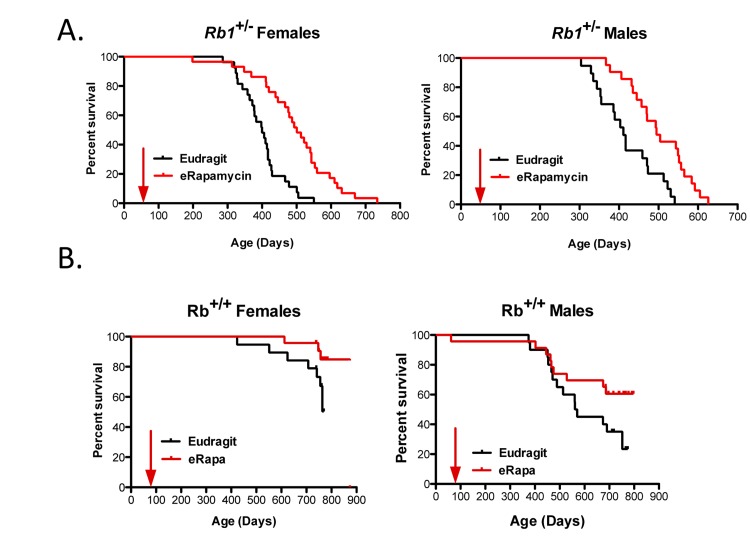
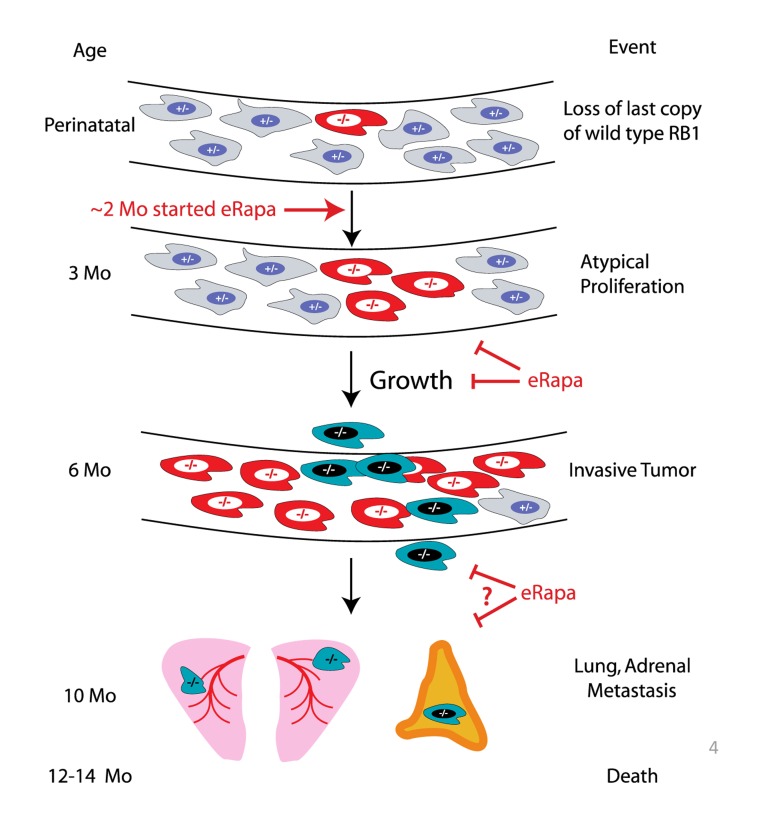
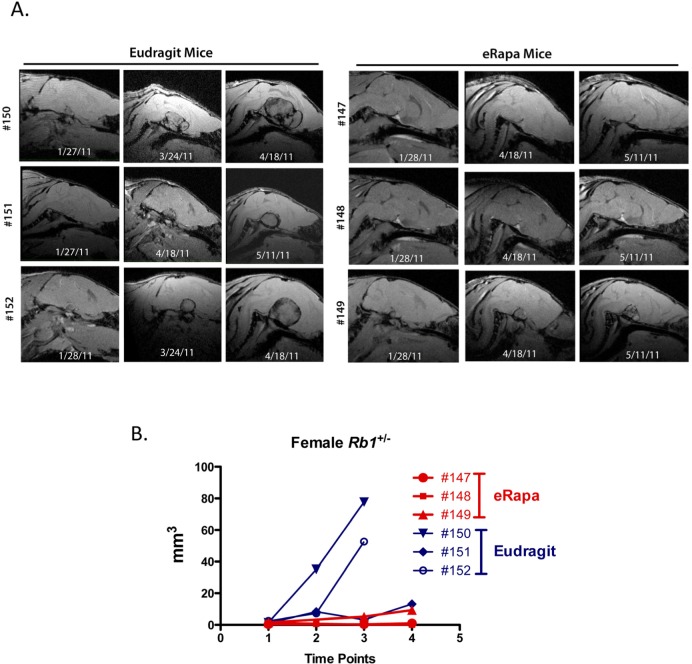
Chronic treatment of mice with an enterically released formulation of rapamycin (eRapa) extends median and maximum life span, partly by attenuating cancer. The mechanistic basis of this response is not known. To gain a better understanding of thesein vivo effects, we used a defined preclinical model of neuroendocrine cancer, Rb1+/- mice. Previous results showed that diet restriction (DR) had minimal or no effect on the lifespan of Rb1+/- mice, suggesting that the beneficial response to DR is dependent on pRb1. Since long-term eRapa treatment may at least partially mimic chronic DR in lifespan extension, we predicted that it would have a minimal effect in Rb1+/- mice. Beginning at 9 weeks of age until death, we fed Rb1+/- mice a diet without or with eRapa at 14 mg/kg food, which results in an approximate dose of 2.24 mg/kg body weight per day, and yielded rapamycin blood levels of about 4 ng/ml. Surprisingly, we found that eRapa dramatically extended life span of both female and male Rb1+/- mice, and slowed the appearance and growth of pituitary and decreased the incidence of thyroid tumors commonly observed in these mice. In this model, eRapa appears to act differently than DR, suggesting diverse mechanisms of action on survival and anti-tumor effects. In particular the beneficial effects of rapamycin did not depend on the dose of Rb1.
用肠道缓释雷帕霉素制剂(eRapa)对小鼠进行长期治疗可延长其平均寿命和最大寿命,部分原因是减轻了癌症。这种反应的机制基础尚不清楚。为了更好地理解这些体内效应,我们使用了一种明确的神经内分泌癌临床前模型,即Rb1+/-小鼠。先前的结果表明,饮食限制(DR)对Rb1+/-小鼠的寿命影响极小或没有影响,这表明对DR的有益反应依赖于pRb1。由于长期使用eRapa治疗在延长寿命方面可能至少部分模拟了慢性DR,我们预测它对Rb1+/-小鼠的影响极小。从9周龄开始直至死亡,我们给Rb1+/-小鼠喂食不含或含有14 mg/kg食物的eRapa的饮食,这导致每天的剂量约为2.24 mg/kg体重,并使雷帕霉素的血液水平达到约4 ng/ml。令人惊讶的是,我们发现eRapa显著延长了雌性和雄性Rb1+/-小鼠的寿命,并减缓了垂体肿瘤的出现和生长,降低了这些小鼠中常见的甲状腺肿瘤的发生率。在这个模型中,eRapa的作用似乎与DR不同,这表明其在生存和抗肿瘤作用方面有不同的作用机制。特别是雷帕霉素的有益作用不依赖于Rb1的剂量。