Roswell Park Comprehensive Cancer Center, Buffalo, NY 14263, USA.
Aging (Albany NY). 2022 Oct 24;14(20):8140-8149. doi: 10.18632/aging.204354.
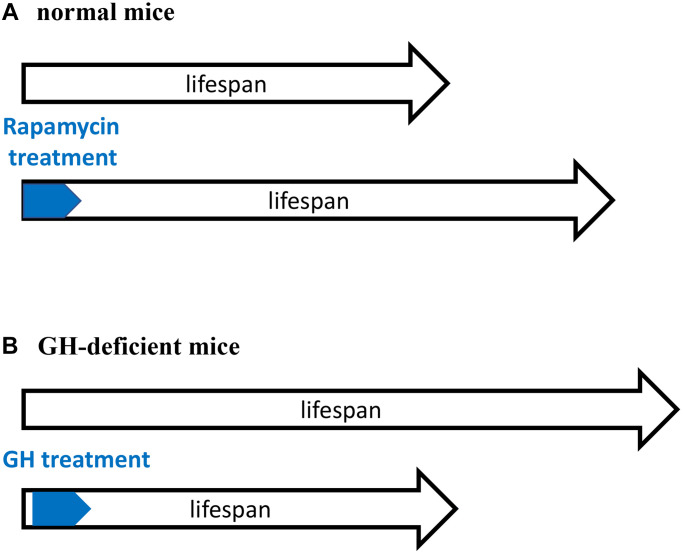
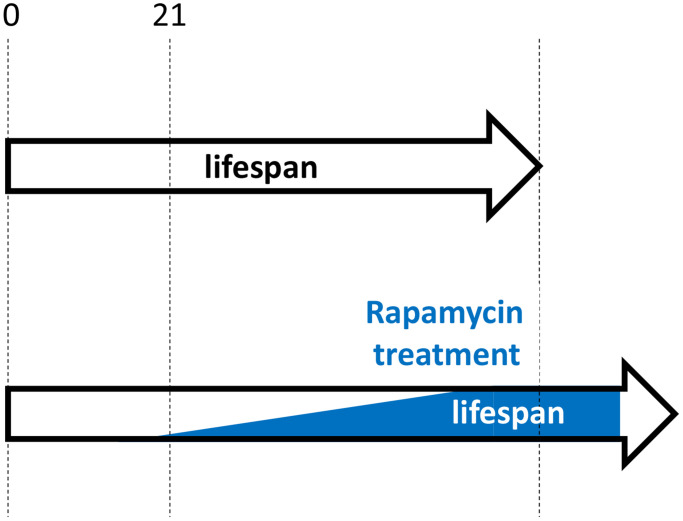
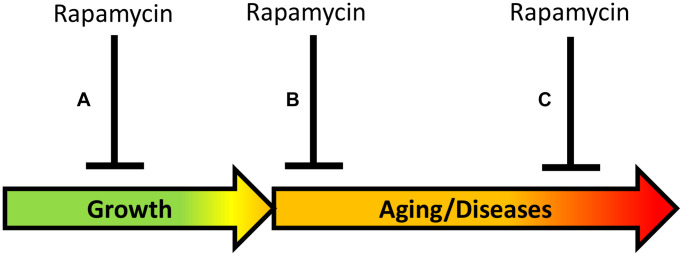
Making provocative headlines, three outstanding publications demonstrated that early-life treatment with rapamycin, including treatments during developmental growth, extends lifespan in animals, confirming predictions of hyperfunction theory, which views aging as a quasi-program (an unintended continuation of developmental growth) driven in part by mTOR. Despite their high theoretical importance, clinical applications of two of these studies in mice, and cannot be implemented in humans because that would require growth retardation started at birth. A third study demonstrated that a transient (around 20% of total lifespan in ) treatment with rapamycin early in adult life is as effective as lifelong treatment, whereas a late-life treatment is not effective. However, previous studies in mice demonstrated that a transient late-life treatment is highly effective. Based on hyperfunction theory, this article attempts to reconcile conflicting results and suggests the optimal treatment strategy to extend human lifespan.
三篇杰出的出版物提出了一个颇具争议的观点,即雷帕霉素在生命早期(包括发育生长期间)的治疗可以延长动物的寿命,这一观点印证了过度功能理论的预测,该理论认为衰老是一种准程序(部分由 mTOR 驱动的发育生长的意外延续)。尽管这两项研究在理论上具有重要意义,但其中两项在小鼠中的临床应用,以及研究无法在人类中实施,因为这需要从出生开始就进行生长抑制。第三项研究表明,在成年早期进行短暂(约占总寿命的 20%)的雷帕霉素治疗与终身治疗一样有效,而晚期治疗则无效。然而,之前在小鼠中的研究表明,短暂的晚期治疗非常有效。基于过度功能理论,本文试图调和相互矛盾的结果,并提出了延长人类寿命的最佳治疗策略。