MRC Centre of Epidemiology for Child Health, UCL Institute of Child Health, London, UK.
BMJ Open. 2013 Mar 1;3(3):e002290. doi: 10.1136/bmjopen-2012-002290.
To investigate the biological, social, behavioural and environmental factors associated with non-consent, and non-return of reliable accelerometer data (≥2 days lasting ≥10 h/day), in a UK-wide postal study of children's activity.
Nationally representative prospective cohort study.
Children born across the UK, between 2000 and 2002.
13 681 7 to 8-year-old singleton children who were invited to wear an accelerometer on their right hip for 7 consecutive days. Consenting families were posted an Actigraph GT1M accelerometer and asked to return it by post.
Study consent and reliable accelerometer data acquisition.
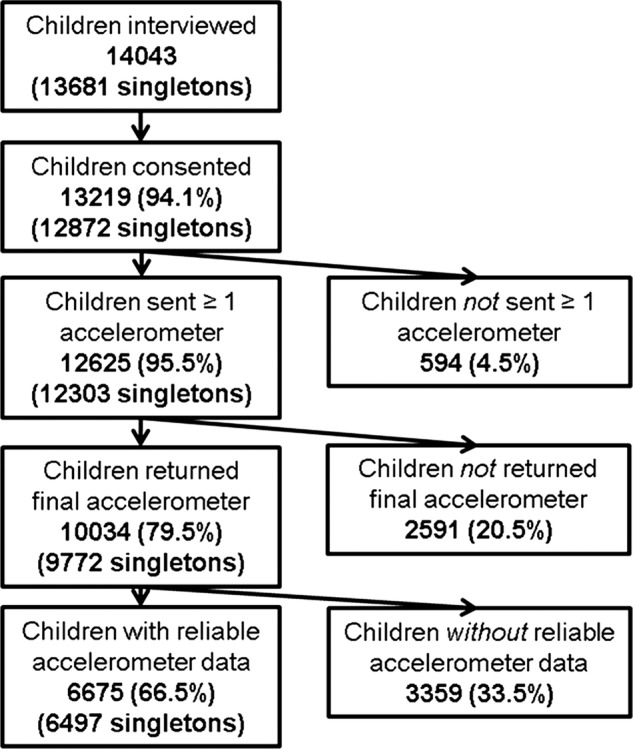
Consent was obtained for 12 872 (94.5%) interviewed singletons, of whom 6497 (50.5%) returned reliable accelerometer data. Consent was less likely for children with a limiting illness or disability, children who did not have people smoking near them, children who had access to a garden, and those who lived in Northern Ireland. From those who consented, reliable accelerometer data were less likely to be acquired from children who: were boys; overweight/obese; of white, mixed or 'other' ethnicity; had an illness or disability limiting daily activity; whose mothers did not have a degree; who lived in rented accommodation; who exercised once a week or less; who had been breastfed; were from disadvantaged wards; had younger mothers or lone mothers; or were from households with just one, or more than three children.
Studies need to encourage consent and reliable data return in the wide range of groups we have identified to improve response and reduce non-response bias. Additional efforts targeted at such children should increase study consent and data acquisition while also reducing non-response bias. Adjustment must be made for missing data that account for missing data as a non-random event.
在一项针对英国儿童活动的全国性邮寄研究中,调查与不同意和无法返回可靠加速度计数据(持续≥2 天且每天≥10 小时)相关的生物学、社会、行为和环境因素。
全国代表性的前瞻性队列研究。
2000 年至 2002 年期间在英国各地出生的 13681 名 7 至 8 岁的单胎儿童。邀请同意的家庭在右髋部佩戴加速度计连续 7 天。同意的家庭会收到 Actigraph GT1M 加速度计,并被要求通过邮寄返回。
研究同意和可靠的加速度计数据采集。
在接受采访的 12872 名单胎儿童中,有 12872 名(94.5%)获得了同意,其中 6497 名(50.5%)返回了可靠的加速度计数据。患有限制日常活动的疾病或残疾、身边没有人吸烟、有花园和居住在北爱尔兰的儿童同意的可能性较低。在同意的儿童中,以下儿童更不可能获得可靠的加速度计数据:男孩;超重/肥胖;白人、混合或“其他”种族;患有限制日常活动的疾病或残疾;母亲没有学位;居住在租赁住房中;每周锻炼一次或更少;母乳喂养;来自贫困街区;母亲较年轻或单身母亲;或来自只有一个或多于三个孩子的家庭。
为了改善回应率和减少无回应偏差,研究需要鼓励我们确定的广泛群体同意并返回可靠数据。针对这些儿童的额外努力应增加研究同意和数据采集,同时减少无回应偏差。必须对因非随机事件而缺失的数据进行调整。