
积极活动的儿童和青少年是否有更高的风险受伤导致住院或到急症室就诊?威尔士和苏格兰的队列研究和电子病历分析。
Are active children and young people at increased risk of injuries resulting in hospital admission or accident and emergency department attendance? Analysis of linked cohort and electronic hospital records in Wales and Scotland.
机构信息
Health Data Research UK, Wales and Northern Ireland, Swansea University Medical School, Swansea, United Kingdom.
Life Course Epidemiology and Biostatistics, UCL Great Ormond Street Institute of Child Health, London, United Kingdom.
出版信息
PLoS One. 2019 Apr 10;14(4):e0213435. doi: 10.1371/journal.pone.0213435. eCollection 2019.
INTRODUCTION
Children and young people (CYP) are encouraged to increase time spent being physically active, especially in moderate and vigorous intensity pursuits. However, there is limited evidence on the prospective association of activity levels with injuries resulting in use of hospital services. We examined the relationship between objectively-measured physical activity (PA) and subsequent injuries resulting in hospital admissions or accident and emergency department (A&E) attendances, using linked electronic hospital records (EHR) from a nationally representative prospective cohort of CYP in Wales and Scotland.
METHODS
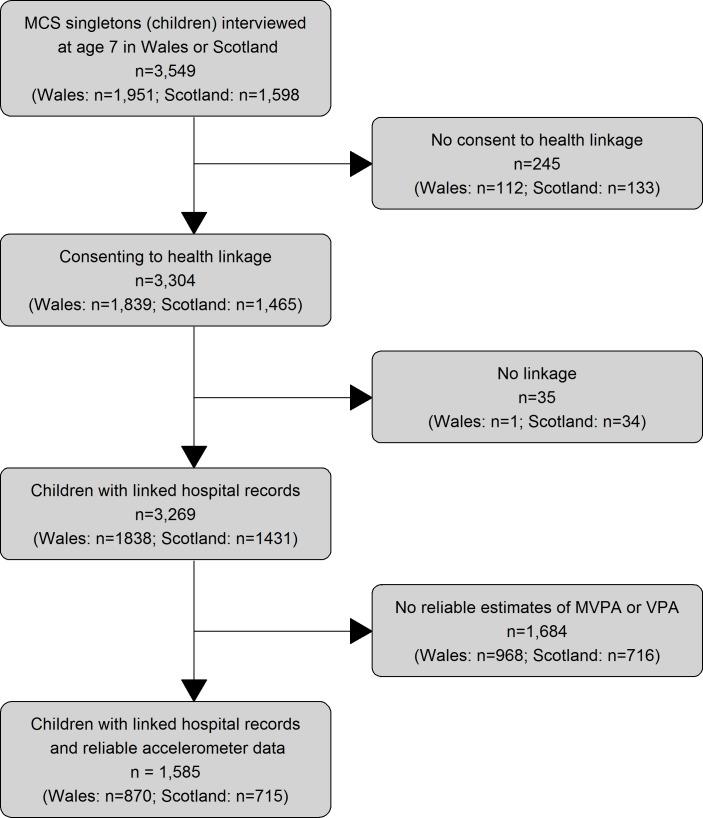
We analysed accelerometer-based estimates of moderate to vigorous (MVPA) and vigorous PA (VPA) from 1,585 (777 [46%] boys) seven-year-old Millennium Cohort Study members, living in Wales or Scotland, whose parents consented to linkage of cohort records to EHRs up until their 14th birthday. Negative binomial regression models adjusted by potential individual, household and area-level confounders, were fitted to estimate associations between average daily minutes of MVPA, and VPA (in 10-minute increments), and number of injury-related hospital admissions and/or A&E attendances from age nine to 14 years.
RESULTS
CYP spent a median of 59.5 and 18.1 minutes in MVPA and VPA/day respectively, with boys significantly more active than girls; 47.3% of children experienced at least one injury-related admission or A&E attendance during the study period. Rates of injury-related hospital admission and/or A&E attendance were positively associated with MVPA and VPA in boys but not in girls: respective adjusted incidence rate ratios (95% CI) for boys: 1.09 (1.01, 1.17) and 1.16 (1.00, 1.34), and for girls: 0.94 (0.86, 1.03) and 0.85 (0.69, 1.04).
CONCLUSION
Boys but not girls who engage in more intense PA at age seven years are at higher risk of injury-related hospital admission or A&E attendance when aged nine to 14 years than their less active peers. This may reflect gender differences in the type and associated risks of activities undertaken. EHRs can make a useful contribution to injury surveillance and prevention if routinely augmented with information on context and setting of the injuries sustained. Injury prevention initiatives should not discourage engagement in PA and outdoor play given their over-riding health and social benefits.
简介
鼓励儿童和青少年(CYP)增加身体活动时间,尤其是进行中高强度的活动。然而,关于活动水平与因伤住院或到急诊部(A&E)就诊之间的前瞻性关联,证据有限。我们使用来自威尔士和苏格兰全国代表性的 CYP 前瞻性队列的电子病历(EHR),检查了通过加速度计测量的身体活动(PA)与随后的伤害之间的关系,这些伤害导致住院或 A&E 就诊。我们分析了来自 1585 名(777[46%]名男孩)七岁千禧年队列研究成员的基于加速度计的中等到剧烈(MVPA)和剧烈 PA(VPA)估计值,这些成员的父母同意在他们 14 岁生日之前将队列记录与 EHR 链接。通过潜在的个体、家庭和区域水平混杂因素调整负二项回归模型,估计了从 9 岁到 14 岁之间,平均每天 MVPA 和 VPA(每 10 分钟增加一次)的分钟数与伤害相关的住院人数和/或 A&E 就诊次数之间的关联。结果:CYP 每天分别进行 MVPA 和 VPA 的中位数为 59.5 分钟和 18.1 分钟,男孩比女孩更活跃;47.3%的儿童在研究期间至少经历过一次伤害相关的住院或 A&E 就诊。伤害相关的住院和/或 A&E 就诊率与男孩的 MVPA 和 VPA 呈正相关,但与女孩的 MVPA 和 VPA 无关:男孩的调整发病率比(95%CI)分别为 1.09(1.01,1.17)和 1.16(1.00,1.34),女孩的分别为 0.94(0.86,1.03)和 0.85(0.69,1.04)。结论:与不太活跃的同龄人相比,7 岁时进行更剧烈 PA 的男孩,在 9 至 14 岁时,因伤住院或 A&E 就诊的风险更高。这可能反映了男孩和女孩在活动类型和相关风险方面的性别差异。如果 EHR 常规地补充受伤的背景和环境信息,它可以为伤害监测和预防做出有益的贡献。鉴于身体活动和户外活动对健康和社会的巨大益处,不应因预防伤害而阻止人们参与这些活动。
 Zotero 插件