Cancer Stem Cell Research, University of Manchester, Manchester Academic Health Science Centre, Paterson Institute for Cancer Research, The Christie NHS Foundation Trust, Manchester, United Kingdom.
PLoS One. 2013;8(2):e56840. doi: 10.1371/journal.pone.0056840. Epub 2013 Feb 14.
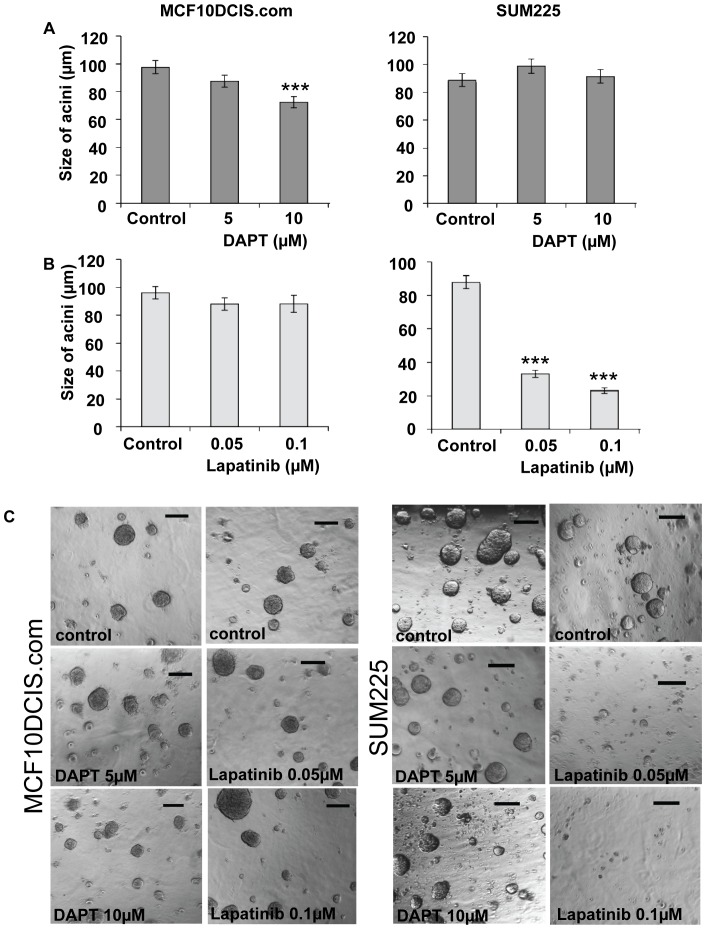
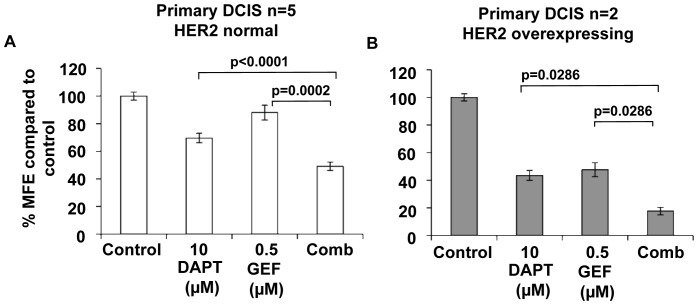
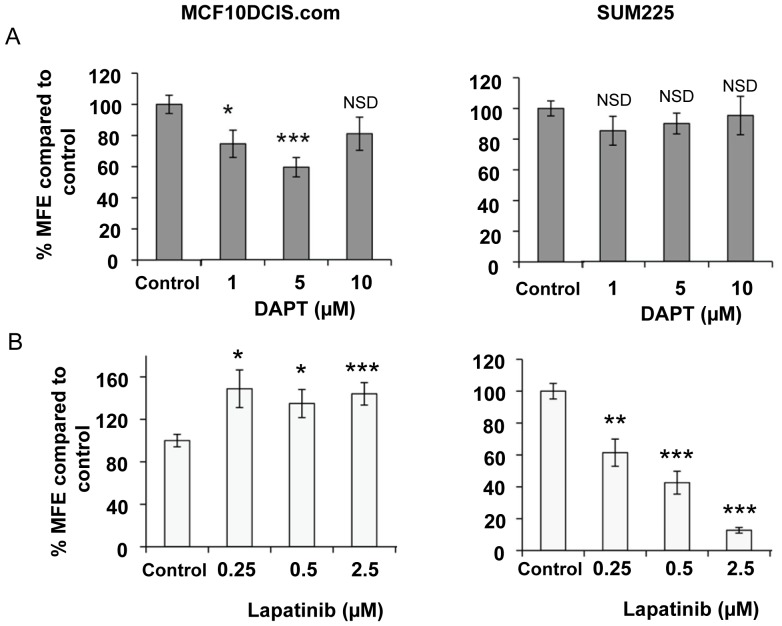
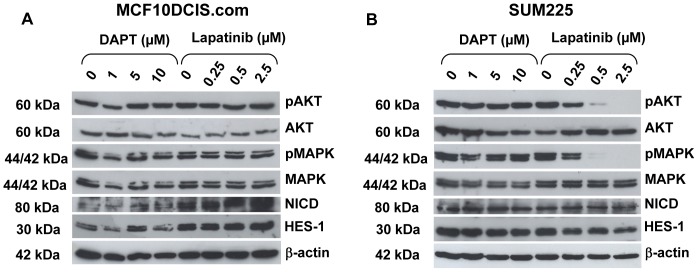
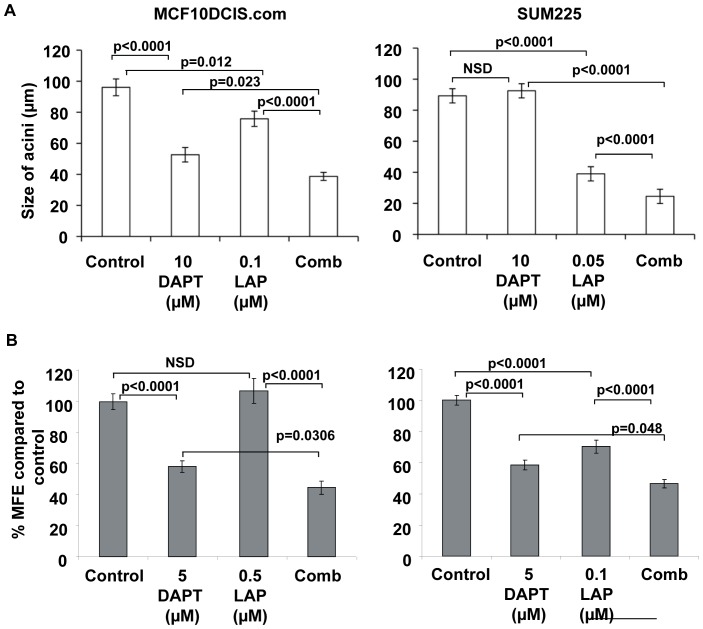
Pathways involved in DCIS stem and progenitor signalling are poorly understood yet are critical to understand DCIS biology and to develop new therapies. Notch and ErbB1/2 receptor signalling cross talk has been demonstrated in invasive breast cancer, but their role in DCIS stem and progenitor cells has not been investigated. We have utilised 2 DCIS cell lines, MCF10DCIS.com (ErbB2-normal) and SUM225 (ErbB2-overexpressing) and 7 human primary DCIS samples were cultured in 3D matrigel and as mammospheres in the presence, absence or combination of the Notch inhibitor, DAPT, and ErbB1/2 inhibitors, lapatinib or gefitinib. Western blotting was applied to assess downstream signalling. In this study we demonstrate that DAPT reduced acini size and mammosphere formation in MCF10DCIS.com whereas there was no effect in SUM225. Lapatinb reduced acini size and mammosphere formation in SUM225, whereas mammosphere formation and Notch1 activity were increased in MCF10DCIS.com. Combined DAPT/lapatinib treatment was more effective at reducing acini size in both DCIS cell lines. Mammosphere formation in cell lines and human primary DCIS was reduced further by DAPT/lapatinib or DAPT/gefitinib regardless of ErbB2 receptor status. Our pre-clinical human models of DCIS demonstrate that Notch and ErbB1/2 both play a role in DCIS acini growth and stem cell activity. We report for the first time that cross talk between the two pathways in DCIS occurs regardless of ErbB2 receptor status and inhibition of Notch and ErbB1/2 was more efficacious than either alone. These data provide further understanding of DCIS biology and suggest treatment strategies combining Notch and ErbB1/2 inhibitors should be investigated regardless of ErbB2 receptor status.
涉及 DCIS 干细胞和祖细胞信号通路的机制尚不清楚,但对于理解 DCIS 生物学和开发新疗法至关重要。在浸润性乳腺癌中已经证明了 Notch 和 ErbB1/2 受体信号转导的相互作用,但它们在 DCIS 干细胞和祖细胞中的作用尚未被研究。我们利用了 2 种 DCIS 细胞系,MCF10DCIS.com(ErbB2 正常)和 SUM225(ErbB2 过表达),以及 7 个人类原发性 DCIS 样本,在 3D 基质胶中培养,并在 Notch 抑制剂 DAPT、ErbB1/2 抑制剂 lapatinib 或 gefitinib 的存在、不存在或组合的情况下培养成类乳腺球体。应用 Western blot 法评估下游信号转导。在这项研究中,我们证明 DAPT 减少了 MCF10DCIS.com 中的小腺泡大小和类乳腺球体形成,而在 SUM225 中则没有影响。Lapatinb 减少了 SUM225 中的小腺泡大小和类乳腺球体形成,而 MCF10DCIS.com 中的类乳腺球体形成和 Notch1 活性增加。DAPT/lapatinib 联合治疗在两种 DCIS 细胞系中更有效地减少小腺泡大小。DAPT/lapatinib 或 DAPT/gefitinib 进一步减少了细胞系和人类原发性 DCIS 的类乳腺球体形成,无论 ErbB2 受体状态如何。我们的 DCIS 临床前人类模型表明,Notch 和 ErbB1/2 都在 DCIS 小腺泡生长和干细胞活性中发挥作用。我们首次报道,无论 ErbB2 受体状态如何,这两条通路之间的串扰都会发生,并且 Notch 和 ErbB1/2 的抑制作用比单独抑制更有效。这些数据进一步加深了对 DCIS 生物学的理解,并表明无论 ErbB2 受体状态如何,联合使用 Notch 和 ErbB1/2 抑制剂的治疗策略都应该被研究。