Institute of Tropical Medicine, Antwerp, Belgium.
PLoS Negl Trop Dis. 2013;7(2):e2053. doi: 10.1371/journal.pntd.0002053. Epub 2013 Feb 14.
Asymptomatic persons infected with the parasites causing visceral leishmaniasis (VL) usually outnumber clinically apparent cases by a ratio of 4-10 to 1. We describe patterns of markers of Leishmania donovani infection and clinical VL in relation to age in Bihar, India.
We selected eleven villages highly endemic for Leishmania donovani. During a 1-year interval we conducted two house to house surveys during which we collected blood samples on filter paper from all consenting individuals aged 2 years and above. Samples were tested for anti-leishmania serology by Direct Agglutination Test (DAT) and rK39 ELISA. Data collected during the surveys included information on episodes of clinical VL among study participants.
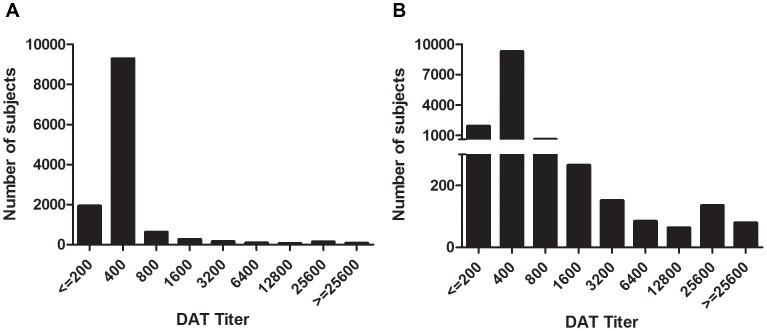
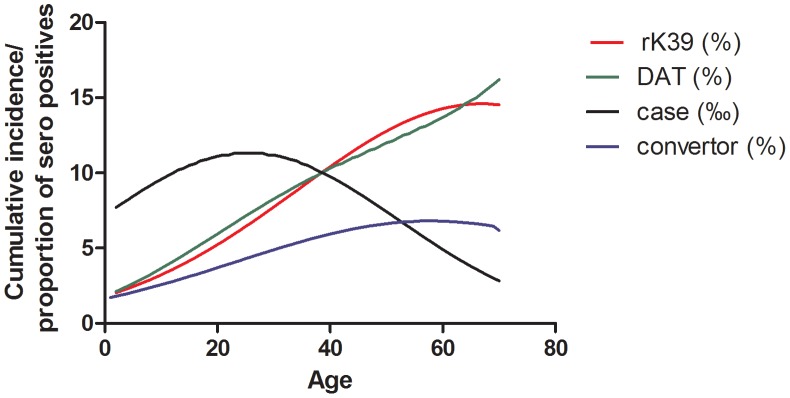
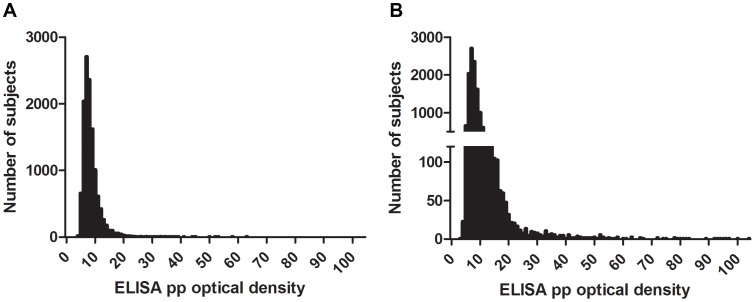
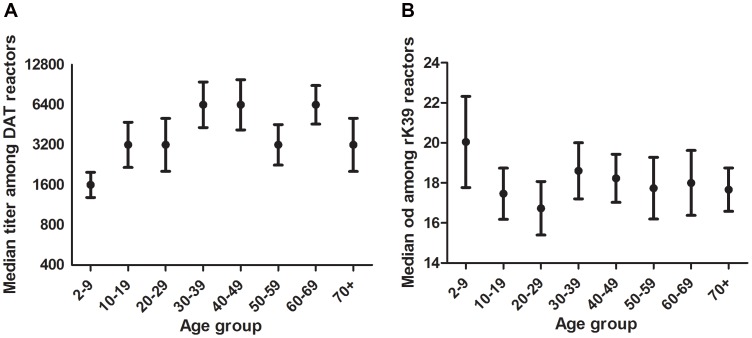
We enrolled 13,163 persons; 6.2% were reactive to DAT and 5.9% to rK39. Agreement between the tests was weak (kappa = 0.30). Among those who were negative on both tests at baseline, 3.6% had converted to sero-positive on either of the two tests one year later. Proportions of sero-positives and sero-converters increased steadily with age. Clinical VL occurred mainly among children and young adults (median age 19 years).
Although infection with L. donovani is assumed to be permanent, serological markers revert to negative. Most VL cases occur at younger ages, yet we observed a steady increase with age in the frequency of sero-positivity and sero-conversion. Our findings can be explained by a boosting effect upon repeated exposure to the parasite or by intermittent release of parasites in infected subjects from safe target cells. A certain proportion of sero-negative subjects could have been infected but below the threshold of antibody abundance for our serologic testing.
感染内脏利什曼病(VL)寄生虫的无症状者通常比临床明显病例多 4-10 比 1。我们描述了印度比哈尔邦与年龄相关的利什曼原虫感染和临床 VL 的标志物模式。
我们选择了 11 个高度流行利什曼原虫的村庄。在一年的时间间隔内,我们进行了两次逐户调查,从所有同意的 2 岁及以上的人身上收集滤纸血样。用直接凝集试验(DAT)和 rK39 ELISA 检测血清抗利什曼原虫抗体。调查期间收集的数据包括研究参与者中临床 VL 发作的信息。
我们共招募了 13163 人;6.2%的人 DAT 阳性,5.9%的人 rK39 阳性。两种检测方法的一致性较弱(kappa=0.30)。在基线时两种检测均为阴性的人群中,3.6%的人在一年后其中一种检测转为阳性。血清阳性和血清转换者的比例随着年龄的增长而稳步上升。临床 VL 主要发生在儿童和青年(中位年龄 19 岁)。
尽管感染利什曼原虫被认为是永久性的,但血清标志物会恢复阴性。大多数 VL 病例发生在较年轻的年龄,但我们观察到血清阳性率和血清转化率随着年龄的增长而稳定增加。我们的发现可以用寄生虫反复暴露或感染宿主从安全靶细胞间歇性释放寄生虫来解释。一定比例的血清阴性者可能已经感染,但低于我们血清学检测的抗体丰度阈值。