Computational Neurobiology Laboratory, Beckman Institute, Department of Molecular and Integrative Physiology, University of Illinois at Urbana-Champaign Urbana, IL, USA.
Front Pharmacol. 2013 Mar 1;4:16. doi: 10.3389/fphar.2013.00016. eCollection 2013.
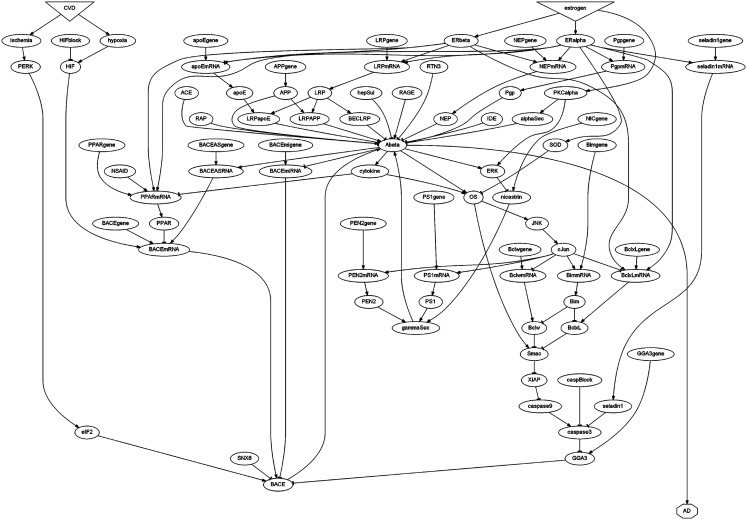
According to the amyloid hypothesis, Alzheimer Disease results from the accumulation beyond normative levels of the peptide amyloid-β (Aβ). Perhaps because of its pathological potential, Aβ and the enzymes that produce it are heavily regulated by the molecular interactions occurring within cells, including neurons. This regulation involves a highly complex system of intertwined normative and pathological processes, and the sex hormone estrogen contributes to it by influencing the Aβ-regulation system at many different points. Owing to its high complexity, Aβ regulation and the contribution of estrogen are very difficult to reason about. This report describes a computational model of the contribution of estrogen to Aβ regulation that provides new insights and generates experimentally testable and therapeutically relevant predictions. The computational model is written in the declarative programming language known as Maude, which allows not only simulation but also analysis of the system using temporal-logic. The model illustrates how the various effects of estrogen could work together to reduce Aβ levels, or prevent them from rising, in the presence of pathological triggers. The model predicts that estrogen itself should be more effective in reducing Aβ than agonists of estrogen receptor α (ERα), and that agonists of ERβ should be ineffective. The model shows how estrogen itself could dramatically reduce Aβ, and predicts that non-steroidal anti-inflammatory drugs should provide a small additional benefit. It also predicts that certain compounds, but not others, could augment the reduction in Aβ due to estrogen. The model is intended as a starting point for a computational/experimental interaction in which model predictions are tested experimentally, the results are used to confirm, correct, and expand the model, new predictions are generated, and the process continues, producing a model of ever increasing explanatory power and predictive value.
根据淀粉样蛋白假说,阿尔茨海默病是由于肽淀粉样蛋白-β(Aβ)的积累超过正常水平引起的。也许是因为其潜在的病理作用,Aβ和产生它的酶受到细胞内发生的分子相互作用的强烈调节,包括神经元。这种调节涉及到一个高度复杂的相互交织的正常和病理过程的系统,而性激素雌激素通过在许多不同的点影响 Aβ 调节系统来促进其发生。由于其高度复杂性,Aβ 调节和雌激素的贡献非常难以理解。本报告描述了一个雌激素对 Aβ 调节贡献的计算模型,该模型提供了新的见解,并产生了可实验验证和具有治疗相关性的预测。该计算模型是用称为 Maude 的声明式编程语言编写的,它不仅允许进行模拟,还允许使用时态逻辑对系统进行分析。该模型说明了雌激素的各种影响如何协同作用,以在存在病理触发的情况下降低 Aβ 水平,或防止其升高。该模型预测,雌激素本身降低 Aβ 的效果应该优于雌激素受体 α(ERα)激动剂,而 ERβ 激动剂应该无效。该模型显示了雌激素本身如何能显著降低 Aβ,并预测非甾体抗炎药应该能提供较小的额外益处。它还预测了某些化合物,但不是其他化合物,可以增强由于雌激素导致的 Aβ 减少。该模型旨在作为计算/实验交互的起点,在该交互中,模型预测通过实验进行测试,结果用于确认、纠正和扩展模型,生成新的预测,并继续进行,从而产生具有越来越高的解释力和预测价值的模型。