Pflanzenphysiologie, Technische Universität Kaiserslautern Kaiserslautern, Germany.
Front Plant Sci. 2013 Mar 1;4:34. doi: 10.3389/fpls.2013.00034. eCollection 2013.
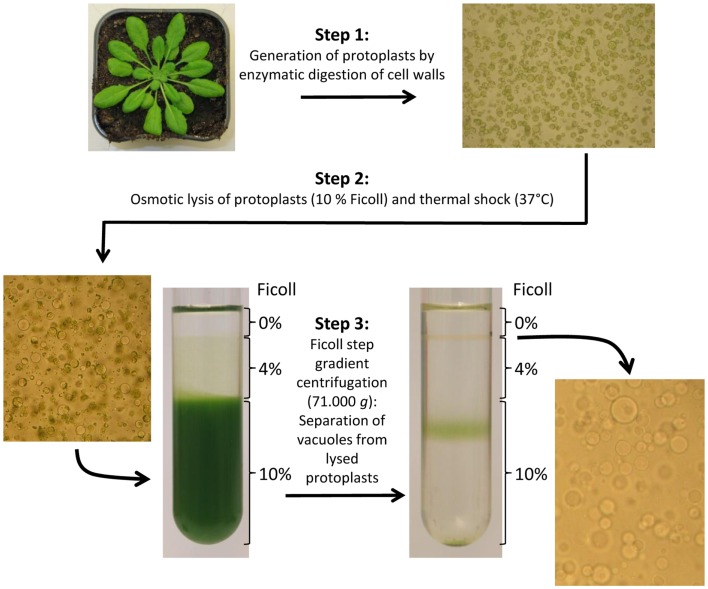
Vacuoles of plants fulfill various biologically important functions, like turgor generation and maintenance, detoxification, solute sequestration, or protein storage. Different types of plant vacuoles (lytic versus protein storage) are characterized by different functional properties apparently caused by a different composition/abundance and regulation of transport proteins in the surrounding membrane, the tonoplast. Proteome analyses allow the identification of vacuolar proteins and provide an informative basis for assigning observed transport processes to specific carriers or channels. This review summarizes techniques required for vacuolar proteome analyses, like e.g., isolation of the large central vacuole or tonoplast membrane purification. Moreover, an overview about diverse published vacuolar proteome studies is provided. It becomes evident that qualitative proteomes from different plant species represent just the tip of the iceberg. During the past few years, mass spectrometry achieved immense improvement concerning its accuracy, sensitivity, and application. As a consequence, modern tonoplast proteome approaches are suited for detecting alterations in membrane protein abundance in response to changing environmental/physiological conditions and help to clarify the regulation of tonoplast transport processes.
植物液泡具有多种重要的生物学功能,如膨压的产生和维持、解毒、溶质隔离或蛋白质储存。不同类型的植物液泡(溶酶体与蛋白储存液泡)具有不同的功能特性,这显然是由于周围膜(液泡膜)中转运蛋白的组成/丰度和调控不同所致。蛋白质组学分析可以鉴定液泡蛋白,并为将观察到的转运过程分配给特定的载体或通道提供信息基础。本综述总结了液泡蛋白质组分析所需的技术,例如大中央液泡或液泡膜的分离。此外,还提供了关于各种已发表的液泡蛋白质组研究的概述。显然,来自不同植物物种的定性蛋白质组学只代表了冰山一角。在过去的几年中,质谱技术在准确性、灵敏度和应用方面取得了巨大的进步。因此,现代的液泡蛋白质组学方法适合检测膜蛋白丰度在环境/生理条件变化时的变化,有助于阐明液泡转运过程的调控。