Department of Biological Statistics and Computational Biology, Cornell University, Ithaca, New York, USA.
PLoS Genet. 2013;9(2):e1003321. doi: 10.1371/journal.pgen.1003321. Epub 2013 Feb 28.
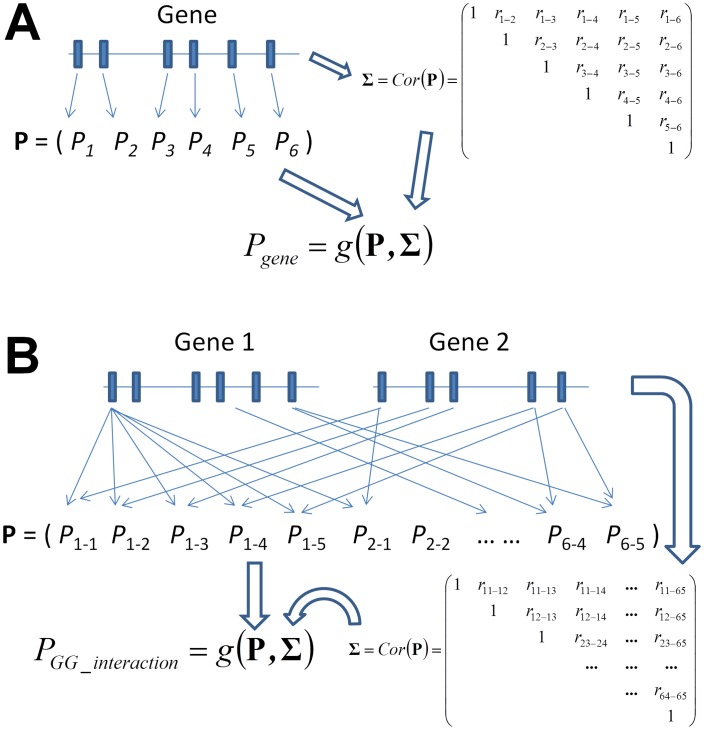
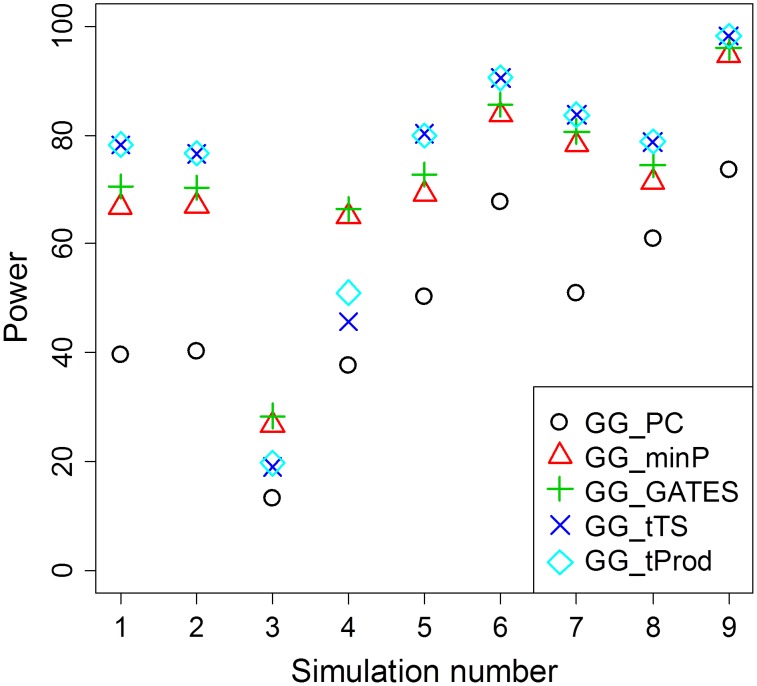
Various methods have been developed for identifying gene-gene interactions in genome-wide association studies (GWAS). However, most methods focus on individual markers as the testing unit, and the large number of such tests drastically erodes statistical power. In this study, we propose novel interaction tests of quantitative traits that are gene-based and that confer advantage in both statistical power and biological interpretation. The framework of gene-based gene-gene interaction (GGG) tests combine marker-based interaction tests between all pairs of markers in two genes to produce a gene-level test for interaction between the two. The tests are based on an analytical formula we derive for the correlation between marker-based interaction tests due to linkage disequilibrium. We propose four GGG tests that extend the following P value combining methods: minimum P value, extended Simes procedure, truncated tail strength, and truncated P value product. Extensive simulations point to correct type I error rates of all tests and show that the two truncated tests are more powerful than the other tests in cases of markers involved in the underlying interaction not being directly genotyped and in cases of multiple underlying interactions. We applied our tests to pairs of genes that exhibit a protein-protein interaction to test for gene-level interactions underlying lipid levels using genotype data from the Atherosclerosis Risk in Communities study. We identified five novel interactions that are not evident from marker-based interaction testing and successfully replicated one of these interactions, between SMAD3 and NEDD9, in an independent sample from the Multi-Ethnic Study of Atherosclerosis. We conclude that our GGG tests show improved power to identify gene-level interactions in existing, as well as emerging, association studies.
已经开发出多种方法来识别全基因组关联研究 (GWAS) 中的基因-基因相互作用。然而,大多数方法都将单个标记作为测试单元,而大量此类测试极大地削弱了统计功效。在这项研究中,我们提出了新的基于基因的数量性状基因-基因相互作用 (GGG) 检验,这些检验具有统计优势和生物学解释。基于基因的基因-基因相互作用 (GGG) 检验的框架结合了两个基因中所有标记之间的基于标记的相互作用检验,以产生两个基因之间相互作用的基因水平检验。这些检验基于我们推导的由于连锁不平衡导致的基于标记的相互作用检验之间的相关分析公式。我们提出了四种 GGG 检验,扩展了以下 P 值组合方法:最小 P 值、扩展 Simes 过程、截断尾部强度和截断 P 值乘积。广泛的模拟表明所有检验都具有正确的Ⅰ型错误率,并表明在涉及潜在相互作用的标记未直接进行基因分型的情况下以及在存在多个潜在相互作用的情况下,两种截断检验比其他检验更有效。我们应用我们的检验来检验两个表现出蛋白质-蛋白质相互作用的基因,使用来自动脉粥样硬化风险社区研究的基因型数据来检验脂质水平的基因水平相互作用。我们确定了五个基于标记的相互作用检验中不明显的五个新相互作用,并在动脉粥样硬化多民族研究的独立样本中成功复制了其中一个相互作用,即 SMAD3 和 NEDD9 之间的相互作用。我们得出结论,我们的 GGG 检验在现有的以及新出现的关联研究中具有提高识别基因水平相互作用的功效。