Program in Cell Biology, Stem Cells and Development, School of Medicine, University of Colorado, Anschutz Medical Campus, Aurora, CO, USA.
Department of Craniofacial Biology, School of Dental Medicine, University of Colorado, Anschutz Medical Campus, Aurora, CO, USA.
Oncogene. 2014 Mar 6;33(10):1306-15. doi: 10.1038/onc.2013.59. Epub 2013 Mar 11.
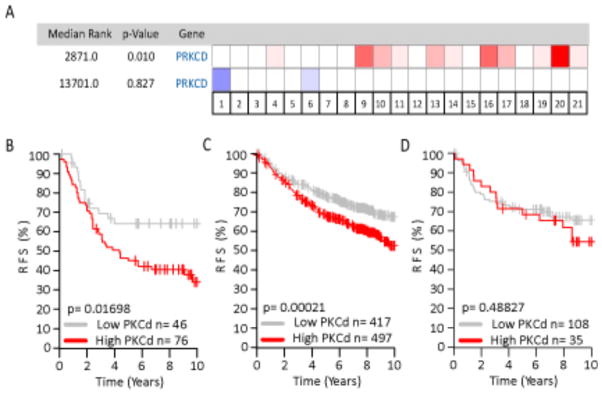
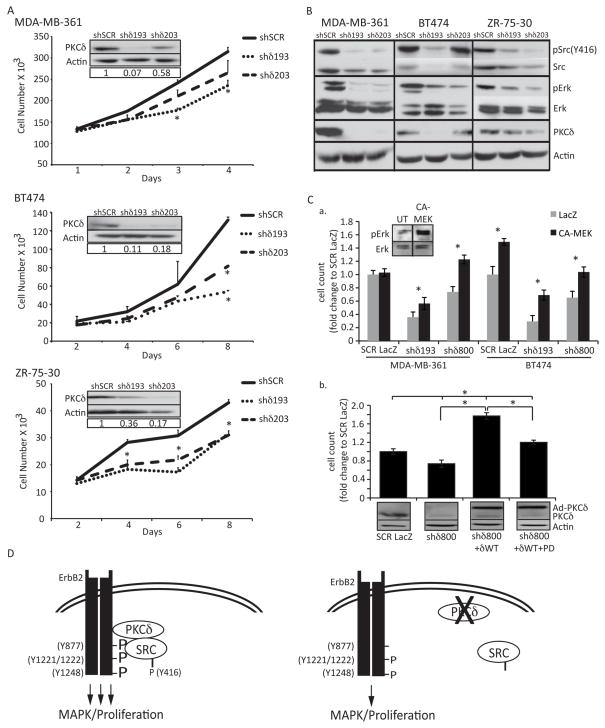
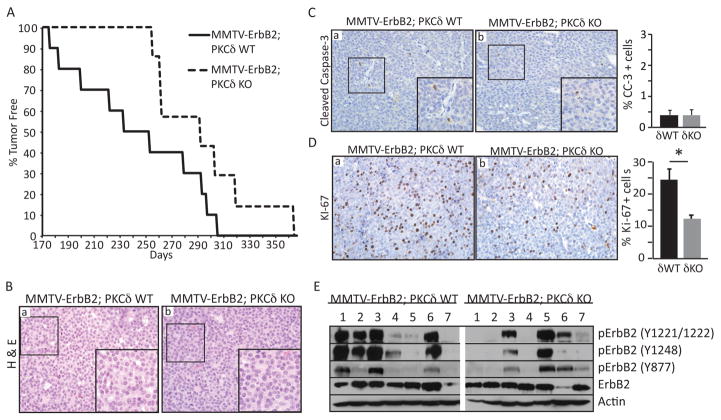
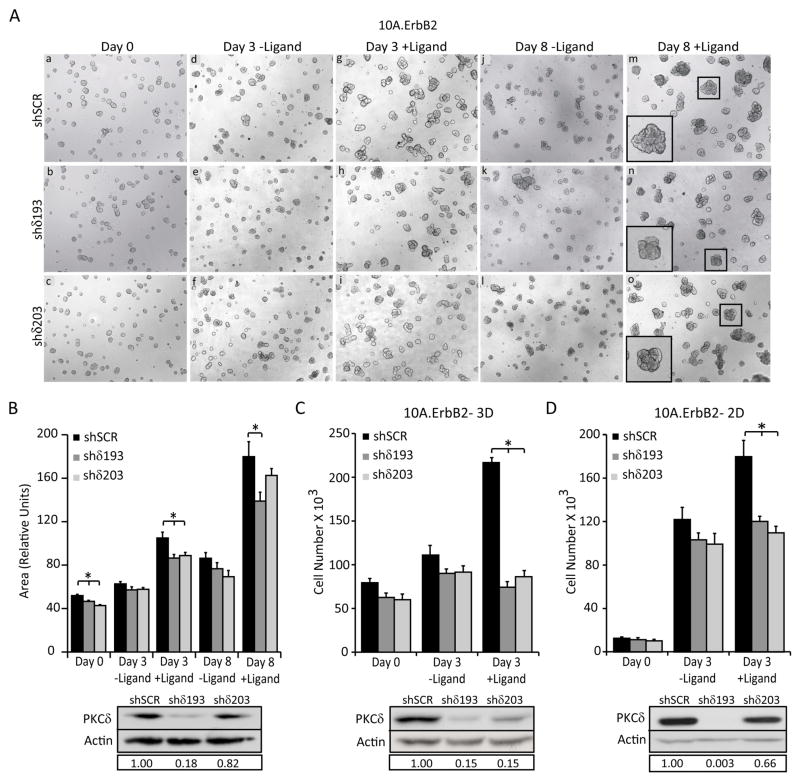
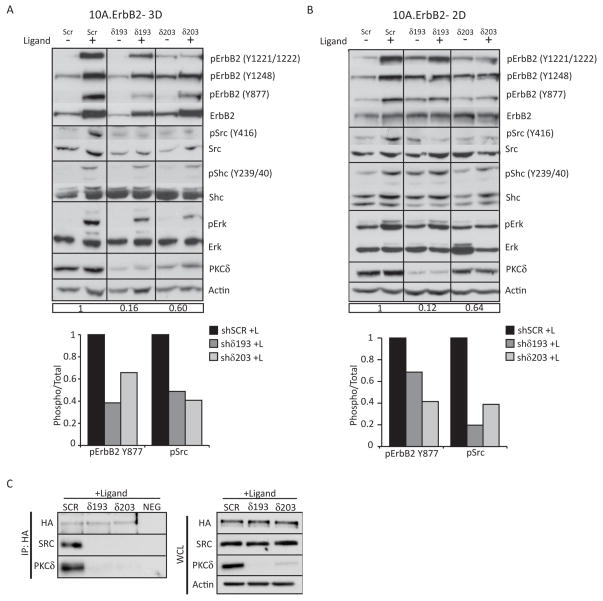
Protein kinase C δ (PKCδ) regulates apoptosis in the mammary gland, however, the functional contribution of PKCδ to the development or progression of breast cancer has yet to be determined. Meta-analysis of ErbB2-positive breast cancers shows increased PKCδ expression, and a negative correlation between PKCδ expression and prognosis. Here, we present in-vivo evidence that PKCδ is essential for the development of mammary gland tumors in a ErbB2-overexpressing transgenic mouse model, and in-vitro evidence that PKCδ is required for proliferative signaling downstream of the ErbB2 receptor. Mouse mammary tumor virus (MMTV)-ErbB2 mice lacking PKCδ (δKO) have increased tumor latency compared with MMTV-ErbB2 wild-type (δWT) mice, and the tumors show a dramatic decrease in Ki-67 staining. To explore the relationship between PKCδ and ErbB2-driven proliferation more directly, we used MCF-10A cells engineered to express a synthetic ligand-inducible form of the ErbB2 receptor. Depletion of PKCδ with short hairpin RNA inhibited ligand-induced growth in both two-dimensional (2D) (plastic) and three-dimensional (3D) (Matrigel) culture, and correlated with decreased phosphorylation of the ErbB2 receptor and reduced activation of Src and MAPK/ERK pathways. Similarly, in human breast cancer cell lines in which ErbB2 is overexpressed, depletion of PKCδ suppresses proliferation, Src and ERK activation. PKCδ appears to drive proliferation through the formation of an active ErbB2/PKCδ/Src signaling complex, as depletion of PKCδ disrupts association of Src with the ErbB2 receptor. Taken together, our studies present the first evidence that PKCδ is a critical regulator of ErbB2-mediated tumorigenesis, and suggest further investigation of PKCδ as a target in ErbB2-positive breast cancer.
蛋白激酶 C δ(PKCδ)调节乳腺细胞凋亡,然而,PKCδ 对乳腺癌的发展或进展的功能贡献尚未确定。对 ErbB2 阳性乳腺癌的荟萃分析显示 PKCδ 表达增加,PKCδ 表达与预后呈负相关。在这里,我们提供了体内证据表明,PKCδ 是在 ErbB2 过表达转基因小鼠模型中乳腺肿瘤发展所必需的,并且体外证据表明 PKCδ 是 ErbB2 受体下游增殖信号所必需的。缺乏 PKCδ(δKO)的鼠乳腺肿瘤病毒(MMTV)-ErbB2 小鼠与 MMTV-ErbB2 野生型(δWT)小鼠相比,肿瘤潜伏期增加,并且 Ki-67 染色明显减少。为了更直接地探讨 PKCδ 与 ErbB2 驱动增殖之间的关系,我们使用工程化表达合成配体诱导型 ErbB2 受体的 MCF-10A 细胞。短发夹 RNA 敲低 PKCδ 抑制了二维(塑料)和三维(Matrigel)培养中配体诱导的生长,并与 ErbB2 受体磷酸化减少和 Src 和 MAPK/ERK 途径激活减少相关。同样,在 ErbB2 过表达的人乳腺癌细胞系中,敲低 PKCδ 抑制增殖、Src 和 ERK 激活。PKCδ 似乎通过形成活性 ErbB2/PKCδ/Src 信号复合物来驱动增殖,因为 PKCδ 的敲低会破坏 Src 与 ErbB2 受体的结合。总之,我们的研究首次证明 PKCδ 是 ErbB2 介导的肿瘤发生的关键调节因子,并表明进一步研究 PKCδ 作为 ErbB2 阳性乳腺癌的靶点。