Department of Psychiatry, University of California San Diego, La Jolla, CA 92093-0804, United States.
Schizophr Res. 2013 May;146(1-3):326-35. doi: 10.1016/j.schres.2013.01.035. Epub 2013 Mar 11.
Mismatch negativity (MNN) and P3a are event related potential (ERP) measures of early sensory information processing. These components are usually conceptualized as being "pre-attentive" and therefore immune to changes with variations in attentional functioning. This study aimed to determine whether manipulations of attention influence the amplitudes and latencies of MMN and P3a and, if so, the extent to which these early sensory processes govern concurrent behavioral vigilance performance in schizophrenia patients and normal subjects.
Schizophrenia patients (SZ; n = 20) and Nonpsychiatric Control Subjects (NCS; n = 20) underwent auditory ERP testing to assess MMN and P3a across 4 EEG recording sessions in which attentional demand (low vs. high) and sensory modality of directed attention (visual vs. auditory) were experimentally varied.
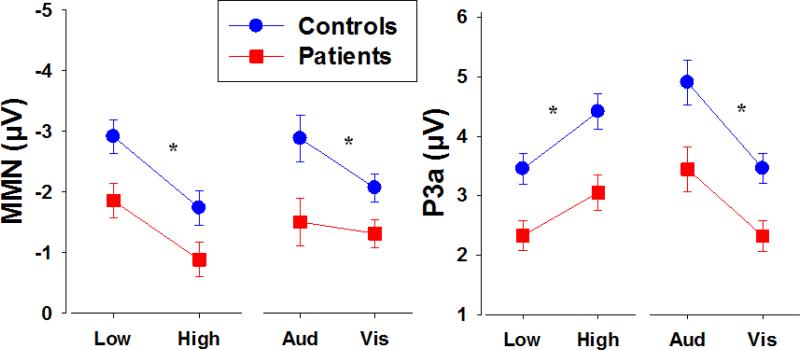
Across conditions, SZ patients exhibited deficits in MMN and P3a amplitudes. Significant amplitude and latency modulation were observed in both SZ and NCS but there were no group-by-condition interactions. The amount of MMN amplitude attenuation from low- to high-demand tasks was significantly associated with increased vigilance performance in both SZ and NCS groups (r = -0.67 and r = -0.60). Several other robust associations were also observed among neurophysiologic, clinical and cognitive variables.
Attentional demand and modality of directed attention significantly influence the amplitude and latencies of "pre-attentive" ERP components in both SZ and NCS. Deficits in MMN and P3a were not "normalized" when attention was directed to the auditory stimuli in schizophrenia patients. The adaptive modulation of early sensory information processing appears to govern concurrent attentional task performance. The temporal window reflecting automatic sensory discrimination as indexed as MMN and P3a may serve as a gateway to some higher order cognitive operations necessary for psychosocial functioning.
失匹配负波(MMN)和 P3a 是事件相关电位(ERP)的早期感觉信息处理的测量方法。这些成分通常被概念化为“非注意”,因此不受注意力功能变化的影响。本研究旨在确定注意力的变化是否会影响 MMN 和 P3a 的幅度和潜伏期,如果是这样,这些早期感觉过程在多大程度上控制精神分裂症患者和正常受试者的同时注意警觉表现。
精神分裂症患者(SZ;n=20)和非精神病对照受试者(NCS;n=20)接受听觉 ERP 测试,以评估在 4 次 EEG 记录会话中的 MMN 和 P3a,在这些会话中,注意力需求(低与高)和定向注意力的感觉模态(视觉与听觉)进行了实验变化。
在所有条件下,SZ 患者的 MMN 和 P3a 幅度均降低。在 SZ 和 NCS 中均观察到幅度和潜伏期的明显调制,但无组间条件相互作用。从低需求任务到高需求任务的 MMN 幅度衰减量与 SZ 和 NCS 组的警觉表现增加显著相关(r=-0.67 和 r=-0.60)。在神经生理、临床和认知变量之间还观察到其他几个稳健的关联。
注意力需求和定向注意力的模式会显著影响 SZ 和 NCS 中“非注意”ERP 成分的幅度和潜伏期。当注意力指向精神分裂症患者的听觉刺激时,MMN 和 P3a 的缺陷并未“正常化”。早期感觉信息处理的适应性调制似乎控制着同时的注意力任务表现。反映自动感觉辨别作为 MMN 和 P3a 的时间窗口可能作为某些必要的心理社会功能的更高阶认知操作的门户。