Kladt Nikolay, Hanslik Ulrike, Heinzel Hans-Georg
Institut fuer Zoologie, University of Bonn, Poppelsdorfer Schloss, 53115 Bonn, Germany; ; Janelia Farm Research Campus, HHMI, Ashburn VA 20147, U. S.
J Undergrad Neurosci Educ. 2010 Fall;9(1):A20-35. Epub 2010 Oct 15.
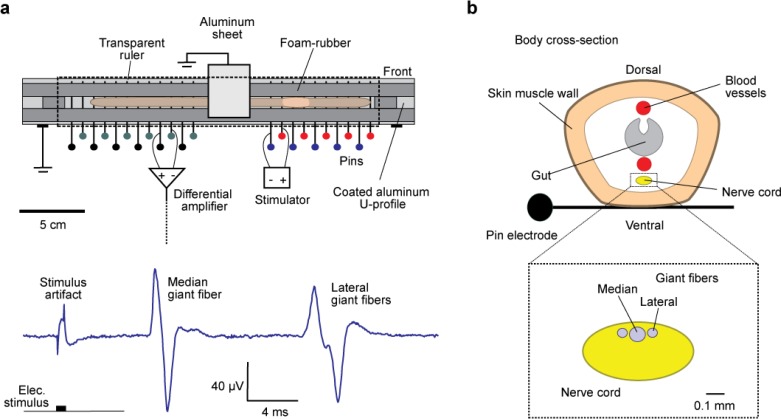
Introductory neurobiology courses face the problem that practical exercises often require expensive equipment, dissections, and a favorable student-instructor ratio. Furthermore, the duration of an experiment might exceed available time or the level of required expertise is too high to successfully complete the experiment. As a result, neurobiological experiments are commonly replaced by models and simulations, or provide only very basic experiments, such as the frog sciatic nerve preparation, which are often time consuming and tedious. Action potential recordings in giant fibers of intact earthworms (Lumbricus terrestris) circumvent many of these problems and result in a nearly 100% success rate. Originally, these experiments were introduced as classroom exercises by Charles Drewes in 1978 using awake, moving earthworms. In 1990, Hans-Georg Heinzel described further experiments using anesthetized earthworms. In this article, we focus on the application of these experiments as teaching tools for basic neurobiology courses. We describe and extend selected experiments, focusing on specific neurobiological principles with experimental protocols optimized for classroom application. Furthermore, we discuss our experience using these experiments in animal physiology and various neurobiology courses at the University of Bonn.
实践操作通常需要昂贵的设备、解剖以及良好的师生比例。此外,实验的持续时间可能会超过可用时间,或者所需的专业知识水平过高,以至于学生无法成功完成实验。因此,神经生物学实验通常被模型和模拟所取代,或者只提供非常基础的实验,比如青蛙坐骨神经制备实验,而这类实验往往既耗时又乏味。在完整蚯蚓(陆正蚓)的巨纤维中记录动作电位可以避免许多此类问题,并且成功率接近100%。最初,这些实验是由查尔斯·德鲁斯于1978年作为课堂练习引入的,使用的是清醒、活动的蚯蚓。1990年,汉斯 - 格奥尔格·海因策尔描述了使用麻醉蚯蚓的进一步实验。在本文中,我们重点关注这些实验作为基础神经生物学课程教学工具的应用。我们描述并扩展了选定的实验,着重于特定的神经生物学原理,并针对课堂应用对实验方案进行了优化。此外,我们还讨论了在波恩大学的动物生理学和各种神经生物学课程中使用这些实验的经验。