Kılıc Ayşe, Kalender Hakan, Eroksuz Hatice, Muz Adile, Tasdemir Bülent
Sivrice Vocational High School, Firat University, 23119, Elazig, Turkey,
Trop Anim Health Prod. 2013 Oct;45(7):1525-31. doi: 10.1007/s11250-013-0394-3. Epub 2013 Mar 15.
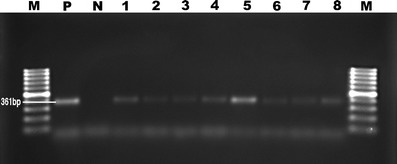
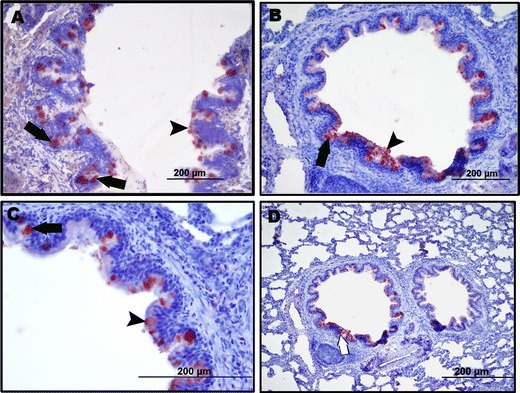
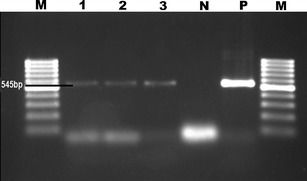
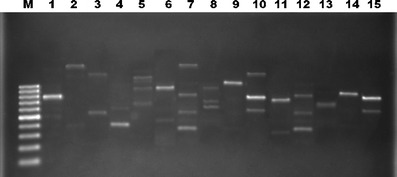
This study used cultures, polymerase chain reaction (PCR), and immunoperoxidase to examine samples from 216 lungs from sheep and lambs with macroscopic pneumonia lesions for the presence of Mycoplasma species. DNA was extracted from lung tissue samples and broth cultures with the help of a DNA extraction kit and replicated using genus-specific and species-specific primers for mycoplasma. The lung samples were examined by the immunoperoxidase method using hyperimmune Mycoplasma ovipneumoniae serum. The randomly amplified polymorphic DNA (RAPD) test was used for the molecular typing of M. ovipneumoniae isolates. Mycoplasma was isolated in the cultures of 80 (37.03 %) of a total of 216 lung samples. Genus-specific mycoplasma DNA was identified by PCR in 96 (44.44 %) samples in broth cultures and 36 (16.66 %) directly in the lung tissue. Of these 96 cases in which genus-specific identification was made, 57 (59.37 %) were positive for reaction with species-specific primers for M. ovipneumoniae and 31 (32.29 %) for Mycoplasma arginini. The DNA of neither of the latter two species could be identified in the remaining eight samples (8.33 %) where mycoplasma had been identified. As for the immunoperoxidase method, it identified M. ovipneumoniae in 61 of 216 lung samples (28 %). Positive staining was concentrated in the bronchial epithelium cell cytoplasm and cell surface. RAPD analysis resulted in 15 different profiles. Our results suggest that PCR methods could be successfully used in the diagnosis of mycoplasma infections as an alternative to culture method and identifying this agent at the species level.
本研究采用培养、聚合酶链反应(PCR)和免疫过氧化物酶法,对216份来自患有肉眼可见肺炎病变的绵羊和羔羊肺部的样本进行检测,以确定支原体种类的存在情况。借助DNA提取试剂盒从肺组织样本和肉汤培养物中提取DNA,并使用支原体属特异性和种特异性引物进行复制。采用抗绵羊肺炎支原体超免疫血清,通过免疫过氧化物酶法对肺样本进行检测。随机扩增多态性DNA(RAPD)试验用于绵羊肺炎支原体分离株的分子分型。在总共216份肺样本中,有80份(37.03%)的培养物中分离出支原体。通过PCR在肉汤培养物中的96份(44.44%)样本和直接在肺组织中的36份(16.66%)样本中鉴定出属特异性支原体DNA。在这96例进行属特异性鉴定的病例中,57例(59.37%)与绵羊肺炎支原体种特异性引物反应呈阳性,31例(32.29%)与精氨酸支原体反应呈阳性。在其余8份(8.33%)已鉴定出支原体的样本中,未鉴定出后两种支原体的DNA。至于免疫过氧化物酶法,在216份肺样本中的61份(28%)中鉴定出绵羊肺炎支原体。阳性染色集中在支气管上皮细胞的细胞质和细胞表面。RAPD分析产生了15种不同的图谱。我们的结果表明,PCR方法可作为培养方法的替代方法,成功用于支原体感染的诊断,并在种水平上鉴定该病原体。