Université de Lyon, Université Claude Bernard Lyon I, Lyon, France.
BMC Genomics. 2013 Mar 16;14:184. doi: 10.1186/1471-2164-14-184.
MicroRNAs (miRNAs), a group of short non-coding RNAs that negatively regulate gene expression, have recently emerged as potential modulators of cellular response to ionizing radiations both in vitro and in vivo in various cell types and tissues. However, in epidermal cells, the involvement of the miRNA machinery in the cellular response to ionizing radiations remains to be clarified. Indeed, understanding the mechanisms of cutaneous radiosensitivity is an important issue since skin is the most exposed organ to ionizing radiations and among the most sensitive.
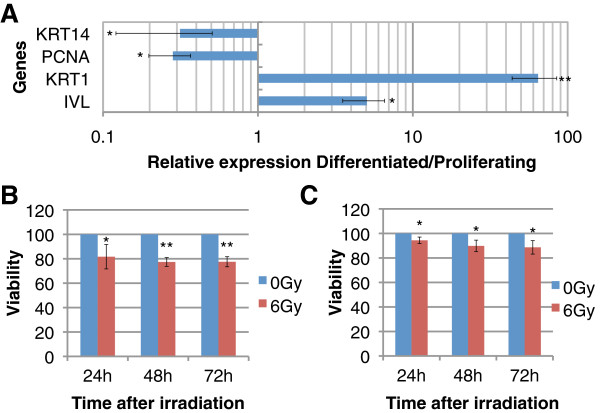
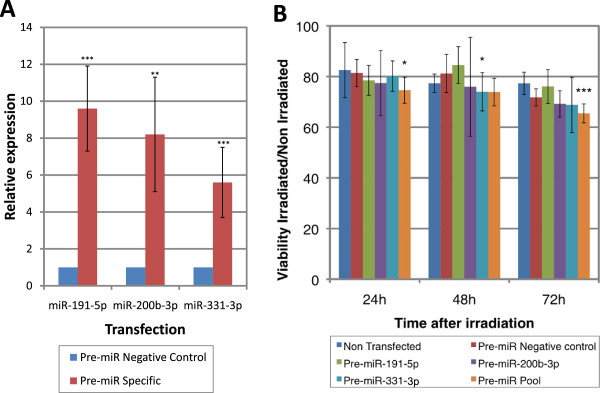
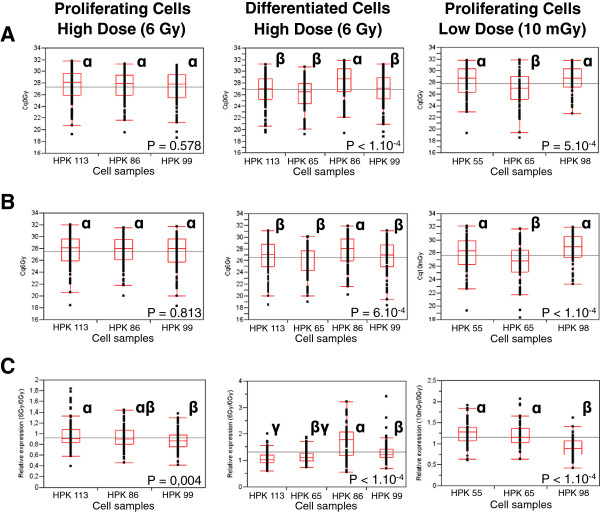
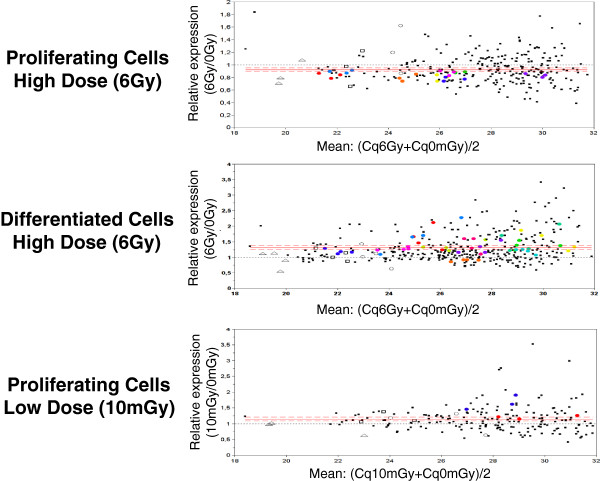
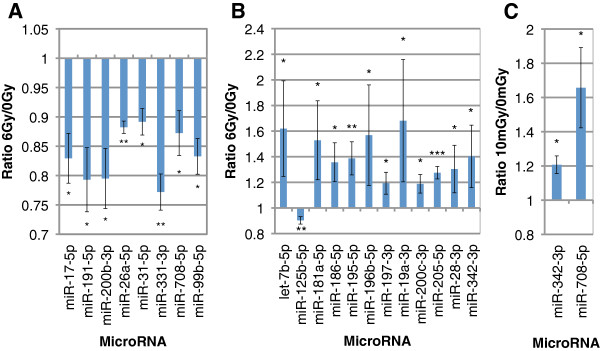
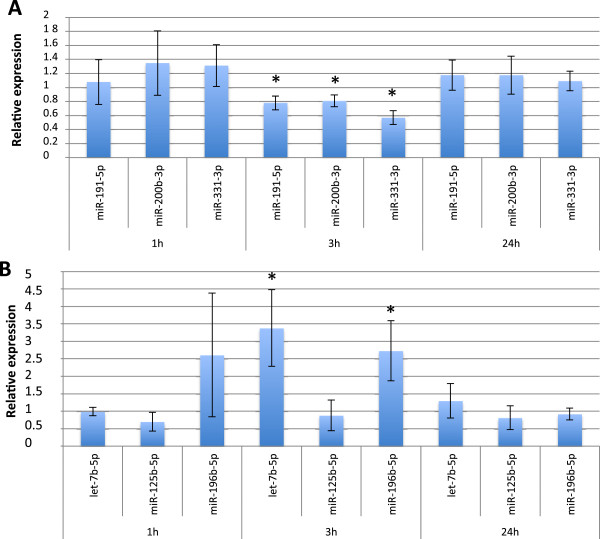
We settled up an expression study of miRNAs in primary human skin keratinocytes using a microfluidic system of qPCR assay, which permits to assess the expression of almost 700 annotated miRNAs. The keratinocytes were cultured to a proliferative or a differentiated state mimicking basal or suprabasal layers of human epidermis. These cells were irradiated at 10 mGy or 6 Gy and RNA was extracted 3 hours after irradiation. We found that proliferative cells irradiated at 6 Gy display a global fall of miRNA expression whereas differentiated cells exposed to the same dose display a global increase of miRNAs expression. We identified twenty miRNAs weakly but significantly modulated after 6 Gy irradiation, whereas only 2 miRNAs were modulated after low-dose irradiation in proliferating cells. To go further into the biological meaning of this miRNA response, we over-expressed some of the responding miRNA in proliferating cells: we observed a significant decrease of cell viability 72 hours after irradiation. Functional annotation of their predicted targets revealed that G-protein related pathways might be regulated by these responding miRNAs.
Our results reveal that human primary keratinocytes exposed to ionizing irradiation expressed a miRNA pattern strongly related to the differentiation status of irradiated cells. We also demonstrate that some miRNAs play a role in the radiation response to ensure the short-term survival of irradiated keratinocytes.
微小 RNA(miRNA)是一组短的非编码 RNA,可负向调节基因表达,最近已成为各种细胞类型和组织中体外和体内细胞对电离辐射反应的潜在调节剂。然而,在表皮细胞中,miRNA 机制在细胞对电离辐射的反应中的参与仍有待阐明。事实上,了解皮肤辐射敏感性的机制是一个重要的问题,因为皮肤是最暴露于电离辐射的器官,也是最敏感的器官之一。
我们使用微流控 qPCR 分析系统在原代人皮肤角质形成细胞中建立了 miRNA 表达研究,该系统允许评估近 700 个注释 miRNA 的表达。角质形成细胞培养至增殖或分化状态,模拟人表皮的基底层或棘层。这些细胞在 10 mGy 或 6 Gy 下照射,并在照射后 3 小时提取 RNA。我们发现,6 Gy 照射的增殖细胞显示 miRNA 表达的全面下降,而暴露于相同剂量的分化细胞显示 miRNA 表达的全面增加。我们鉴定出 20 个 miRNA 在 6 Gy 照射后弱但显著调节,而在增殖细胞中低剂量照射后仅调节 2 个 miRNA。为了进一步研究这种 miRNA 反应的生物学意义,我们在增殖细胞中过表达了一些反应性 miRNA:我们观察到照射后 72 小时细胞活力显著下降。对其预测靶标的功能注释表明,G 蛋白相关途径可能受到这些反应性 miRNA 的调节。
我们的结果表明,暴露于电离辐射的人原代角质形成细胞表达的 miRNA 模式与照射细胞的分化状态密切相关。我们还证明,一些 miRNA 在辐射反应中发挥作用,以确保照射角质形成细胞的短期存活。