Department of Neurology, Philipps-University, Marburg, Germany.
Health Qual Life Outcomes. 2013 Mar 8;11:35. doi: 10.1186/1477-7525-11-35.
Clinical studies employ the Unified Parkinson's Disease Rating Scale (UPDRS) to measure the severity of Parkinson's disease. Evaluations often fail to consider the health-related quality of life (HrQoL) or apply disease-specific instruments. Health-economic studies normally use estimates of utilities to calculate quality-adjusted life years. We aimed to develop an estimation algorithm for EuroQol- 5 dimensions (EQ-5D)-based utilities from the clinical UPDRS or disease-specific HrQoL data in the absence of original utilities estimates.
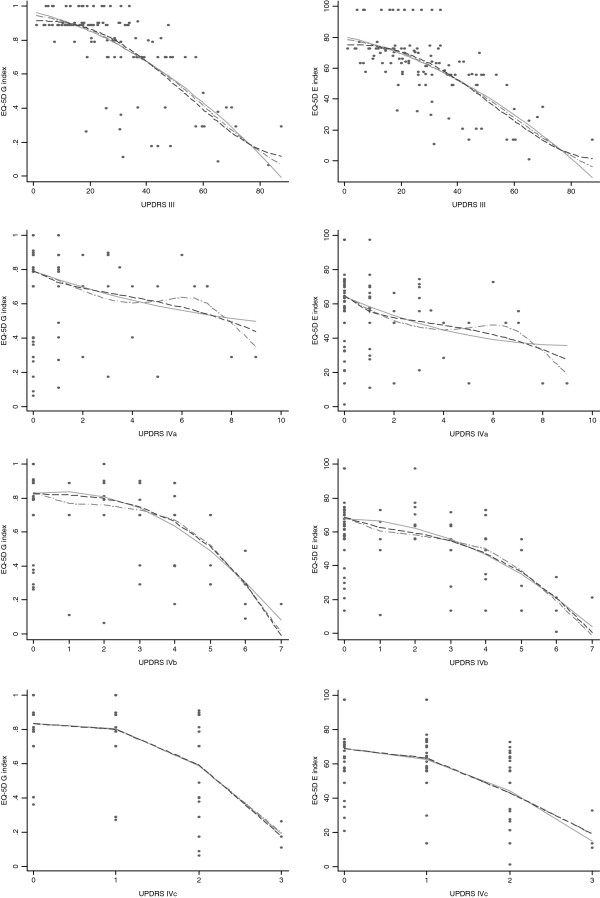
Linear and fractional polynomial regression analyses were performed with data from a study of Parkinson's disease patients (n=138) to predict the EQ-5D index values from UPDRS and Parkinson's disease questionnaire eight dimensions (PDQ-8) data. German and European weights were used to calculate the EQ-5D index. The models were compared by R(2), the root mean square error (RMS), the Bayesian information criterion, and Pregibon's link test. Three independent data sets validated the models.
The regression analyses resulted in a single best prediction model (R(2): 0.713 and 0.684, RMS: 0.139 and 13.78 for indices with German and European weights, respectively) consisting of UPDRS subscores II, III, IVa-c as predictors. When the PDQ-8 items were utilised as independent variables, the model resulted in an R2 of 0.60 and 0.67. The independent data confirmed the prediction models.
The best results were obtained from a model consisting of UPDRS subscores II, III, IVa-c. Although a good model fit was observed, primary EQ-5D data are always preferable. Further validation of the prediction algorithm within large, independent studies is necessary prior to its generalised use.
临床研究采用统一帕金森病评定量表(UPDRS)来衡量帕金森病的严重程度。评估往往未能考虑到健康相关的生活质量(HrQoL)或应用特定于疾病的工具。健康经济学研究通常使用效用估计来计算质量调整生命年。我们旨在开发一种从临床 UPDRS 或特定于疾病的 HrQoL 数据中估算基于 EuroQol-5 维度(EQ-5D)的效用的估算算法,而无需原始效用估计。
使用帕金森病患者研究(n=138)的数据进行线性和分数多项式回归分析,以预测 UPDRS 和帕金森病问卷 8 维度(PDQ-8)数据的 EQ-5D 指数值。使用德国和欧洲权重计算 EQ-5D 指数。通过 R(2)、均方根误差(RMS)、贝叶斯信息准则和 Pregibon 链接检验比较模型。三个独立的数据集验证了模型。
回归分析得出了一个最佳的单一预测模型(R(2):分别为 0.713 和 0.684,RMS:分别为 0.139 和 13.78,用于德国和欧洲权重的指数),由 UPDRS 子量表 II、III、IVa-c 作为预测因子。当 PDQ-8 项目用作独立变量时,模型的 R2 为 0.60 和 0.67。独立数据证实了预测模型。
最好的结果来自于由 UPDRS 子量表 II、III、IVa-c 组成的模型。虽然观察到模型拟合良好,但始终首选原始 EQ-5D 数据。在广泛的独立研究中进一步验证预测算法的有效性是必要的,然后才能广泛使用。