Zhejiang Provincial Center for Disease Control and Prevention, Hangzhou, Zhejiang, China.
BMC Microbiol. 2013 Mar 4;13:52. doi: 10.1186/1471-2180-13-52.
Cholera is still a significant public health issue in developing countries. The aetiological agent is Vibrio cholerae and only two serogroups, O1 and O139, are known to cause pandemic or epidemic cholera. In contrast, non-O1/non-O139 V. cholerae has only been reported to cause sporadic cholera-like illness and localised outbreaks. The aim of this study was to determine the genetic diversity of non-O1/non-O139 V. cholerae isolates from hospitalised diarrhoeal patients in Zhejiang Province, China.
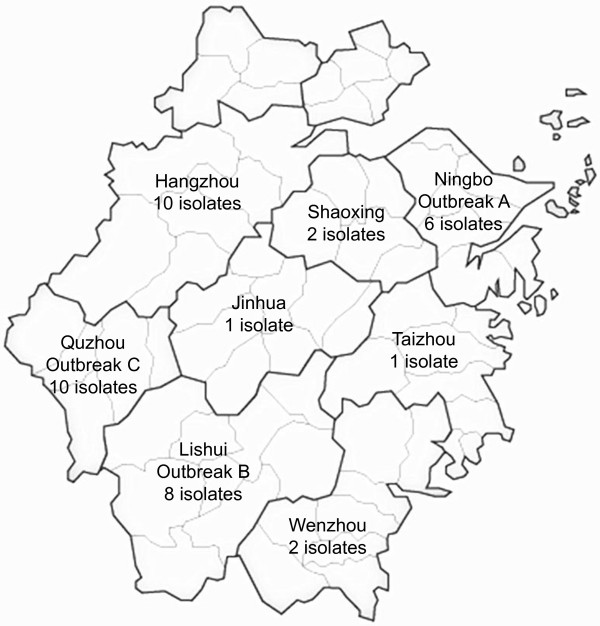
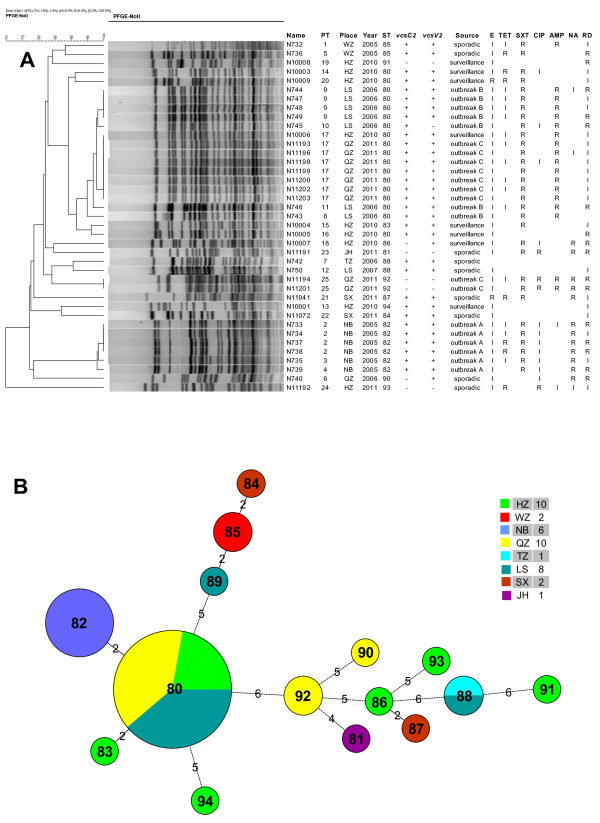
In an active surveillance of enteric pathogens in hospitalised diarrhoeal patients, nine non-O1/non-O139 V. cholerae isolates were identified from 746 diarrhoeal stool samples at a rate of 1.2%. These isolates and an additional 31 isolates from sporadic cases and three outbreaks were analysed using pulsed-field gel electrophoresis (PFGE) and multilocus sequence typing (MLST). PFGE divided the isolates into 25 PFGE types while MLST divided them into 15 sequence types (STs). A single ST, ST80, was predominant which persisted over several years in different cities and caused two outbreaks in recent years. Antibiotic resistance varied with the majority of the isolates resistant to sulphamethoxazole/trimethoprim and nearly all isolates either resistant or intermediate to erythromycin and rifampicin. None of the isolates carried the cholera toxin genes or toxin co-regulated pilus genes but the majority carried a type III secretion system as the key virulence factor.
Non-O1/non-O139 V. cholerae is an important contributor to diarrhoeal infections in China. Resistance to commonly used antibiotics limits treatment options. Continuous surveillance of non-O1/non-O139 V. cholerae is important for control and prevention of diarrhoeal infections.
霍乱仍是发展中国家的一个重大公共卫生问题。病原体是霍乱弧菌,已知只有两个血清群,O1 和 O139,会引起大流行或流行霍乱。相比之下,非 O1/非 O139 霍乱弧菌仅被报道引起散发性霍乱样疾病和局部暴发。本研究旨在确定中国浙江省住院腹泻患者中非 O1/非 O139 霍乱弧菌分离株的遗传多样性。
在对住院腹泻患者肠道病原体的主动监测中,从 746 份腹泻粪便样本中鉴定出 9 株非 O1/非 O139 霍乱弧菌,检出率为 1.2%。这些分离株和另外 31 株来自散发病例和 3 次暴发的分离株,以及 31 株来自散发病例和 3 次暴发的分离株,通过脉冲场凝胶电泳(PFGE)和多位点序列分型(MLST)进行了分析。PFGE 将分离株分为 25 种 PFGE 型,而 MLST 将其分为 15 种序列型(ST)。单一 ST,ST80,占主导地位,在不同城市持续多年,并在近年来引发了两次暴发。抗生素耐药性各不相同,大多数分离株对磺胺甲恶唑/甲氧苄啶耐药,几乎所有分离株对红霉素和利福平耐药或中介。没有分离株携带霍乱毒素基因或毒素调节菌毛基因,但大多数分离株携带 III 型分泌系统作为关键毒力因子。
非 O1/非 O139 霍乱弧菌是中国腹泻感染的重要原因。对常用抗生素的耐药性限制了治疗选择。对非 O1/非 O139 霍乱弧菌的持续监测对于控制和预防腹泻感染非常重要。