Department of Microbiology and Biotechnology, Western Delta University, Oghara, Delta State, Nigeria.
Applied and Environmental Microbiology Research Group, Department of Biochemistry and Microbiology, University of Fort Hare, Alice, 5700, South Africa.
Arch Microbiol. 2022 May 14;204(6):323. doi: 10.1007/s00203-022-02866-1.
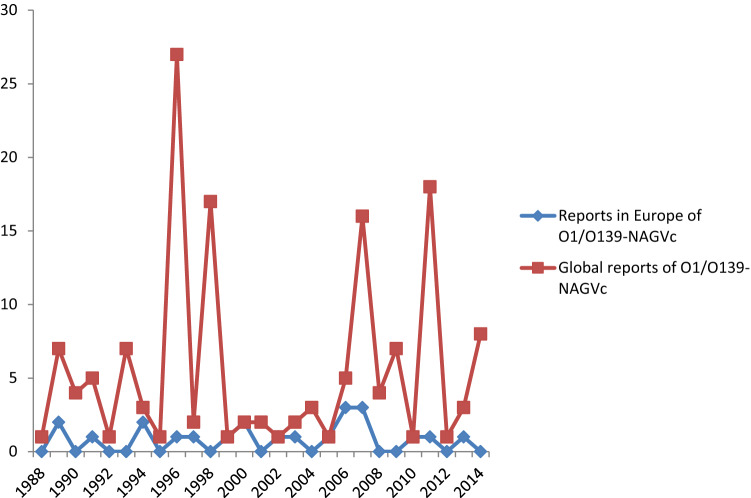
Somatic antigen agglutinable type-1/139 Vibrio cholerae (SAAT-1/139-Vc) members or O1/O139 V. cholerae have been described by various investigators as pathogenic due to their increasing virulence potential and production of choleragen. Reported cholera outbreak cases around the world have been associated with these choleragenic V. cholerae with high case fatality affecting various human and animals. These virulent Vibrio members have shown genealogical and phylogenetic relationship with the avirulent somatic antigen non-agglutinable strains of 1/139 V. cholerae (SANAS-1/139- Vc) or O1/O139 non-agglutinating V. cholerae (O1/O139-NAG-Vc). Reports on implication of O1/O139-NAGVc members in most sporadic cholera/cholera-like cases of diarrhea, production of cholera toxin and transmission via consumption and/or contact with contaminated water/seafood are currently on the rise. Some reported sporadic cases of cholera outbreaks and observed change in nature has also been tracable to these non-agglutinable Vibrio members (O1/O139-NAGVc) yet there is a sustained paucity of research interest on the non-agglutinable V. cholerae members. The emergence of fulminating extraintestinal and systemic vibriosis is another aspect of SANAS-1/139- Vc implication which has received low attention in terms of research driven interest. This review addresses the need to appraise and continually expand research based studies on the somatic antigen non-serogroup agglutinable type-1/139 V. cholerae members which are currently prevalent in studies of water bodies, fruits/vegetables, foods and terrestrial environment. Our opinion is amassed from interest in integrated surveillance studies, management/control of cholera outbreaks as well as diarrhea and other disease-related cases both in the rural, suburban and urban metropolis.
各种研究人员已经将具有体抗原可凝集型 1/139 霍乱弧菌(SAAT-1/139-Vc)成员或 O1/O139 霍乱弧菌的成员描述为致病性的,因为它们具有增加的毒力潜力和霍乱毒素的产生。世界各地报道的霍乱暴发病例都与这些产霍乱毒素的霍乱弧菌有关,这些霍乱弧菌具有高病死率,影响着各种人类和动物。这些具有毒力的弧菌成员与无毒性体抗原不可凝集的 1/139 霍乱弧菌(SANAS-1/139-Vc)或 O1/O139 不可凝集的霍乱弧菌(O1/O139-NAG-Vc)的非毒力的同种血清型具有遗传和系统发育关系。关于 O1/O139-NAGVc 成员在大多数散发的霍乱/类霍乱腹泻病例中的作用、霍乱毒素的产生以及通过食用和/或接触污染的水/海鲜传播的报告正在增加。一些报道的霍乱暴发散发病例和观察到的性质变化也可追踪到这些不可凝集的弧菌成员(O1/O139-NAGVc),但对不可凝集的霍乱弧菌成员的研究兴趣仍然不足。暴发性肠外和全身弧菌病的出现是 SANAS-1/139-Vc 参与的另一个方面,这方面在研究驱动的兴趣方面受到的关注较少。这篇综述强调了需要评估和不断扩大基于研究的研究,以评估当前在水体、水果/蔬菜、食品和陆地环境研究中普遍存在的非血清群可凝集型 1/139 霍乱弧菌成员。我们的观点是基于对综合监测研究、霍乱暴发以及农村、郊区和城市大都市的腹泻和其他疾病相关病例的管理/控制的兴趣而积累的。