State Key Laboratory of Oncology in South China, Sun Yat-Sen University Cancer Centre, Guangzhou, Guangdong, China.
J Transl Med. 2013 Mar 7;11:59. doi: 10.1186/1479-5876-11-59.
Protein tyrosine kinase 6 (PTK6), also known as breast tumor kinase (Brk), was a nonreceptor tyrosine kinase containing SH3, SH2, and tyrosine kinase catalytic domains. The deregulated expression of PTK6 was observed in various human cancers. However, little was known about PTK6 expression and its clinicopathological significance in human laryngeal squamous cell carcinoma (LSCC).
PTK6 expression was evaluated in 7 pairs of surgically resectable laryngeal tissues by Western blotting and in 13 pairs of surgically resectable laryngeal tissues by reverse transcription-PCR (RT-PCR). Using immunohistochemistry, we performed a retrospective study of the PTK6 expression levels on 134 archival LSCC paraffin-embedded samples. Prognostic outcomes correlated with PTK6 were examined using Kaplan-Meier analysis and Cox proportional hazards model.
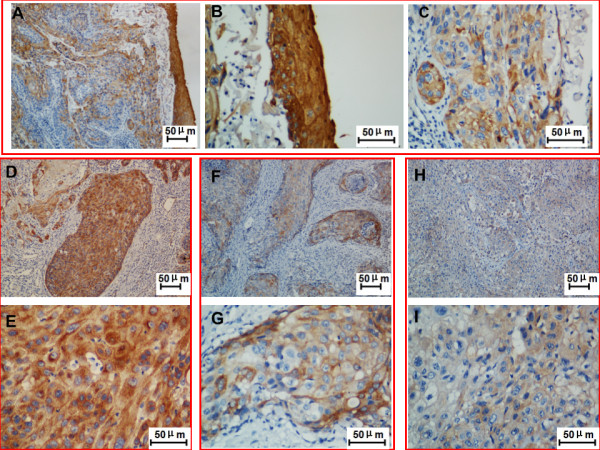
The PTK6 expression level was lower in LSCC tissues than in the adjacent noncancerous epithelial laryngeal tissues by Western blots and RT-PCR. By immunohistochemical analysis, we observed high expression of PTK6 in 25 of 76 (32.9%) adjacent noncancerous epithelial laryngeal tissues and in 39 of 134 (29.1%) of LSCC, respectively. Multivariate analysis demonstrated that pN status and the expression level of PTK6 (P < 0.05) were independent and significant prognostic factors. In the primary LSCC category, median DFS (disease free survival) of high, medium and low PTK6 expression patients were 88.5 months ,74.5 months and 49.0 months (log-rank test, P = 0.002); median OS (overall survival) of high, medium and low PTK6 expression patients were 88.5 months ,76.3 months and 65.7 months (log-rank test, P = 0.002). Reduced cytoplasmic PTK6 expression in LSCC was significantly associated with late pN status (P =0.005, r = 0.27), advanced pTNM stages (III and IV) (P =0.027, r = 0.147), and poor differentiated LSCC (P <0.0001, r = 0.486). In adjacent paracancerous laryngeal epithelial samples, median DFS of high, medium and low PTK6 expression patients were 92.6 months ,75.6 months and 48.5 months (log-rank test, P = 0.020); median OS of high, medium and low PTK6 expression patients were 92.9 months ,78.9 months and 74.6 months (log-rank test, P = 0.042).
The present findings indicated that cytoplasmic PTK6 expression is a potential prognostic factor for survival in LSCC patients. High expression of PTK6 was associated with favorable OS and DFS in LSCC patients.
蛋白酪氨酸激酶 6(PTK6),又称为乳腺癌激酶(Brk),是一种非受体酪氨酸激酶,包含 SH3、SH2 和酪氨酸激酶催化结构域。PTK6 的失调表达在各种人类癌症中都有观察到。然而,关于 PTK6 在人类喉鳞状细胞癌(LSCC)中的表达及其临床病理意义知之甚少。
通过 Western blot 和逆转录-PCR(RT-PCR)分别在 7 对可手术切除的喉组织和 13 对可手术切除的喉组织中评估 PTK6 的表达。通过免疫组织化学,我们对 134 例存档的 LSCC 石蜡包埋样本进行了 PTK6 表达水平的回顾性研究。使用 Kaplan-Meier 分析和 Cox 比例风险模型检查与 PTK6 相关的预后结果。
Western blot 和 RT-PCR 显示 LSCC 组织中的 PTK6 表达水平低于相邻非癌性喉上皮组织。通过免疫组织化学分析,我们观察到 76 例相邻非癌性喉上皮组织中有 25 例(32.9%)和 134 例 LSCC 中有 39 例(29.1%)高表达 PTK6。多变量分析表明,pN 状态和 PTK6 的表达水平(P<0.05)是独立且重要的预后因素。在原发性 LSCC 分类中,高、中、低 PTK6 表达患者的中位无病生存期(DFS)分别为 88.5 个月、74.5 个月和 49.0 个月(对数秩检验,P=0.002);高、中、低 PTK6 表达患者的中位总生存期(OS)分别为 88.5 个月、76.3 个月和 65.7 个月(对数秩检验,P=0.002)。LSCC 细胞质中 PTK6 表达减少与晚期 pN 状态(P=0.005,r=0.27)、晚期 pTNM 分期(III 和 IV)(P=0.027,r=0.147)和低分化 LSCC(P<0.0001,r=0.486)显著相关。在相邻的癌旁喉上皮样本中,高、中、低 PTK6 表达患者的中位 DFS 分别为 92.6 个月、75.6 个月和 48.5 个月(对数秩检验,P=0.020);高、中、低 PTK6 表达患者的中位 OS 分别为 92.9 个月、78.9 个月和 74.6 个月(对数秩检验,P=0.042)。
本研究结果表明,细胞质 PTK6 表达是 LSCC 患者生存的潜在预后因素。PTK6 的高表达与 LSCC 患者的良好 OS 和 DFS 相关。