Grupo de Microbiología Molecular, Escuela de Microbiología, Universidad de Antioquia, Medellín, Colombia.
Parasit Vectors. 2013 Mar 7;6:61. doi: 10.1186/1756-3305-6-61.
In Colombia for several years, the Urabá-Bajo Cauca and Alto Sinú region has registered the highest numbers of malaria cases in the country. Malaria vector incrimination and the characterization of entomological parameters will allow for a better understanding of malaria transmission dynamics and the design of effective vector control strategies for this region.
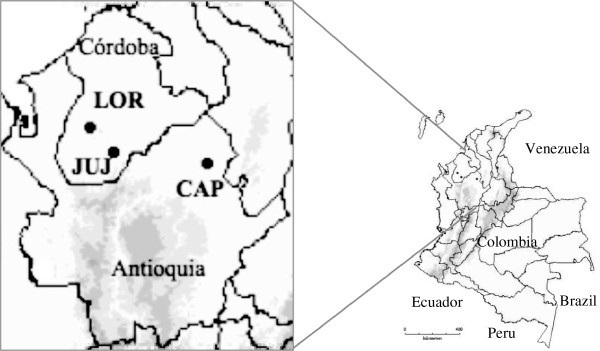
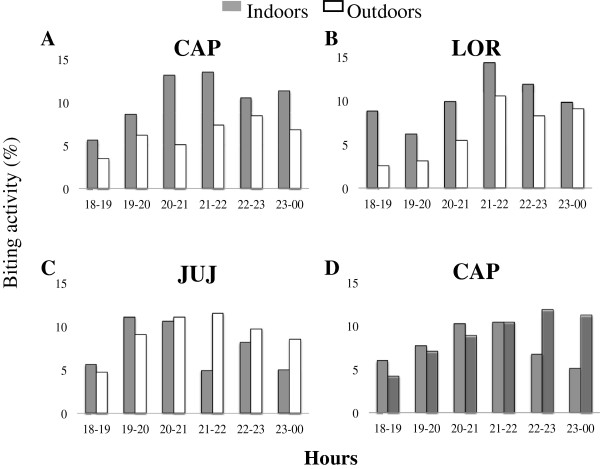
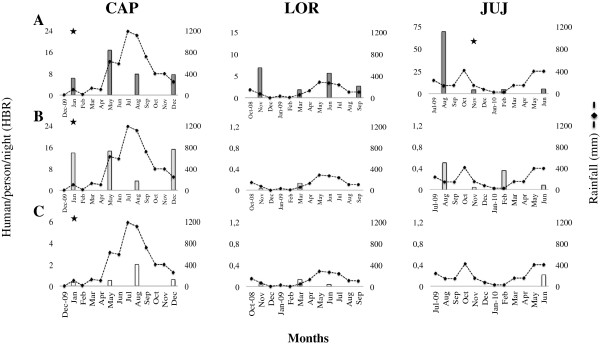
We conducted a longitudinal survey between November 2008 and June 2010 to quantify entomological (abundance and biting activity) and transmission parameters, including infection rate (IR) and entomological inoculation rate (EIR), to incriminate potential anopheline vectors in three localities of a major Colombian malaria endemic region, the Urabá-Bajo Cauca and Alto Sinú: La Capilla, Juan Jose and El Loro.
A total of 5,316 anopheline mosquitoes corresponding to seven species were collected. Anopheles nuneztovari (69.5%) and Anopheles darlingi (22.2%) were the most abundant species, followed by Anopheles pseudopunctipennis (4.5%), Anopheles albitarsis s.l. (2%), Anopheles triannulatus lineage Northwest (1.8%), Anopheles punctimacula and Anopheles argyritarsis (at < 1%, each). Three species were naturally infected with Plasmodium vivax, An. nuneztovari, An. darlingi (IRs < 1%) and An. triannulatus (IR = 1.5%). Annual EIRs for these species ranged from 3.5 to 4.8 infective bites per year.
These results indicate that An. nuneztovari and An. darlingi continue to be the most important malaria vectors in this region. Anopheles triannulatus, a species of local importance in other South American countries was found naturally infected with Plasmodium vivax VK247; therefore, further work should be directed to understand if this species has a role in malaria transmission in this region.
在哥伦比亚的几年中,乌拉瓦-下考卡和上辛努地区的疟疾病例数一直位居全国首位。疟疾病媒的罪责认定和昆虫学参数的特征描述将有助于更好地了解疟疾传播动态,并为该地区设计有效的病媒控制策略。
我们于 2008 年 11 月至 2010 年 6 月期间进行了一项纵向调查,以量化昆虫学(丰度和叮咬活性)和传播参数,包括感染率(IR)和昆虫学接种率(EIR),以确定三个主要哥伦比亚疟疾流行地区的潜在按蚊病媒,乌拉瓦-下考卡和上辛努:拉卡皮拉、胡安何塞和埃洛罗。
共收集了 5316 只属于七个物种的按蚊。最丰富的物种是努涅兹氏按蚊(69.5%)和致倦库蚊(22.2%),其次是伪尖音按蚊(4.5%)、白足按蚊复合体(2%)、三带喙库蚊西北谱系(1.8%)、 punctimacula 按蚊和阿氏按蚊(各占<1%)。三种自然感染了间日疟原虫,分别为努涅兹氏按蚊、致倦库蚊(IR<1%)和三带喙库蚊(IR=1.5%)。这些物种的年 EIR 为每年 3.5 至 4.8 次感染性叮咬。
这些结果表明,努涅兹氏按蚊和致倦库蚊仍然是该地区最重要的疟疾传播媒介。三带喙库蚊是其他南美国家具有局部重要性的物种,被发现自然感染间日疟原虫 VK247;因此,应进一步努力了解该物种在该地区疟疾传播中的作用。