Institute for Therapy and Health Research (IFT-Nord) and the Institute for Medical Psychology and Medical Sociology, University Hospital Schleswig-Holstein, Kiel, Germany.
Geisel School of Medicine at Dartmouth, Lebanon, New Hampshire.
Am J Prev Med. 2013 Apr;44(4):339-344. doi: 10.1016/j.amepre.2012.11.037.
Longitudinal studies from the U.S. suggest a causal relationship between exposure to images of smoking in movies and adolescent smoking onset.
This study investigates whether adolescent smoking onset is predicted by the amount of exposure to smoking in movies across six European countries with various cultural and regulatory approaches to tobacco.
Longitudinal survey of 9987 adolescent never-smokers recruited in the years 2009-2010 (mean age=13.2 years) in 112 state-funded schools from Germany, Iceland, Italy, The Netherlands, Poland, and the United Kingdom (UK), and followed up in 2011. Exposure to movie smoking was estimated from 250 top-grossing movies in each country. Multilevel mixed-effects Poisson regressions were performed in 2012 to assess the relationship between exposure at baseline and smoking status at follow-up.
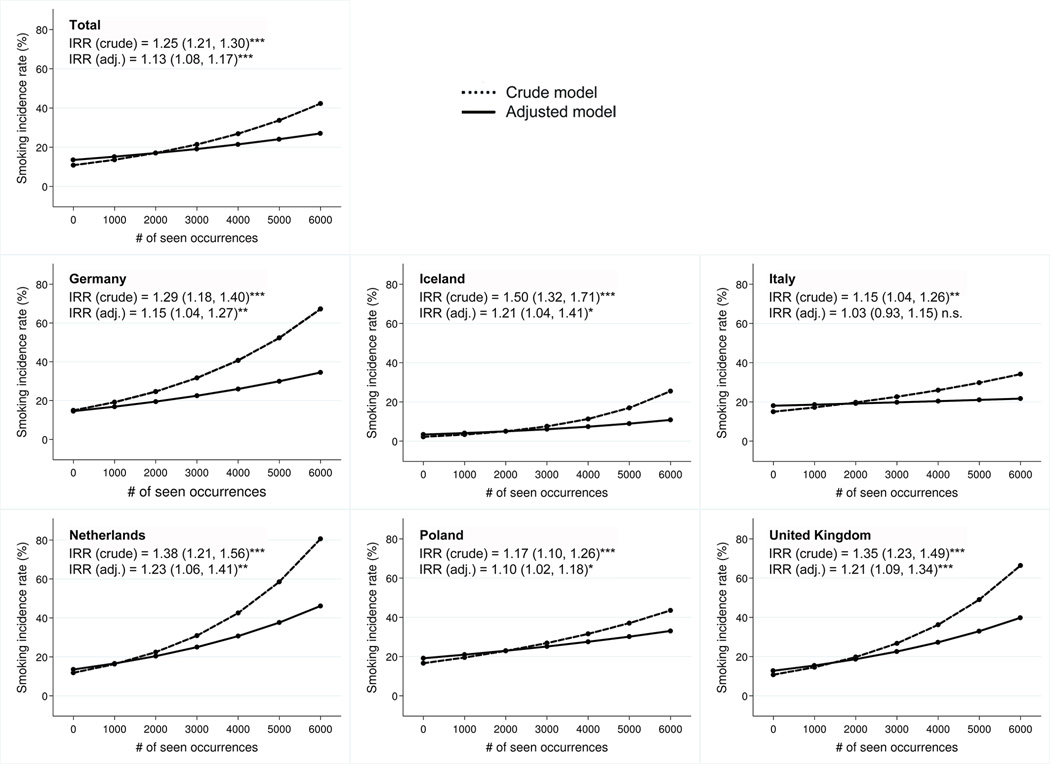
During the observation period (M=12 months), 17% of the sample initiated smoking. The estimated mean exposure to on-screen tobacco was 1560 occurrences. Overall, and after controlling for age; gender; family affluence; school performance; TV screen time; personality characteristics; and smoking status of peers, parents, and siblings, exposure to each additional 1000 tobacco occurrences increased the adjusted relative risk for smoking onset by 13% (95% CI=8%, 17%, p<0.001). The crude relationship between movie smoking exposure and smoking initiation was significant in all countries; after covariate adjustment, the relationship remained significant in Germany, Iceland, The Netherlands, Poland, and UK.
Seeing smoking in movies is a predictor of smoking onset in various cultural contexts. The results confirm that limiting young people's exposure to movie smoking might be an effective way to decrease adolescent smoking onset.
美国的纵向研究表明,在电影中接触吸烟图像与青少年开始吸烟之间存在因果关系。
本研究调查了在德国、冰岛、意大利、荷兰、波兰和英国(英国)的 112 所政府资助的学校中,从未吸烟的 9987 名青少年中,通过 6 个具有不同文化和烟草监管方式的欧洲国家的各种文化和监管方式,是否可以通过电影中吸烟的暴露量来预测青少年吸烟的开始。
2009 年至 2010 年期间,对从未吸烟的 9987 名青少年进行了纵向调查(平均年龄= 13.2 岁),并在德国、冰岛、意大利、荷兰、波兰和英国(英国)的 112 所政府资助的学校中进行了随访。从每个国家的 250 部最卖座电影中估算出电影吸烟的暴露量。 2012 年进行了多层次混合效应泊松回归分析,以评估基线时的暴露与随访时的吸烟状况之间的关系。
在观察期(M= 12 个月)内,该样本中有 17%的人开始吸烟。估计的屏幕上烟草总暴露量为 1560 次。总体而言,在控制了年龄;性别;家庭富裕程度;学校表现;电视屏幕时间;个性特征;以及同伴,父母和兄弟姐妹的吸烟状况后,每增加 1000 次烟草暴露,调整后的相对风险就会增加 13%(95%CI= 8%,17%,p <0.001)。在所有国家中,电影吸烟暴露与吸烟开始之间的粗略关系均具有统计学意义;在调整了协变量后,这种关系在德国,冰岛,荷兰,波兰和英国仍然具有统计学意义。
在各种文化背景下,观看电影中的吸烟是吸烟开始的预测指标。结果证实,限制年轻人对电影吸烟的接触可能是减少青少年吸烟开始的有效方法。