
高效扩散分子保留肿瘤靶向。
High efficiency diffusion molecular retention tumor targeting.
机构信息
Department of Radiology, Center for Translational Nuclear Medicine and Molecular Imaging, Massachusetts General Hospital, Charlestown, Massachusetts, United States of America.
出版信息
PLoS One. 2013;8(3):e58290. doi: 10.1371/journal.pone.0058290. Epub 2013 Mar 11.
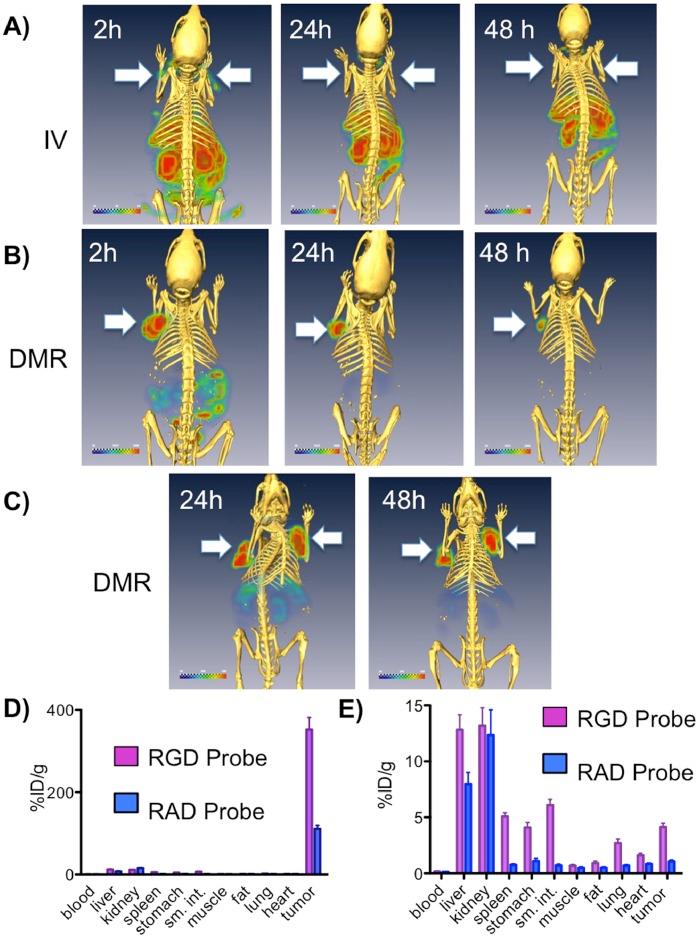
Here we introduce diffusion molecular retention (DMR) tumor targeting, a technique that employs PEG-fluorochrome shielded probes that, after a peritumoral (PT) injection, undergo slow vascular uptake and extensive interstitial diffusion, with tumor retention only through integrin molecular recognition. To demonstrate DMR, RGD (integrin binding) and RAD (control) probes were synthesized bearing DOTA (for (111) In(3+)), a NIR fluorochrome, and 5 kDa PEG that endows probes with a protein-like volume of 25 kDa and decreases non-specific interactions. With a GFP-BT-20 breast carcinoma model, tumor targeting by the DMR or i.v. methods was assessed by surface fluorescence, biodistribution of [(111)In] RGD and [(111)In] RAD probes, and whole animal SPECT. After a PT injection, both probes rapidly diffused through the normal and tumor interstitium, with retention of the RGD probe due to integrin interactions. With PT injection and the [(111)In] RGD probe, SPECT indicated a highly tumor specific uptake at 24 h post injection, with 352%ID/g tumor obtained by DMR (vs 4.14%ID/g by i.v.). The high efficiency molecular targeting of DMR employed low probe doses (e.g. 25 ng as RGD peptide), which minimizes toxicity risks and facilitates clinical translation. DMR applications include the delivery of fluorochromes for intraoperative tumor margin delineation, the delivery of radioisotopes (e.g. toxic, short range alpha emitters) for radiotherapy, or the delivery of photosensitizers to tumors accessible to light.
在这里,我们介绍扩散分子保留(DMR)肿瘤靶向技术,该技术采用 PEG-荧光素屏蔽探针,在肿瘤周围(PT)注射后,探针经历缓慢的血管摄取和广泛的间质扩散,只有通过整合素分子识别才能保留在肿瘤中。为了证明 DMR,我们合成了带有 DOTA(用于 (111)In(3+))、近红外荧光团和 5 kDa PEG 的 RGD(整合素结合)和 RAD(对照)探针,PEG 赋予探针类似于 25 kDa 蛋白质的体积,并减少非特异性相互作用。使用 GFP-BT-20 乳腺癌模型,通过表面荧光、[(111)In]RGD 和 [(111)In]RAD 探针的生物分布以及整个动物 SPECT 评估 DMR 或静脉内方法的肿瘤靶向。PT 注射后,两种探针迅速扩散到正常和肿瘤间质中,由于整合素相互作用,RGD 探针保留下来。PT 注射和 [(111)In]RGD 探针后,SPECT 在注射后 24 小时指示出高度肿瘤特异性摄取,通过 DMR 获得 352%ID/g 肿瘤(静脉内为 4.14%ID/g)。DMR 采用低探针剂量(例如 RGD 肽 25 ng)实现高效分子靶向,最大限度地降低了毒性风险并促进了临床转化。DMR 的应用包括递送至用于术中肿瘤边界描绘的荧光团、递送至用于放射治疗的放射性同位素(例如有毒、短程α发射体)、或递送至可接受光的肿瘤的光敏剂。


 Zotero 插件