Ali Omar A, Doherty Edward, Mooney David J, Emerich Dwaine
School of Engineering and Applied Sciences, Harvard University, Cambridge, MA, USA.
Biomatter. 2011 Jul-Sep;1(1):66-75. doi: 10.4161/biom.1.1.16277.
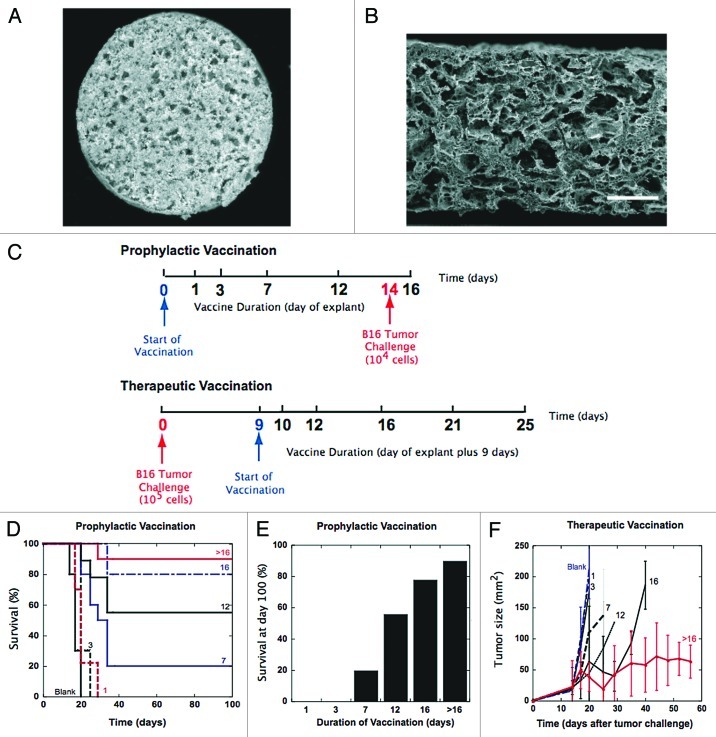
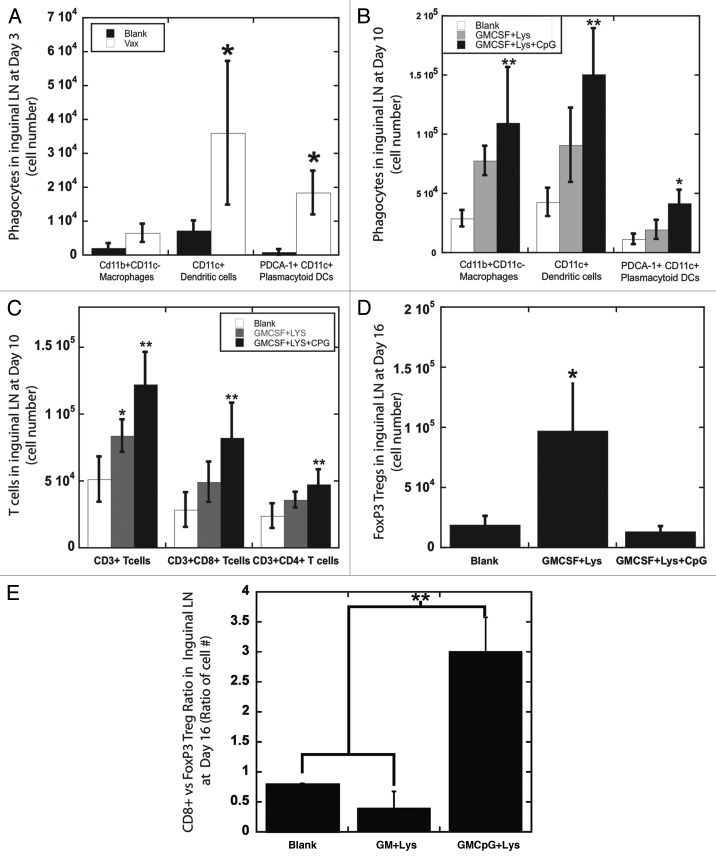
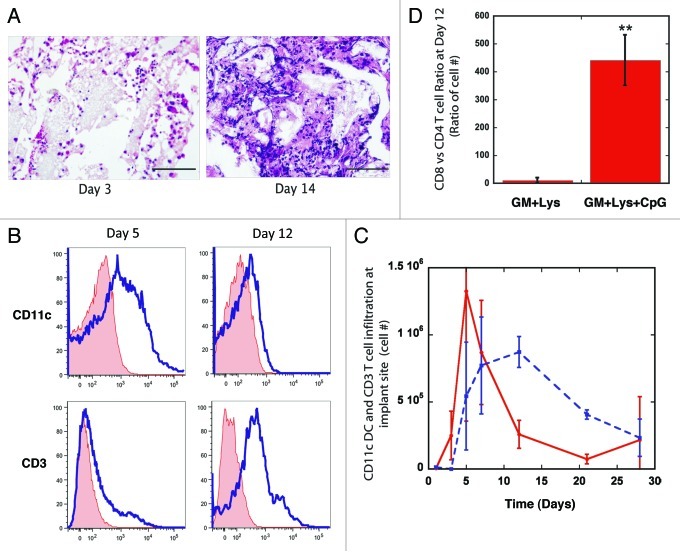
Cancer vaccines are typically formulated for bolus injection and often produce short-lived immunostimulation resulting in poor temporal control over immune cell activation and weak oncolytic activity. One means of overcoming these limitations utilizes immunologically active biomaterial constructs. We previously reported that antigen-laden, macroporous PLG scaffolds induce potent dendritic cell (DC) and cytotoxic T-lymphocyte (CTL) responses via the controlled signaling of inflammatory cytokines, antigen and toll-like receptor agonists. In this study, we describe the kinetics of these responses and illustrate their fundamental relationship to potent tumor rejection when implanted subcutaneously in a mouse B16 model of melanoma. By explanting scaffolds from mice at times ranging from 1-7 d, a seamless relationship was observed between the production of controlled CTL responses, tumor growth and long-term survival in both prophylactic and therapeutic models. Scaffolds must be implanted for > 7 d to augment CTL responses via the prolonged presentation of tumor antigen, and the benefits included a notable regression of established tumors. Host DC infiltration into the porous material persisted for 12 days (peaking at day 5 1.4 x 10(6) cells), and a sharp attenuation in DC numbers coincided with peak CD8(+) CTL infiltration at day 12 (8 x 10(5) cells). Importantly, these PLG systems enhanced DC numbers in the draining lymph node, resulting in increased CD(+) CTL subsets at days 10-16 of vaccination. These results indicate that material systems can finely control innate and adaptive immune cell responses to kill typically untreatable melanoma tumors and provide critical kinetic data for the design of vaccine carriers.
癌症疫苗通常设计用于推注给药,且往往产生短暂的免疫刺激,导致对免疫细胞激活的时间控制不佳,溶瘤活性较弱。克服这些局限性的一种方法是利用具有免疫活性的生物材料构建体。我们之前报道过,负载抗原的大孔聚乳酸-羟基乙酸共聚物(PLG)支架通过炎症细胞因子、抗原和 Toll 样受体激动剂的可控信号传导诱导强大的树突状细胞(DC)和细胞毒性 T 淋巴细胞(CTL)反应。在本研究中,我们描述了这些反应的动力学,并说明了将其皮下植入小鼠黑色素瘤 B16 模型时,它们与有效的肿瘤排斥之间的基本关系。通过在 1 - 7 天的不同时间从小鼠体内取出支架,在预防和治疗模型中均观察到可控的 CTL 反应产生、肿瘤生长和长期存活之间存在无缝关联。支架必须植入超过 7 天,以通过延长肿瘤抗原的呈递来增强 CTL 反应,其益处包括使已形成的肿瘤显著消退。宿主 DC 浸润到多孔材料中持续了 12 天(在第 5 天达到峰值,约 1.4×10⁶ 个细胞),DC 数量的急剧减少与第 12 天 CD8⁺ CTL 浸润的峰值(约 8×10⁵ 个细胞)同时出现。重要的是,这些 PLG 系统增加了引流淋巴结中的 DC 数量,导致在接种疫苗后的第 10 - 16 天 CD⁺ CTL 亚群增加。这些结果表明,材料系统可以精确控制先天性和适应性免疫细胞反应,以杀死通常难以治疗的黑色素瘤肿瘤,并为疫苗载体的设计提供关键的动力学数据。