Rossa Fabio Della, Dercole Fabio, Piccardi Carlo
Politecnico di Milano, DEIB-Department of Electronics, Information and Bioengineering, I-20133 Milano, Italy.
Sci Rep. 2013;3:1467. doi: 10.1038/srep01467.
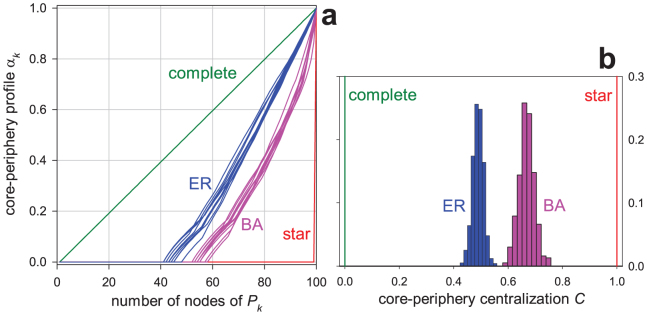
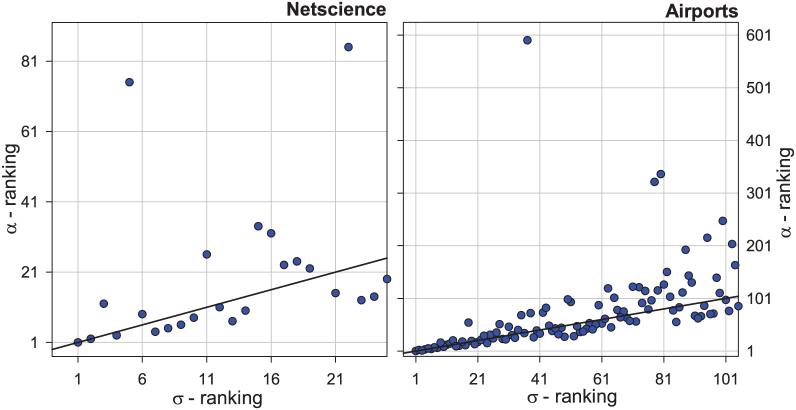
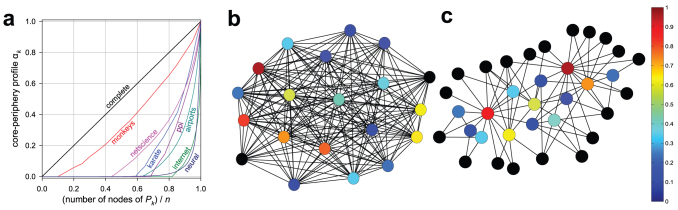
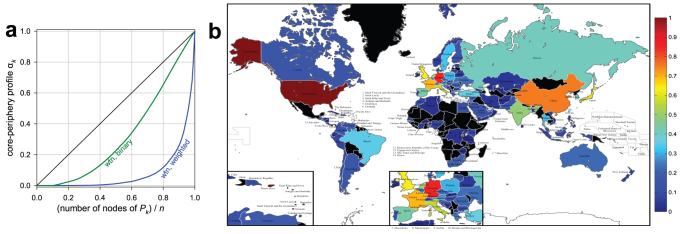
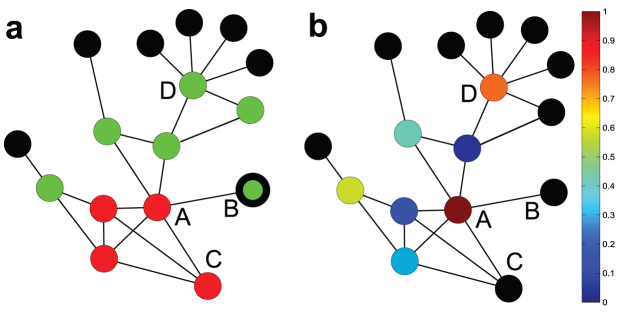
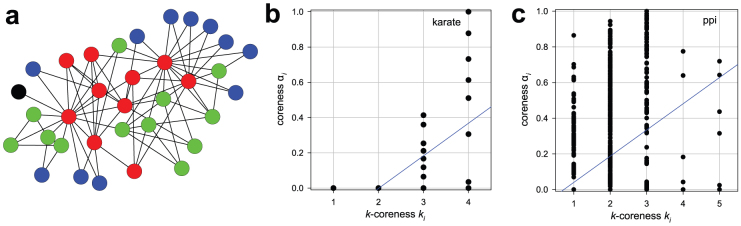
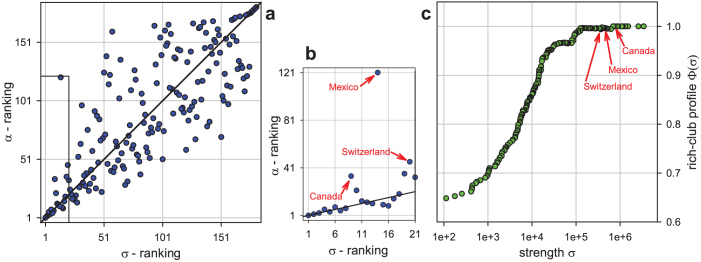
Disclosing the main features of the structure of a network is crucial to understand a number of static and dynamic properties, such as robustness to failures, spreading dynamics, or collective behaviours. Among the possible characterizations, the core-periphery paradigm models the network as the union of a dense core with a sparsely connected periphery, highlighting the role of each node on the basis of its topological position. Here we show that the core-periphery structure can effectively be profiled by elaborating the behaviour of a random walker. A curve--the core-periphery profile--and a numerical indicator are derived, providing a global topological portrait. Simultaneously, a coreness value is attributed to each node, qualifying its position and role. The application to social, technological, economical, and biological networks reveals the power of this technique in disclosing the overall network structure and the peculiar role of some specific nodes.
揭示网络结构的主要特征对于理解许多静态和动态特性至关重要,例如对故障的鲁棒性、传播动态或集体行为。在可能的特征描述中,核心-外围范式将网络建模为一个密集核心与一个稀疏连接的外围的并集,根据每个节点的拓扑位置突出其作用。在这里,我们表明,通过详细研究随机游走者的行为,可以有效地描绘核心-外围结构。我们推导了一条曲线——核心-外围轮廓——和一个数值指标,提供了一个全局拓扑画像。同时,为每个节点赋予一个核心度值,以确定其位置和作用。将其应用于社会、技术、经济和生物网络,揭示了该技术在揭示整体网络结构和某些特定节点的特殊作用方面的强大力量。