The Research Institute of the McGill University Health Centre, Montreal Children's Hospital, McGill University Montreal, QC, Canada.
Front Pharmacol. 2013 Mar 6;4:21. doi: 10.3389/fphar.2013.00021. eCollection 2013.
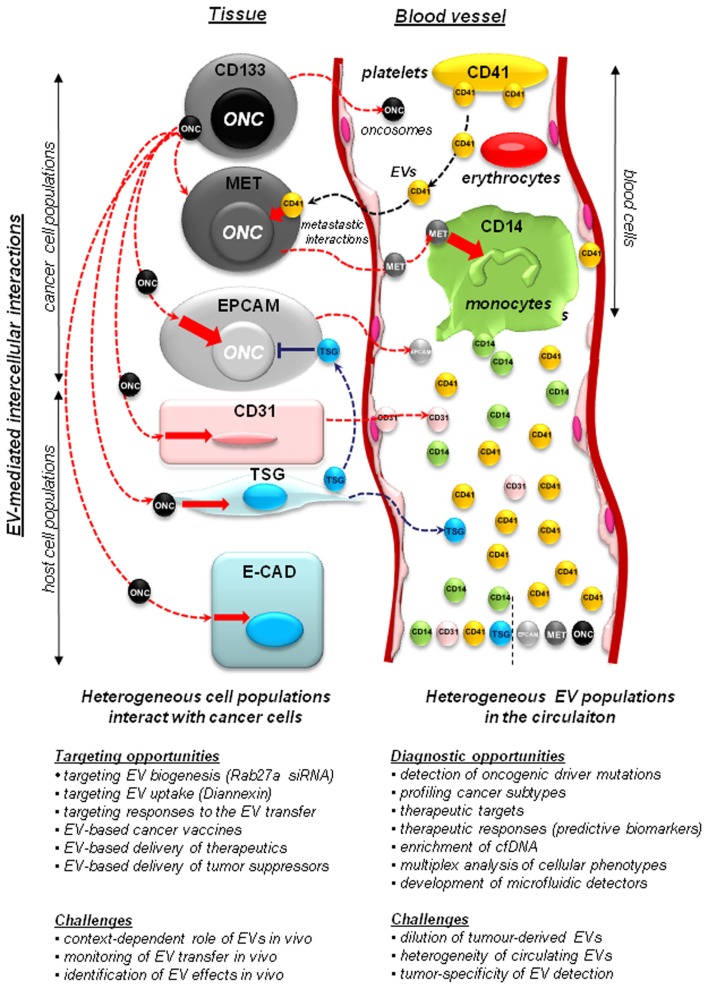
In multicellular organisms both health and disease are defined by patterns of communication between the constituent cells. In addition to networks of soluble mediators, cells are also programed to exchange complex messages pre-assembled as multimolecular cargo of membraneous structures known extracellular vesicles (EV). Several biogenetic pathways produce EVs with different properties, and known as exosomes, ectosomes, and apoptotic bodies. In cancer, EVs carry molecular signatures and effectors of the disease, such as mutant oncoproteins, oncogenic transcripts, microRNA, and DNA sequences. Intercellular trafficking of such EVs (oncosomes) may contribute to horizontal cellular transformation, phenotypic reprograming, and functional re-education of recipient cells, both locally and systemically. The EV-mediated, reciprocal molecular exchange also includes tumor suppressors, phosphoproteins, proteases, growth factors, and bioactive lipids, all of which participate in the functional integration of multiple cells and their collective involvement in tumor angiogenesis, inflammation, immunity, coagulopathy, mobilization of bone marrow-derived effectors, metastasis, drug resistance, or cellular stemness. In cases where the EV role is rate limiting their production and uptake may represent and unexplored anticancer therapy target. Moreover, oncosomes circulating in biofluids of cancer patients offer an unprecedented, remote, and non-invasive access to crucial molecular information about cancer cells, including their driver mutations, classifiers, molecular subtypes, therapeutic targets, and biomarkers of drug resistance. New nanotechnologies are being developed to exploit this unique biomarker platform. Indeed, embracing the notion that human cancers are defined not only by processes occurring within cancer cells, but also between them, and amidst the altered tumor and systemic microenvironment may open new diagnostic and therapeutic opportunities.
在多细胞生物中,健康和疾病都是由组成细胞之间的通讯模式定义的。除了可溶性介质网络外,细胞还被编程为交换预先组装为膜结构多分子货物的复杂信息,这些膜结构称为细胞外囊泡 (EV)。几种生物发生途径产生具有不同特性的 EV,并被称为外泌体、ectosomes 和凋亡小体。在癌症中,EV 携带疾病的分子特征和效应物,如突变癌蛋白、致癌转录本、microRNA 和 DNA 序列。这种 EV(oncosomes)的细胞间运输可能有助于局部和系统性的水平细胞转化、表型重编程和受体细胞的功能再教育。EV 介导的互惠分子交换还包括肿瘤抑制因子、磷酸蛋白、蛋白酶、生长因子和生物活性脂质,所有这些都参与了多个细胞的功能整合及其在肿瘤血管生成、炎症、免疫、凝血障碍、骨髓衍生效应物动员、转移、耐药性或细胞干性方面的集体参与。在 EV 作用是限速的情况下,其产生和摄取可能代表着未被探索的抗癌治疗靶点。此外,循环于癌症患者生物体液中的 oncosomes 提供了一种前所未有的、远程的、非侵入性的方法,可以获得有关癌细胞的关键分子信息,包括其驱动突变、分类器、分子亚型、治疗靶点和耐药性生物标志物。正在开发新的纳米技术来利用这种独特的生物标志物平台。事实上,接受这样一种观点,即人类癌症不仅由发生在癌细胞内的过程定义,而且还由它们之间以及在改变的肿瘤和全身微环境中定义,这可能会开辟新的诊断和治疗机会。