Sabermahani Asma, Barouni Mohsen, Seyedin Hesam, Aryankhesal Aidin
Dept. of Health Economics, School of Health Management and Information Sciences, Tehran University of Medical Sciences, Tehran, Iran.
Iran J Public Health. 2013;42(2):149-57. Epub 2013 Feb 1.
Human Development Index (HDI) is a composite indicator that can show the impact of economic strategies on human life standards. The index is calculated by three main factors of income, education and health. This research studies the status of HDI across the Iranian provinces, its changes over time and the efficiency of provinces in using resources.
The data for 2001 and 2009 was obtained from the Iranian Center of Statistics. Data envelopment analysis technique was used to analyze the data. To calculate the efficiency, Banker, Charnes and Cooper's model was used.
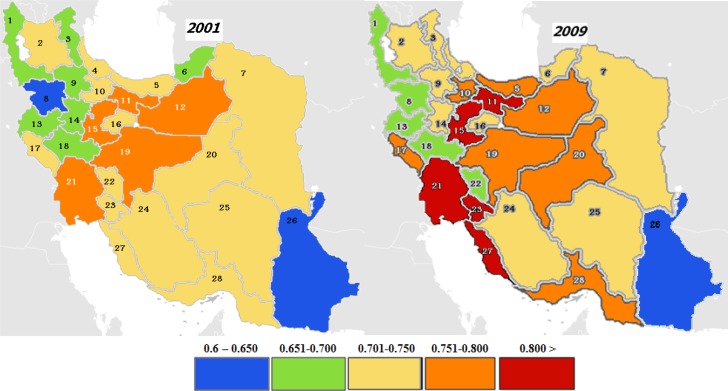
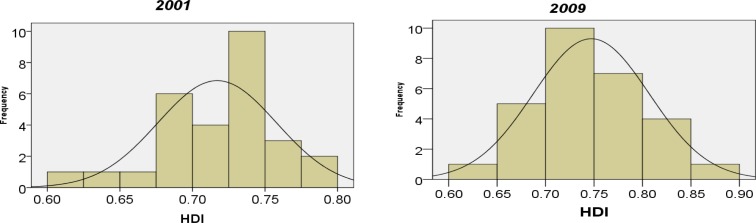
The national mean for the HDI in 2001 was 0.717 while it grew to 0.747 in 2009. Except for one province, all others had an improved human development index. Low ranked provinces such as Sistan & Baluchistan and Kurdistan stayed at the bottom in 2009 as well. Some provinces such as Bushehr with developing oil industries, or those purposively benefited from national oil income showed good growth. In some provinces, such as Hormozgan, out-migration of manpower to its neighboring province, Bushehr, was associated with decrease of the provincial income level. The number of efficient provinces increased from 5 to 13 in 2009.
Iran falls among countries with high human development index based on the 2009 data. However, the distribution of HDI status across provinces was highly varied and the difference between high- and low-developed provinces increased in 2009. The government needs to revise policies concerning distribution of resources among the provinces.
人类发展指数(HDI)是一项综合指标,能够显示经济战略对人类生活水平的影响。该指数由收入、教育和健康这三个主要因素计算得出。本研究考察了伊朗各省的人类发展指数状况、其随时间的变化以及各省在资源利用方面的效率。
2001年和2009年的数据来自伊朗统计中心。采用数据包络分析技术对数据进行分析。为计算效率,使用了班克、查恩斯和库珀模型。
2001年全国人类发展指数平均值为0.717,而在2009年增长至0.747。除一个省份外,其他所有省份的人类发展指数均有所提高。排名靠后的省份,如锡斯坦-俾路支斯坦省和库尔德斯坦省在2009年也仍处于垫底位置。一些拥有发展中的石油产业的省份,如布什尔省,或那些有意从国家石油收入中受益的省份,实现了良好增长。在一些省份,如霍尔木兹甘省,人力外流至其邻省布什尔省与该省收入水平下降有关。2009年,高效省份的数量从5个增加到了13个。
根据2009年的数据,伊朗属于人类发展指数较高的国家。然而,各省人类发展指数状况的分布差异很大,2009年高发展水平省份和低发展水平省份之间的差距有所扩大。政府需要修订有关各省资源分配的政策。