Department of Health Informatics, School of Public Health, Kyoto University, Kyoto, Japan.
PLoS One. 2013;8(3):e57371. doi: 10.1371/journal.pone.0057371. Epub 2013 Mar 13.
Although qualitative studies are becoming more appreciated in healthcare, the number of publications of quality studies remains low. Little is known about the frequency and characteristics of citation in qualitative studies.
To compare the academic impact of qualitative studies to that of two quantitative studies: systematic reviews and randomized controlled trials.
Publications in BMJ between 1997 and 2006 (BMJ's median impact factor was 7.04 during this period) employing qualitative methods were matched to two quantitative studies appearing the same year using PubMed. Using Web of Science, citations within a 24-month publication period were determined. Additionally, three hypotheses were examined: qualitative studies are 1) infrequently cited in original articles or reviews; 2) rarely cited by authors in non-English-speaking countries; and 3) more frequently cited in non-medical disciplines (e.g., psychology or sociology).
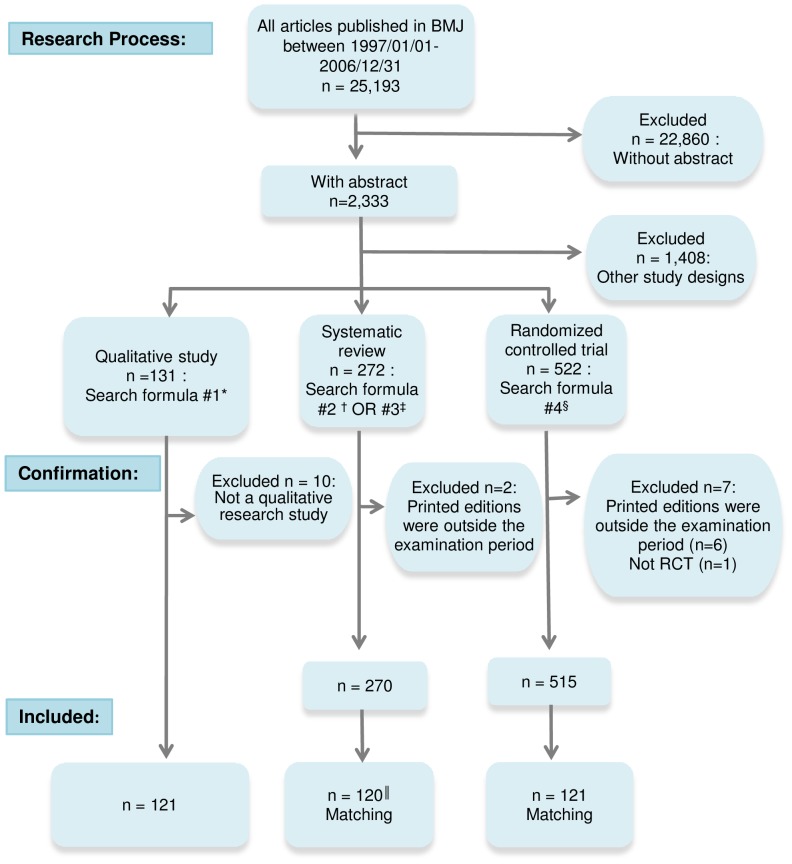
A total of 121 qualitative studies, 270 systematic reviews, and 515 randomised controlled trials were retrieved. Qualitative studies were cited a total of 1,089 times, with a median of 7.00 times (range, 0-34) for each study. Matched systematic reviews and randomized controlled trials were cited 2,411 times and 1,600 times, respectively. With respect to citing documents, original articles and reviews exceeded 60% for each study design. Relative to quantitative studies, qualitative studies were cited more often by authors in English-speaking countries. With respect to subject area, medical disciplines were more frequently cited than non-medical disciplines for all three study designs (>80%).
The median number of citations for qualitative studies was almost the same as the median of BMJ's impact factor during the survey period. For a suitable evaluation of qualitative studies in healthcare, it will be necessary to develop a reporting framework and include explicit discussions of clinical implications when reporting findings. Coordination between researchers and editors will be needed to achieve this goal.
尽管定性研究在医疗保健领域越来越受到重视,但高质量研究的出版物数量仍然很低。关于定性研究的引用频率和特征知之甚少。
比较定性研究与两种定量研究(系统评价和随机对照试验)的学术影响力。
在 1997 年至 2006 年间,通过 PubMed 与同年发表的两种定量研究进行匹配,从《英国医学杂志》(BMJ)中提取使用定性方法的出版物。使用 Web of Science 确定 24 个月出版期内的引文。此外,还检验了三个假设:定性研究 1)在原始文章或综述中引用频率较低;2)在非英语国家的作者中引用频率较低;3)在非医学学科(如心理学或社会学)中引用频率较高。
共检索到 121 篇定性研究、270 篇系统评价和 515 篇随机对照试验。定性研究共被引用 1089 次,中位数为每篇研究 7.00 次(范围,0-34)。匹配的系统评价和随机对照试验分别被引用 2411 次和 1600 次。就引用文献而言,每种研究设计的原始文章和综述都超过了 60%。与定量研究相比,英语国家的作者更倾向于引用定性研究。就学科领域而言,对于所有三种研究设计,医学学科的引用频率都高于非医学学科(>80%)。
定性研究的中位数引文数几乎与调查期间《英国医学杂志》影响因子的中位数相同。为了对医疗保健中的定性研究进行适当的评估,有必要在报告研究结果时制定一个报告框架,并明确讨论临床意义。需要研究人员和编辑之间的协调来实现这一目标。