Diagnostic Imaging Program, Molecular Imaging Center, National Institute of Radiological Sciences, Chiba, Japan.
PLoS One. 2013;8(3):e59248. doi: 10.1371/journal.pone.0059248. Epub 2013 Mar 14.
Small cell lung cancer (SCLC) is an aggressive tumor and prognosis remains poor. Therefore, the development of more effective therapy is needed. We previously reported that high levels of an anti-c-kit antibody (12A8) accumulated in SCLC xenografts. In the present study, we evaluated the efficacy of two antibodies (12A8 and 67A2) for radioimmunotherapy (RIT) of an SCLC mouse model by labeling with the (90)Y isotope.
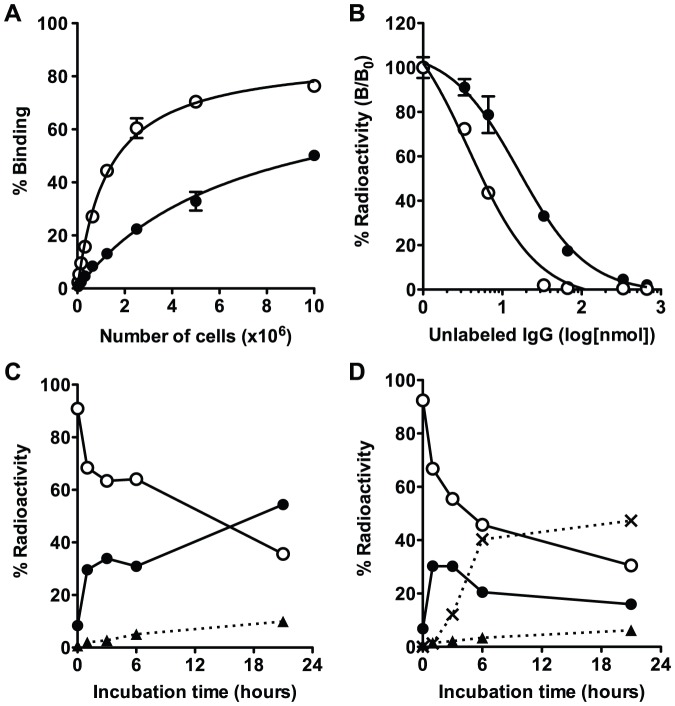
(111)In- or (125)I-labeled antibodies were evaluated in vitro by cell binding, competitive inhibition and cellular internalization assays in c-kit-expressing SY cells and in vivo by biodistribution in SY-bearing mice. Therapeutic efficacy of (90)Y-labeled antibodies was evaluated in SY-bearing mice upto day 28 and histological analysis was conducted at day 7.
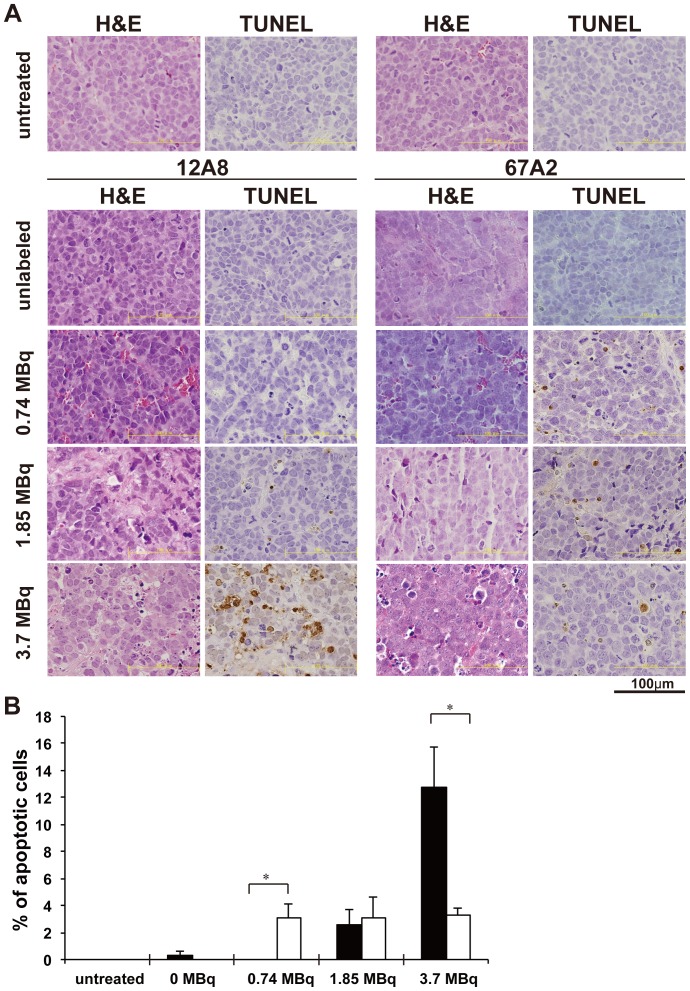
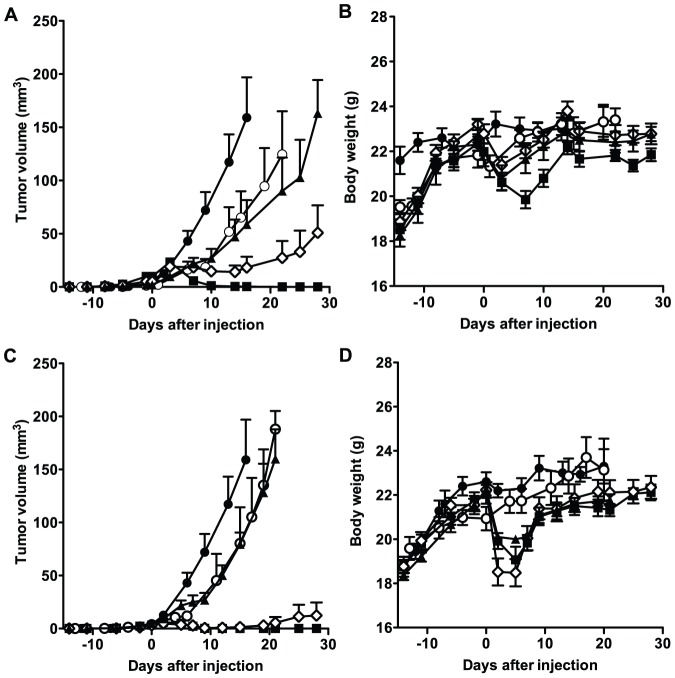
[(111)In]12A8 and [(111)In]67A2 specifically bound to SY cells with high affinity (8.0 and 1.9 nM, respectively). 67A2 was internalized similar to 12A8. High levels of [(111)In]12A8 and [(111)In]67A2 accumulated in tumors, but not in major organs. [(111)In]67A2 uptake by the tumor was 1.7 times higher than for [(111)In]12A8. [(90)Y]12A8, but not [(90)Y]67A2, suppressed tumor growth in a dose-dependent manner. Tumors treated with 3.7 MBq of [(90)Y]12A8, and 1.85 and 3.7 MBq of [(90)Y]67A2 (absorbed doses were 21.0, 18.0 and 35.9 Gy, respectively) almost completely disappeared approximately 2 weeks after injection, and regrowth was not observed except for in one mouse treated with 1.85 MBq [(90)Y]67A2. The area of necrosis and fibrosis increased depending on the RIT effect. Apoptotic cell numbers increased with increased doses of [(90)Y]12A8, whereas no dose-dependent increase was observed following [(90)Y]67A2 treatment. Body weight was temporarily reduced but all mice tolerated the RIT experiments well.
Treatment with [(90)Y]12A8 and [(90)Y]67A2 achieved a complete therapeutic response when SY tumors received an absorbed dose greater than 18 Gy and thus are promising RIT agents for metastatic SCLC cells at distant sites.
本研究旨在通过标记放射性核素 (90)Y,评估两种抗 c-kit 抗体(12A8 和 67A2)用于小细胞肺癌(SCLC)小鼠模型放射免疫治疗(RIT)的疗效。
通过细胞结合、竞争抑制和细胞内化实验,评估了 (111)In-或 (125)I-标记抗体在表达 c-kit 的 SY 细胞中的体外活性,并通过 SY 荷瘤小鼠的体内生物分布进行了评估。在第 28 天评估了 (90)Y-标记抗体的治疗效果,并在第 7 天进行了组织学分析。
[(111)In]12A8 和 [(111)In]67A2 与 SY 细胞具有高亲和力(分别为 8.0 和 1.9 nM)特异性结合。67A2 与 12A8 相似被内化。高浓度的 [(111)In]12A8 和 [(111)In]67A2 积聚在肿瘤中,但不在主要器官中。肿瘤对 [(111)In]67A2 的摄取比 [(111)In]12A8 高 1.7 倍。[(90)Y]12A8 以剂量依赖性方式抑制肿瘤生长,但 [(90)Y]67A2 则不然。接受 3.7 MBq [(90)Y]12A8、1.85 和 3.7 MBq [(90)Y]67A2(吸收剂量分别为 21.0、18.0 和 35.9 Gy)治疗的肿瘤在注射后约 2 周几乎完全消失,除了接受 1.85 MBq [(90)Y]67A2 治疗的一只小鼠外,未观察到肿瘤复发。随着 [(90)Y]12A8 剂量的增加,坏死和纤维化区域增加,而在用 [(90)Y]67A2 治疗时则未观察到剂量依赖性增加。随着 [(90)Y]12A8 剂量的增加,凋亡细胞数量增加,而在用 [(90)Y]67A2 治疗时则没有观察到剂量依赖性增加。体重暂时下降,但所有小鼠均能耐受 RIT 实验。
当 SY 肿瘤接受大于 18 Gy 的吸收剂量时,用 [(90)Y]12A8 和 [(90)Y]67A2 治疗可实现完全治疗反应,因此它们是远处转移 SCLC 细胞有前途的放射免疫治疗剂。