Evolutionary Bioinformatics Laboratory, Department of Crop Sciences, University of Illinois at Urbana-Champaign, Urbana, Illinois, United States of America.
PLoS One. 2013;8(3):e59300. doi: 10.1371/journal.pone.0059300. Epub 2013 Mar 13.
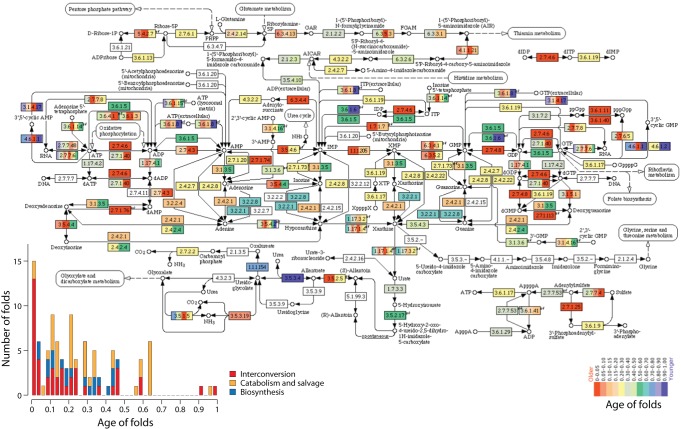
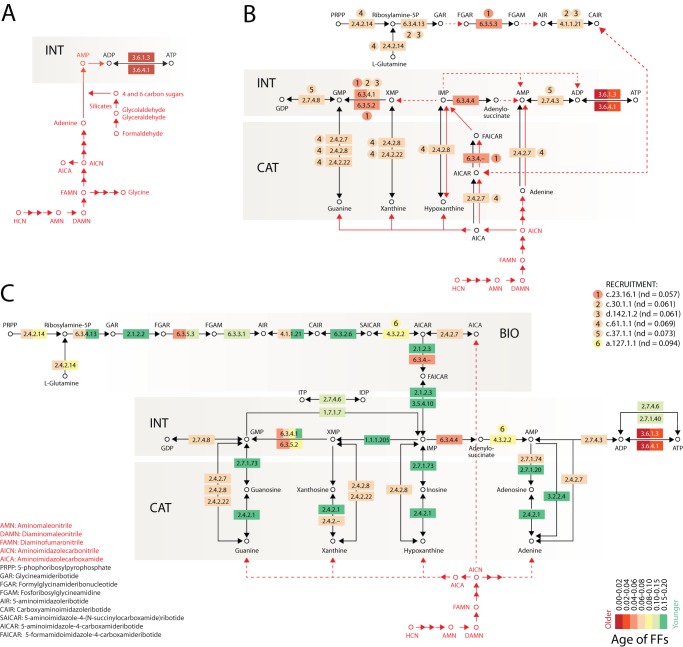
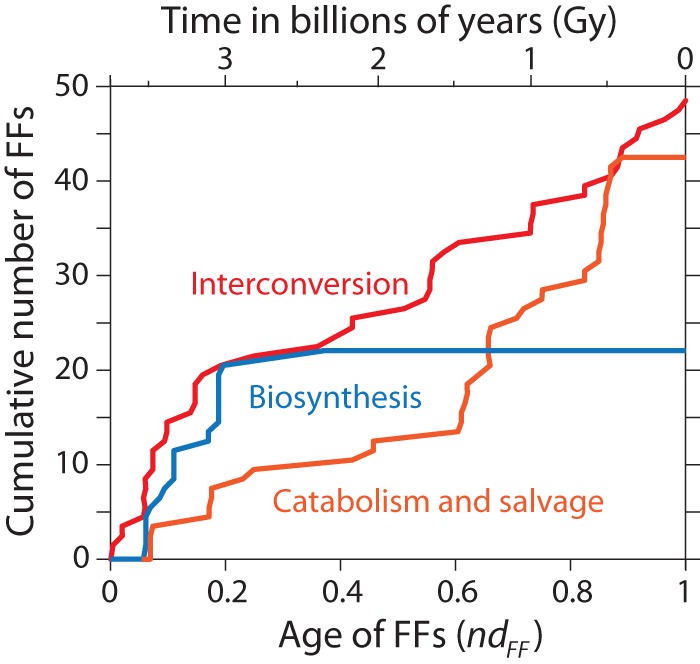
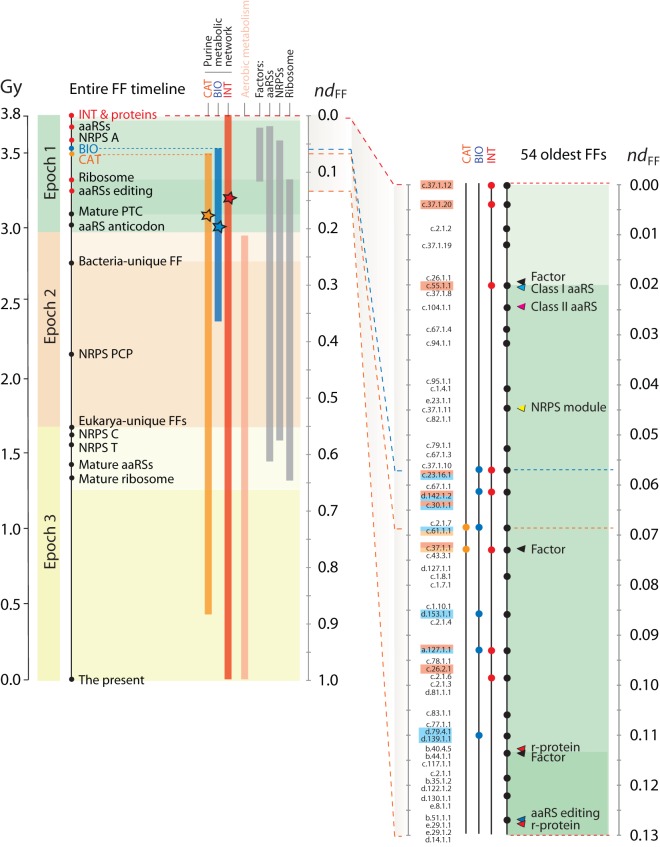
The origin of metabolism has been linked to abiotic chemistries that existed in our planet at the beginning of life. While plausible chemical pathways have been proposed, including the synthesis of nucleobases, ribose and ribonucleotides, the cooption of these reactions by modern enzymes remains shrouded in mystery. Here we study the emergence of purine metabolism. The ages of protein domains derived from a census of fold family structure in hundreds of genomes were mapped onto enzymes in metabolic diagrams. We find that the origin of the nucleotide interconversion pathway benefited most parsimoniously from the prebiotic formation of adenine nucleosides. In turn, pathways of nucleotide biosynthesis, catabolism and salvage originated ∼300 million years later by concerted enzymatic recruitments and gradual replacement of abiotic chemistries. Remarkably, this process led to the emergence of the fully enzymatic biosynthetic pathway ∼3 billion years ago, concurrently with the appearance of a functional ribosome. The simultaneous appearance of purine biosynthesis and the ribosome probably fulfilled the expanding matter-energy and processing needs of genomic information.
代谢的起源与生命之初存在于地球上的非生物化学物质有关。虽然已经提出了包括核碱基、核糖和核糖核苷酸合成在内的合理化学途径,但现代酶对这些反应的选择仍然是个谜。在这里,我们研究嘌呤代谢的出现。从数百个基因组的折叠家族结构普查中得出的蛋白质结构域的年龄被映射到代谢图中的酶上。我们发现核苷酸相互转化途径的起源最有利于前生物腺嘌呤核苷的形成。反过来,核苷酸生物合成、分解代谢和回收途径在大约 3 亿年后通过协同酶募集和逐渐取代非生物化学物质而出现。值得注意的是,这个过程导致了大约 30 亿年前完全酶促生物合成途径的出现,同时出现了功能核糖体。嘌呤合成和核糖体的同时出现可能满足了基因组信息不断扩大的物质-能量和处理需求。