Schizophrenia Research Division, Nathan S. Kline Institute for Psychiatric Research Orangeburg, NY, USA ; Department of Psychiatry, NYU School of Medicine New York, NY, USA ; Department of Psychology, City University of New York New York, NY, USA.
Front Psychol. 2013 Mar 21;4:132. doi: 10.3389/fpsyg.2013.00132. eCollection 2013.
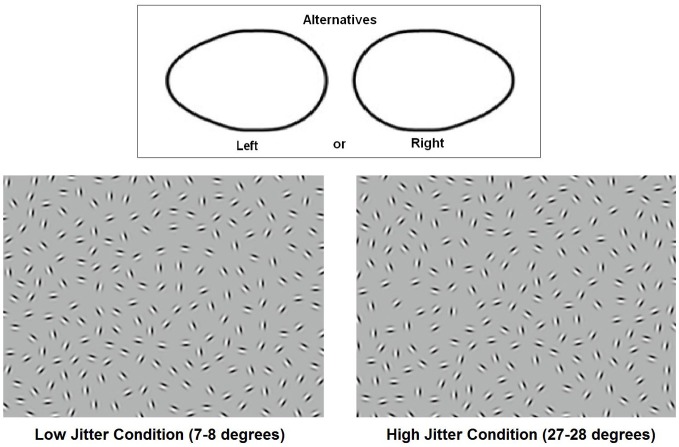
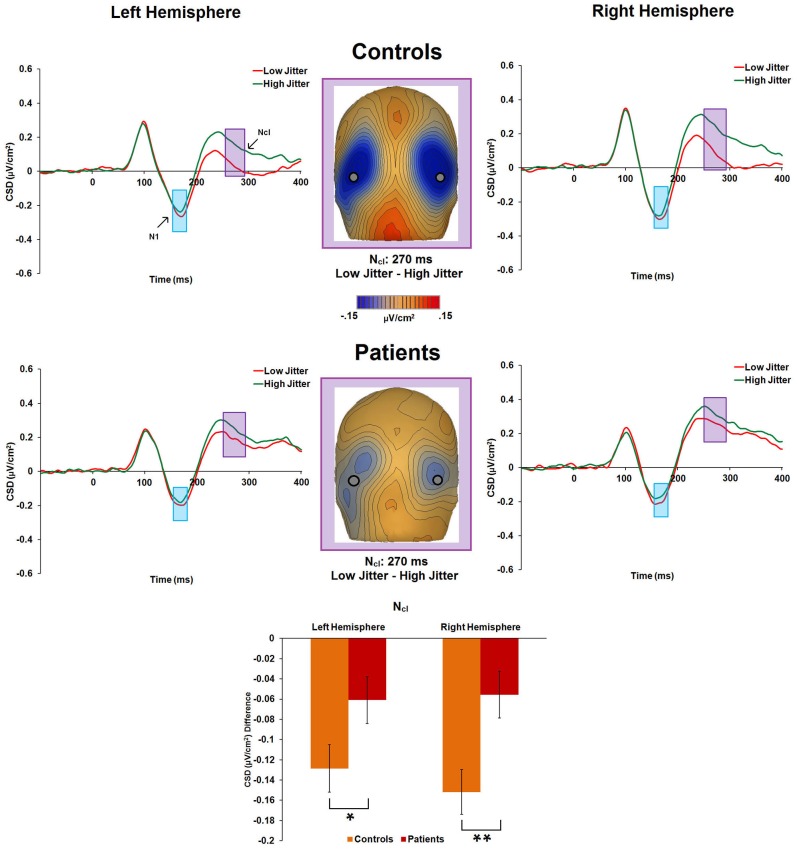
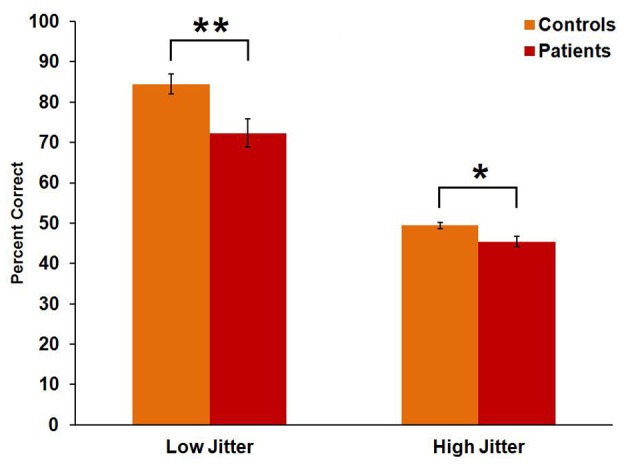
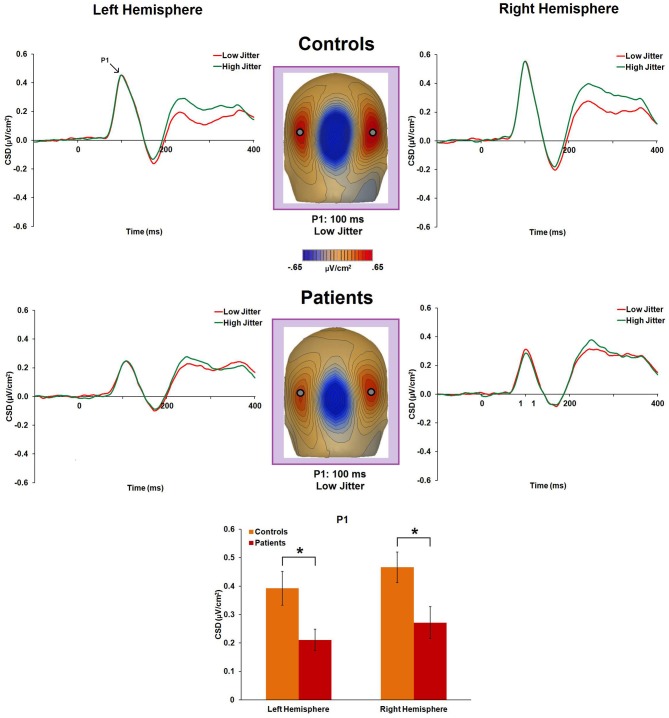
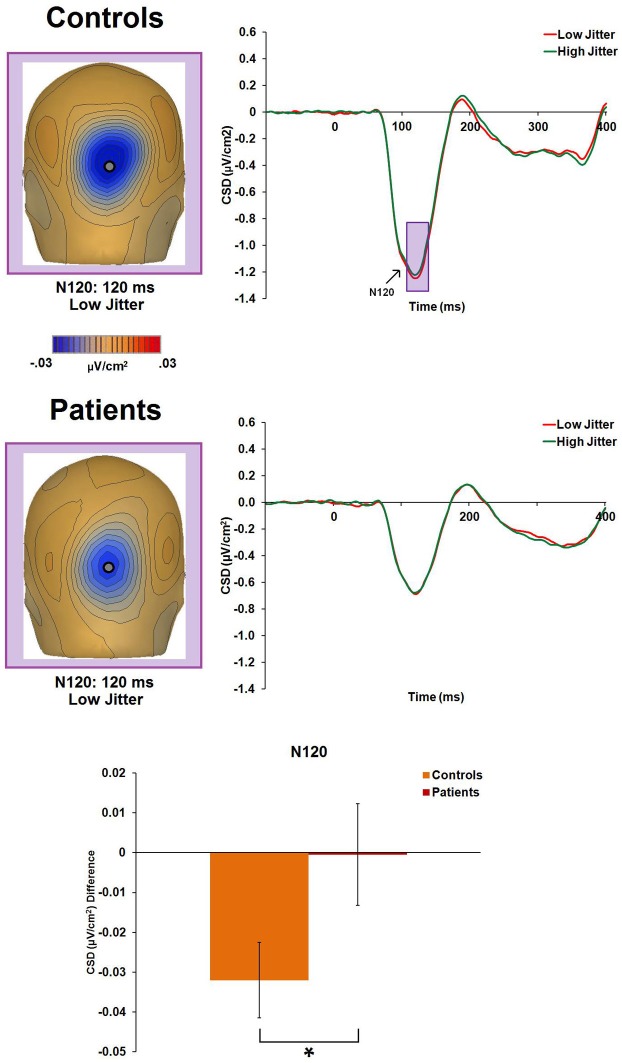
Perceptual organization, which refers to the ability to integrate fragments of stimuli to form a representation of a whole edge, part, or object, is impaired in schizophrenia. A contour integration paradigm, involving detection of a set of Gabor patches forming an oval contour pointing to the right or left embedded in a field of randomly oriented Gabors, has been developed for use in clinical trials of schizophrenia. The purpose of the present study was to assess contributions of early and later stages of processing to deficits in contour integration, as well as to develop an event-related potential (ERP) analog of this task. Twenty-one patients with schizophrenia and 28 controls participated. The Gabor elements forming the contours were given a low or high degree of orientational jitter, making it either easy or difficult to identify the direction in which the contour was pointing. ERP results showed greater negative peaks at ~165 (N1 component) and ~270 ms for the low-jitter versus the high-jitter contours, with a much greater difference between jitter conditions at 270 ms. This later ERP component was previously termed Ncl for closure negativity. Source localization identified the Ncl in the lateral occipital object recognition area. Patients showed a significant decrease in the Ncl, but not N1, compared to controls, and this was associated with impaired behavioral ability to identify contours. In addition, an earlier negative peak was found at ~120 ms (termed N120) that differentiated jitter conditions, had a dorsal stream source, and differed between patients and controls. Patients also showed a deficit in the dorsal stream sensory P1 component. These results are in accord with impairments in distributed circuitry contributing to perceptual organization deficits and provide an ERP analog to the behavioral contour integration task.
知觉组织是指将刺激的碎片整合为一个整体边缘、部分或物体的表示的能力,在精神分裂症中受到损害。一种轮廓整合范式,涉及检测一组形成指向左右的椭圆形轮廓的 Gabor 补丁,这些补丁嵌入在随机定向的 Gabor 场中,已被开发用于精神分裂症的临床试验。本研究的目的是评估早期和晚期处理对轮廓整合缺陷的贡献,并开发该任务的事件相关电位 (ERP) 模拟。21 名精神分裂症患者和 28 名对照者参与了研究。形成轮廓的 Gabor 元素具有低或高的方向抖动程度,使得识别轮廓指向的方向变得容易或困难。ERP 结果表明,低抖动与高抖动轮廓相比,在约 165(N1 成分)和 270 毫秒处出现更大的负峰值,在 270 毫秒时,抖动条件之间的差异更大。这个后来的 ERP 成分以前被称为闭合负性的 Ncl。源定位确定了外侧枕部物体识别区的 Ncl。与对照组相比,患者的 Ncl 显著降低,但 N1 没有降低,这与识别轮廓的行为能力受损有关。此外,在约 120 毫秒处发现了一个较早的负峰值(称为 N120),该峰值区分了抖动条件,具有背流源,并且在患者和对照组之间存在差异。患者还表现出背流感觉 P1 成分的缺陷。这些结果与导致知觉组织缺陷的分布式电路损伤一致,并提供了行为轮廓整合任务的 ERP 模拟。