The Parker Institute, Department of Rheumatology, Copenhagen University Hospital, Frederiksberg, Denmark.
BMC Musculoskelet Disord. 2013 Mar 22;14:106. doi: 10.1186/1471-2474-14-106.
Patients are susceptible for knee osteoarthritis (KOA) with increasing age and obesity and KOA is expected to become a major disabling disease in the future. An important feature of KOA on magnetic resonance imaging (MRI) is changes in the subchondral bone, bone marrow lesions (BMLs), which are related to the future degeneration of the knee joint as well as prevalent clinical symptoms. The aim of this study was to investigate the changes in BMLs after a 16-week weight-loss period in obese subjects with KOA and relate changes in BMLs to the effects of weight-loss on clinical symptoms.
This prospective cohort study included patients with a body mass index ≥ 30 kg/m2, an age ≥ 50 years and primary KOA. Patients underwent a 16 weeks supervised diet program which included formula products and dietetic counselling (ClinicalTrials.gov: NCT00655941). BMLs in tibia and femur were assessed on MRI before and after the weight-loss using the Boston-Leeds Osteoarthritis Knee Score. Response to weight-loss in BML scores was dichotomised to patients experiencing a decrease in BML scores (responders) and patients who did not (non-responders). The association of BMLs to weight-loss was assessed by logistic regressions and correlation analyses.
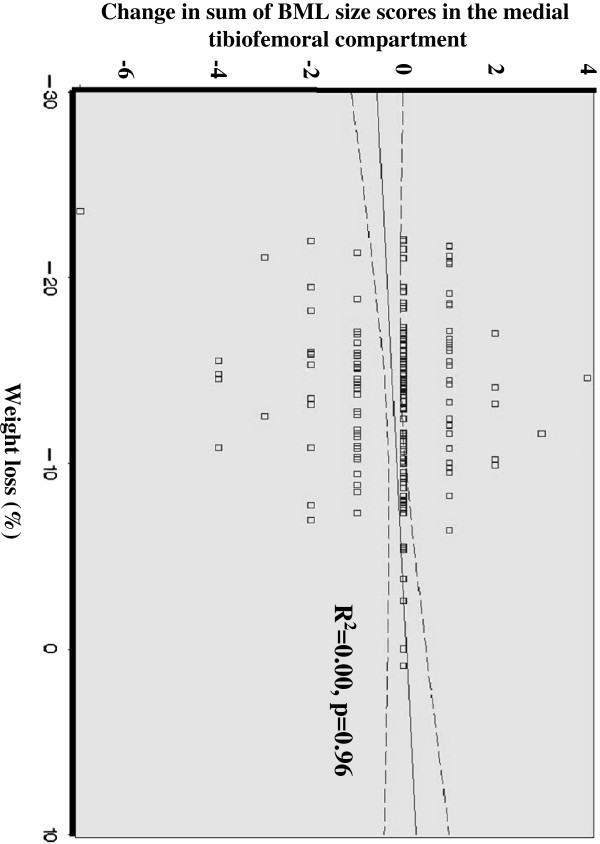
39 patients (23%) were classified as responders in the sum of all BML size scores whereas 130 patients (77%) deteriorated or remained stable and were categorized as non-responders. Logistic regression analyses revealed no association between weight-loss < or ≥ 10% and response in BMLs in the most affected compartment (OR 1.86 [CI 0.66 to 5.26, p=0.24]). There was no association between weight-loss and response in maximum BML score (OR 1.13 [CI 0.39 to 3.28, p=0.81]). The relationship between changes in BMLs and clinical symptoms revealed that an equal proportion of patients classified as BML responders and non-responders experienced an OMERACT-OARSI response (69 vs. 71%, p=0.86).
Weight-loss did not improve the sum of tibiofemoral BML size scores or the maximum tibiofemoral BML score, suggesting that BMLs do not respond to a rapidly decreased body weight. The missing relationship between clinical symptoms and BMLs calls for further investigation.
随着年龄和肥胖的增长,患者易患膝骨关节炎(KOA),预计未来 KOA 将成为主要的致残性疾病。磁共振成像(MRI)上 KOA 的一个重要特征是软骨下骨、骨髓病变(BML)的改变,这与膝关节的未来退变以及普遍存在的临床症状有关。本研究旨在探讨肥胖 KOA 患者在 16 周减肥期后 BML 的变化,并将 BML 的变化与减肥对临床症状的影响联系起来。
这项前瞻性队列研究纳入了 BMI≥30kg/m2、年龄≥50 岁且原发性 KOA 的患者。患者接受了 16 周的监督饮食计划,包括配方产品和饮食咨询(ClinicalTrials.gov:NCT00655941)。使用波士顿-利兹骨关节炎膝关节评分,在减肥前后通过 MRI 评估胫骨和股骨的 BML。BML 评分的减肥反应被分为 BML 评分下降的患者(反应者)和没有下降的患者(非反应者)。通过逻辑回归和相关分析评估 BML 与体重减轻的关系。
39 名患者(23%)在所有 BML 大小评分的总和中被归类为反应者,而 130 名患者(77%)恶化或保持稳定,被归类为非反应者。逻辑回归分析显示,体重减轻≥10%与最受影响部位的 BML 反应之间无关联(OR 1.86[CI 0.66 至 5.26,p=0.24])。体重减轻与最大 BML 评分的反应之间也没有关联(OR 1.13[CI 0.39 至 3.28,p=0.81])。BML 变化与临床症状之间的关系表明,被归类为 BML 反应者和非反应者的患者中,有相同比例的患者出现 OMERACT-OARSI 反应(69%比 71%,p=0.86)。
体重减轻并没有改善胫骨股骨 BML 大小评分的总和或最大胫骨股骨 BML 评分,这表明 BML 不会对体重的快速下降做出反应。临床症状与 BML 之间缺失的关系需要进一步研究。