Duke Brain Tumor Immunotherapy Program, Division of Neurosurgery, Department of Surgery, Duke University Medical Center, Durham, North Carolina, United States of America.
PLoS One. 2013;8(3):e59082. doi: 10.1371/journal.pone.0059082. Epub 2013 Mar 18.
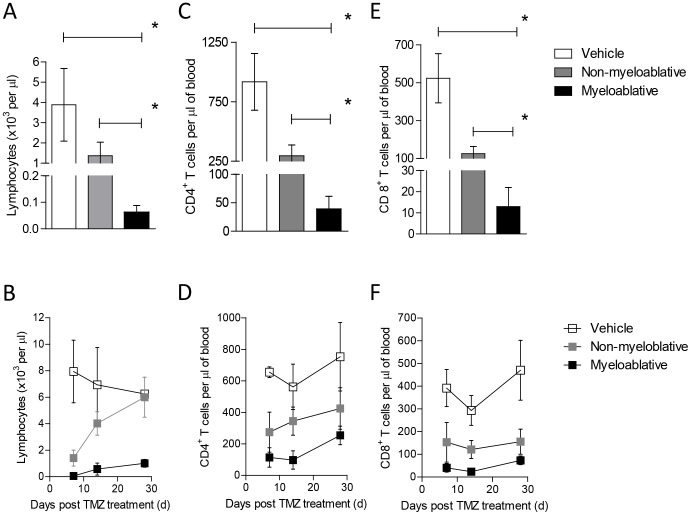
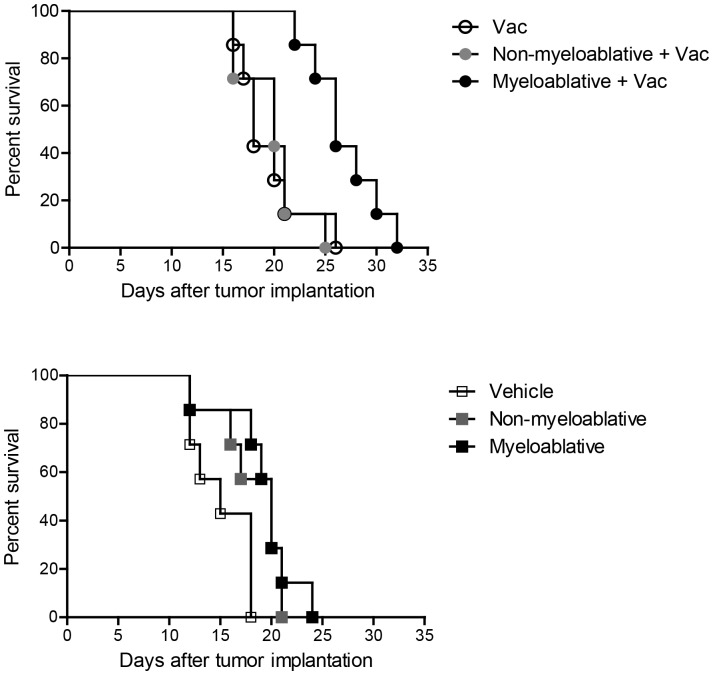
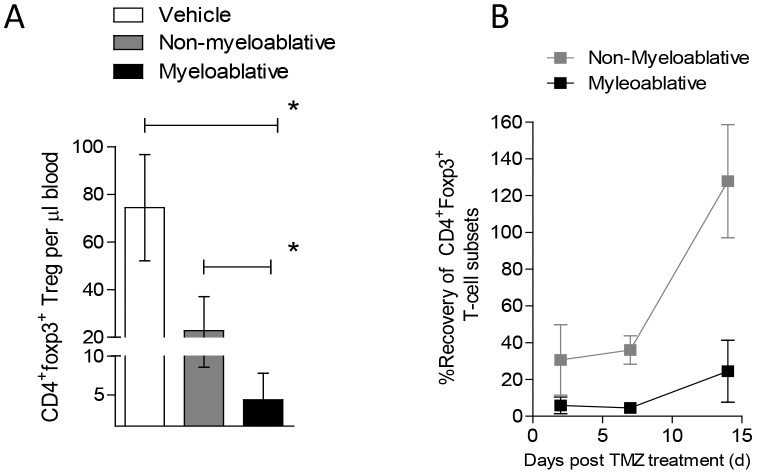
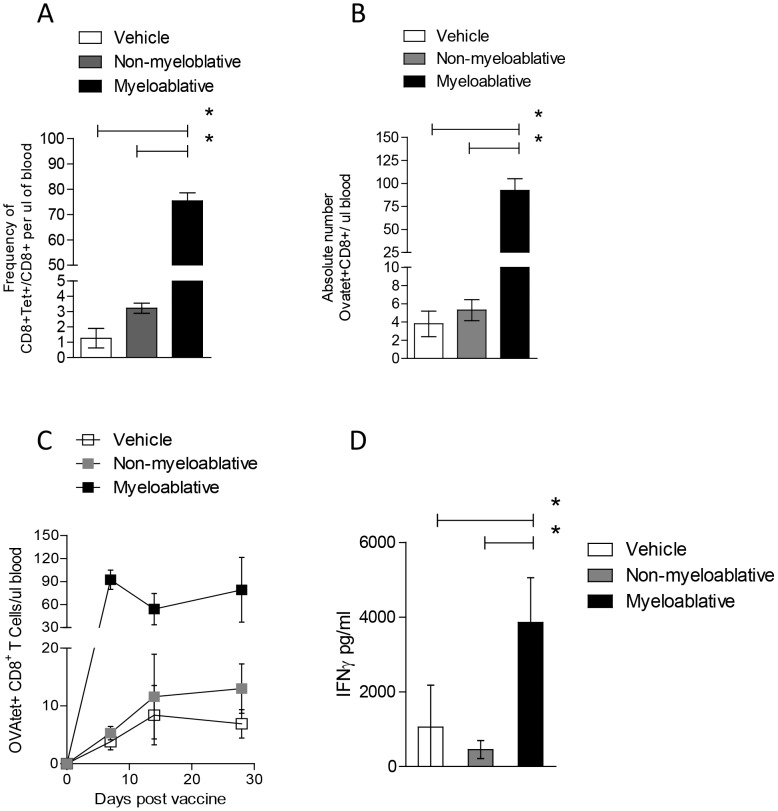
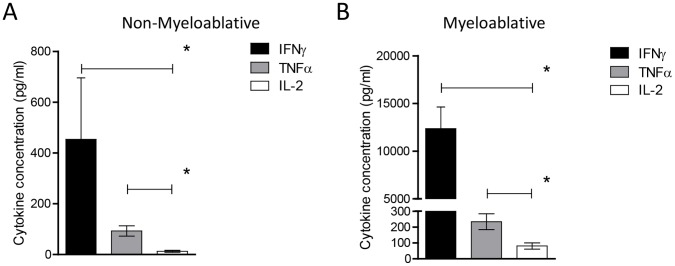
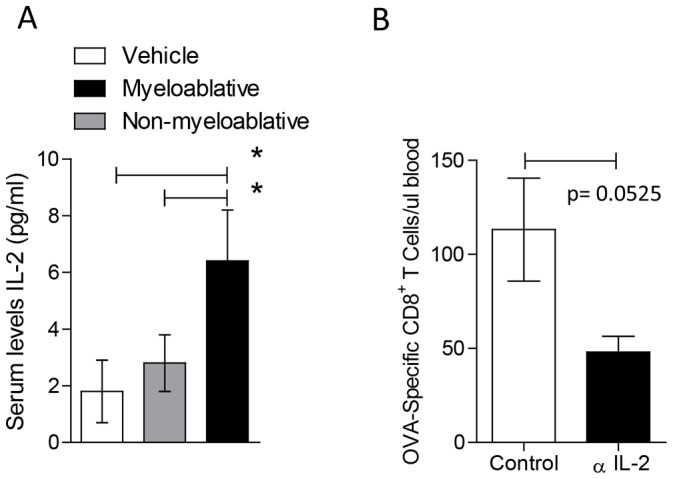
Temozolomide (TMZ) is an alkylating agent shown to prolong survival in patients with high grade glioma and is routinely used to treat melanoma brain metastases. A prominent side effect of TMZ is induction of profound lymphopenia, which some suggest may be incompatible with immunotherapy. Conversely, it has been proposed that recovery from chemotherapy-induced lymphopenia may actually be exploited to potentiate T-cell responses. Here, we report the first demonstration of TMZ as an immune host-conditioning regimen in an experimental model of brain tumor and examine its impact on antitumor efficacy of a well-characterized peptide vaccine. Our results show that high-dose, myeloablative (MA) TMZ resulted in markedly reduced CD4(+), CD8(+) T-cell and CD4(+)Foxp3(+) TReg counts. Adoptive transfer of naïve CD8(+) T cells and vaccination in this setting led to an approximately 70-fold expansion of antigen-specific CD8(+) T cells over controls. Ex vivo analysis of effector functions revealed significantly enhanced levels of pro-inflammatory cytokine secretion from mice receiving MA TMZ when compared to those treated with a lower lymphodepletive, non-myeloablative (NMA) dose. Importantly, MA TMZ, but not NMA TMZ was uniquely associated with an elevation of endogenous IL-2 serum levels, which we also show was required for optimal T-cell expansion. Accordingly, in a murine model of established intracerebral tumor, vaccination-induced immunity in the setting of MA TMZ-but not lymphodepletive, NMA TMZ-led to significantly prolonged survival. Overall, these results may be used to leverage the side-effects of a clinically-approved chemotherapy and should be considered in future study design of immune-based treatments for brain tumors.
替莫唑胺(TMZ)是一种烷化剂,已被证明可延长高级别神经胶质瘤患者的生存期,并且常规用于治疗黑色素瘤脑转移。TMZ 的一个突出副作用是诱导严重的淋巴细胞减少症,一些人认为这可能与免疫疗法不兼容。相反,有人提出,从化疗引起的淋巴细胞减少症中恢复实际上可以被利用来增强 T 细胞反应。在这里,我们报告了 TMZ 在脑肿瘤实验模型中作为免疫宿主调理方案的首次证明,并研究了其对一种经过充分表征的肽疫苗的抗肿瘤疗效的影响。我们的结果表明,高剂量、骨髓清除(MA)TMZ 导致 CD4(+)、CD8(+)T 细胞和 CD4(+)Foxp3(+)TReg 计数明显减少。在这种情况下,过继转移幼稚 CD8(+)T 细胞和接种疫苗导致抗原特异性 CD8(+)T 细胞的扩增约为对照组的 70 倍。体外分析效应功能显示,与接受低淋巴细胞减少、非骨髓清除(NMA)剂量的 TMZ 治疗的小鼠相比,接受 MA TMZ 治疗的小鼠的促炎细胞因子分泌水平显著增强。重要的是,MA TMZ 而不是 NMA TMZ 与内源性 IL-2 血清水平的升高有关,我们还表明这是最佳 T 细胞扩增所必需的。因此,在建立的脑内肿瘤的小鼠模型中,MA TMZ 而非淋巴细胞减少、NMA TMZ 条件下的疫苗接种诱导的免疫导致显著延长的存活。总的来说,这些结果可用于利用临床批准的化疗的副作用,并且应在未来脑肿瘤免疫治疗的研究设计中加以考虑。