Qatar Cardiovascular Research Center, Qatar Foundation, Doha, Qatar.
PLoS One. 2013;8(3):e59206. doi: 10.1371/journal.pone.0059206. Epub 2013 Mar 19.
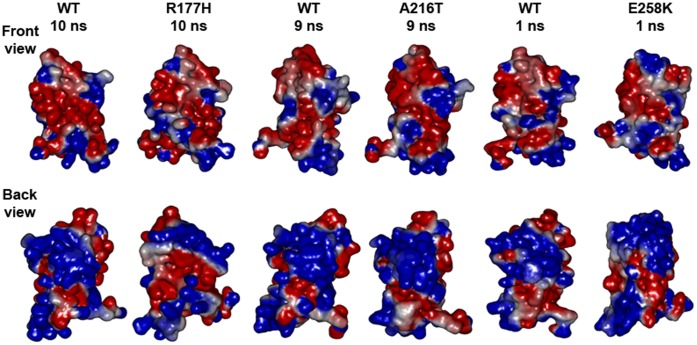
Cardiac myosin binding protein-C (cMyBP-C) is a multi-domain (C0-C10) protein that regulates heart muscle contraction through interaction with myosin, actin and other sarcomeric proteins. Several mutations of this protein cause familial hypertrophic cardiomyopathy (HCM). Domain C1 of cMyBP-C plays a central role in protein interactions with actin and myosin. Here, we studied structure-function relationship of three disease causing mutations, Arg177His, Ala216Thr and Glu258Lys of the domain C1 using computational biology techniques with its available X-ray crystal structure. The results suggest that each mutation could affect structural properties of the domain C1, and hence it's structural integrity through modifying intra-molecular arrangements in a distinct mode. The mutations also change surface charge distributions, which could impact the binding of C1 with other sarcomeric proteins thereby affecting contractile function. These structural consequences of the C1 mutants could be valuable to understand the molecular mechanisms for the disease.
心肌肌球蛋白结合蛋白 C(cMyBP-C)是一种多功能域(C0-C10)蛋白,通过与肌球蛋白、肌动蛋白和其他肌节蛋白相互作用来调节心肌收缩。该蛋白的几种突变可导致家族性肥厚型心肌病(HCM)。cMyBP-C 的结构域 C1 在与肌动蛋白和肌球蛋白的蛋白相互作用中起核心作用。在这里,我们使用计算生物学技术及其可用的 X 射线晶体结构研究了结构域 C1 中三个致病突变(Arg177His、Ala216Thr 和 Glu258Lys)的结构-功能关系。结果表明,每个突变都可能通过以不同的方式改变分子内排列来影响结构域 C1 的结构特性及其结构完整性。这些突变还改变了表面电荷分布,这可能影响 C1 与其他肌节蛋白的结合,从而影响收缩功能。C1 突变体的这些结构后果对于理解疾病的分子机制可能是有价值的。