Biomedical Sciences Research Complex, University of St Andrews, North Haugh, St Andrews, Fife KY16 9ST, UK.
Biochem J. 2013 Jun 1;452(2):223-30. doi: 10.1042/BJ20130269.
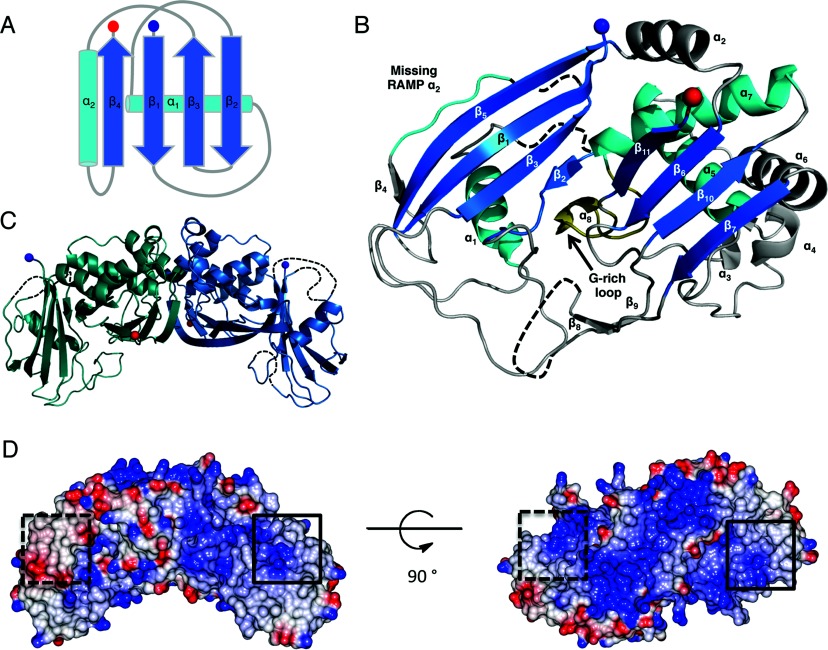
The competition between viruses and hosts is played out in all branches of life. Many prokaryotes have an adaptive immune system termed 'CRISPR' (clustered regularly interspaced short palindromic repeats) which is based on the capture of short pieces of viral DNA. The captured DNA is integrated into the genomic DNA of the organism flanked by direct repeats, transcribed and processed to generate crRNA (CRISPR RNA) that is loaded into a variety of effector complexes. These complexes carry out sequence-specific detection and destruction of invading mobile genetic elements. In the present paper, we report the structure and activity of a Cas6 (CRISPR-associated 6) enzyme (Sso1437) from Sulfolobus solfataricus responsible for the generation of unit-length crRNA species. The crystal structure reveals an unusual dimeric organization that is important for the enzyme's activity. In addition, the active site lacks the canonical catalytic histidine residue that has been viewed as an essential feature of the Cas6 family. Although several residues contribute towards catalysis, none is absolutely essential. Coupled with the very low catalytic rate constants of the Cas6 family and the plasticity of the active site, this suggests that the crRNA recognition and chaperone-like activities of the Cas6 family should be considered as equal to or even more important than their role as traditional enzymes.
病毒和宿主之间的竞争在生命的各个分支中展开。许多原核生物都有一种适应性免疫系统,称为“CRISPR”(成簇的、规律间隔的短回文重复序列),它基于对短片段病毒 DNA 的捕获。捕获的 DNA 被整合到生物体的基因组 DNA 中,两侧是直接重复序列,被转录并加工生成 crRNA(CRISPR RNA),然后装载到各种效应复合物中。这些复合物执行对入侵的移动遗传元件的序列特异性检测和破坏。在本文中,我们报告了来自嗜热硫酸盐古菌的 Cas6(CRISPR 相关蛋白 6)酶(Sso1437)的结构和活性,该酶负责产生单位长度的 crRNA 种类。晶体结构揭示了一种不寻常的二聚化组织,这对酶的活性很重要。此外,活性位点缺乏被认为是 Cas6 家族的一个重要特征的经典催化组氨酸残基。尽管有几个残基有助于催化,但没有一个是绝对必需的。再加上 Cas6 家族非常低的催化速率常数和活性位点的可塑性,这表明 Cas6 家族的 crRNA 识别和分子伴侣样活性应该被认为与它们作为传统酶的作用同等重要,甚至更重要。