Bandason Tsitsi, Langhaug Lisa F, Makamba Memory, Laver Sue, Hatzold Karin, Mahere Stephen, Munyati Shungu, Mungofa Stanley, Corbett Elizabeth L, Ferrand Rashida A
a Biomedical Research and Training Institute , Harare , Zimbabwe.
AIDS Care. 2013;25(12):1520-6. doi: 10.1080/09540121.2013.780120. Epub 2013 Mar 26.
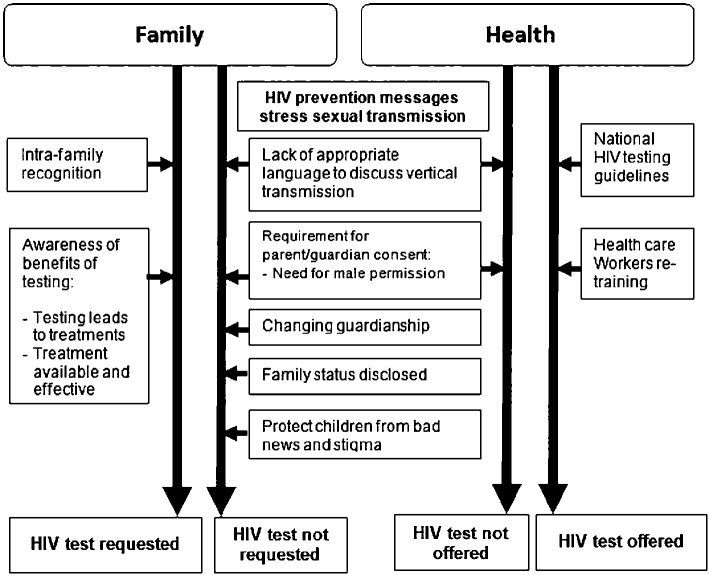
Population-based surveys in Southern Africa suggest a substantial burden of undiagnosed HIV-infected long-term survivors of mother-to-child transmission. We conducted an HIV prevalence survey of primary school pupils in Harare, Zimbabwe, and evaluated school-linked HIV counselling and testing (HCT) for pupils, their families and schoolteachers. Population-weighted cluster sampling was used to select six primary schools. Randomly selected class-grade pupils underwent anonymous HIV testing, with concurrent school-linked family HCT offered during the survey. Focus group discussions and interviews were conducted with pupils, parents/guardians, counsellors, and schoolteachers. About 4386 (73%) pupils provided specimens for anonymous HIV testing. Median age was 9 years (IQR 8-11), and 54% were female. HIV prevalence was 2.7% (95% CI: 2.2-3.1) with no difference by gender. HIV infection was significantly associated with orphanhood, stunting, wasting, and being one or more class grades behind in school due to illness (p<0.001). After adjusting for covariates, orphanhood and stunting remained significantly associated with being HIV positive (p<0.001). Uptake of diagnostic HIV testing by pupils was low with only 47/4386 (1%) pupils undergoing HCT. The HIV prevalence among children under 15 years who underwent HIV testing was 6.8%. The main barrier to HIV testing was parents' fear of their children experiencing stigma and of unmasking their own HIV status should the child test HIV positive. Most guardians believed that a child's HIV-positive result should not be disclosed and the child could take HIV treatment without knowing the reason. Increased recognition of the high burden of undiagnosed HIV infection in children is needed. Despite awareness of the benefits of HIV testing, HIV-related stigma still dominates parents/guardians' psychological landscape. There is need for comprehensive information and support for families to engage with HIV testing services.
南部非洲基于人群的调查表明,母婴传播的未诊断出的艾滋病毒感染长期存活者负担沉重。我们在津巴布韦哈拉雷对小学生进行了艾滋病毒流行率调查,并评估了针对学生、其家庭和学校教师的与学校相关的艾滋病毒咨询和检测(HCT)。采用人口加权整群抽样法选择了六所小学。随机抽取的班级学生接受了匿名艾滋病毒检测,调查期间同时提供与学校相关的家庭HCT。对学生、家长/监护人、咨询师和学校教师进行了焦点小组讨论和访谈。约4386名(73%)学生提供了匿名艾滋病毒检测样本。中位年龄为9岁(四分位间距8 - 11岁),54%为女性。艾滋病毒流行率为2.7%(95%置信区间:2.2 - 3.1),无性别差异。艾滋病毒感染与孤儿身份、发育迟缓、消瘦以及因病在学业上落后一个或多个年级显著相关(p<0.001)。在调整协变量后,孤儿身份和发育迟缓仍与艾滋病毒阳性显著相关(p<0.001)。学生接受诊断性艾滋病毒检测的比例较低,只有47/4386(1%)名学生接受了HCT。接受艾滋病毒检测的15岁以下儿童中的艾滋病毒流行率为6.8%。艾滋病毒检测的主要障碍是家长担心孩子受到污名化,以及如果孩子检测出艾滋病毒呈阳性会暴露自己的艾滋病毒感染状况。大多数监护人认为不应透露孩子的艾滋病毒阳性结果,孩子可以在不知道原因的情况下接受艾滋病毒治疗。需要提高对儿童中未诊断出的艾滋病毒感染高负担的认识。尽管认识到艾滋病毒检测的益处,但与艾滋病毒相关的污名仍然主导着家长/监护人的心理状况。需要为家庭提供全面的信息和支持,以便他们参与艾滋病毒检测服务。