Manchaiah Vinaya K C, Stephens Dafydd, Lunner Thomas
Centre for Long Term and Chronic Conditions, College of Human and Health Sciences, Swansea University, Swansea SA2 8PP, UK ; Linnaeus Centre HEAD, Swedish Institute for Disability Research, Department of Behavioural Sciences and Learning, Linköping University, 58183 Linköping, Sweden.
Int J Otolaryngol. 2013;2013:707910. doi: 10.1155/2013/707910. Epub 2013 Feb 27.
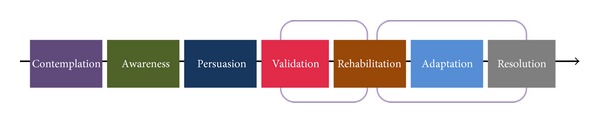
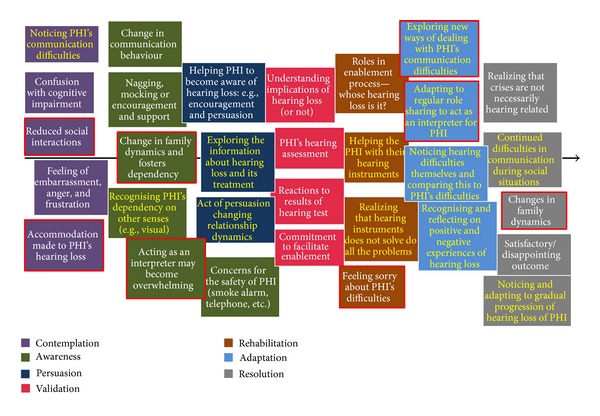
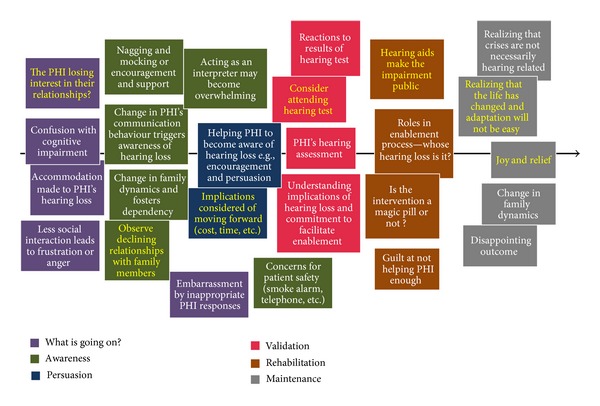
The objective of this study was to further develop the Ida Institute model on communication partners' (CPs) journey through experiences of person with hearing impairment (PHI), based on the perspectives of CPs. Nine CPs of hearing aid users participated in this study, recruited through the Swansea hearing impaired support group. Semi-structured interviews were conducted, the data were analysed using qualitative thematic analysis and presented with the use of process mapping approach. Seven main phases were identified in the CP journey which includes: (1) contemplation, (2) awareness, (3) persuasion, (4) validation, (5) rehabilitation, (6) adaptation, and (7) resolution. The Ida Institute model (based on professionals' perspective) was compared with the new template developed (based on CPs' perspectives). The results suggest some commonalities and differences between the views of professionals and CPs. A new phase, adaptation, was identified from CPs reported experiences, which was not identified by professionals in the Ida Institute model. The CP's journey model could be a useful tool during audiological enablement/rehabilitation sessions to promote discussion between the PHI and the CP. In addition, it can be used in the training of hearing healthcare professionals.
本研究的目的是基于沟通伙伴(CPs)的视角,进一步拓展艾达研究所关于沟通伙伴陪伴听力受损者(PHI)经历的模型。通过斯旺西听力受损者支持小组招募了九名助听器使用者的沟通伙伴参与本研究。进行了半结构化访谈,采用定性主题分析法对数据进行分析,并运用流程映射法呈现结果。在沟通伙伴的历程中确定了七个主要阶段,包括:(1)沉思,(2)认知,(3)说服,(4)确认,(5)康复,(6)适应,以及(7)解决。将艾达研究所模型(基于专业人员视角)与新开发的模板(基于沟通伙伴视角)进行了比较。结果表明专业人员和沟通伙伴的观点存在一些共性和差异。从沟通伙伴报告的经历中确定了一个新的阶段——适应,这在艾达研究所模型中未被专业人员识别。沟通伙伴的历程模型在听力康复/康复治疗过程中可能是一个有用的工具,可促进听力受损者与沟通伙伴之间的讨论。此外,它可用于听力保健专业人员的培训。