Phonak Canada, Mississauga, Canada
Phonak, Stäfa, Switzerland.
Trends Hear. 2016 Oct 12;20:2331216516673833. doi: 10.1177/2331216516673833.
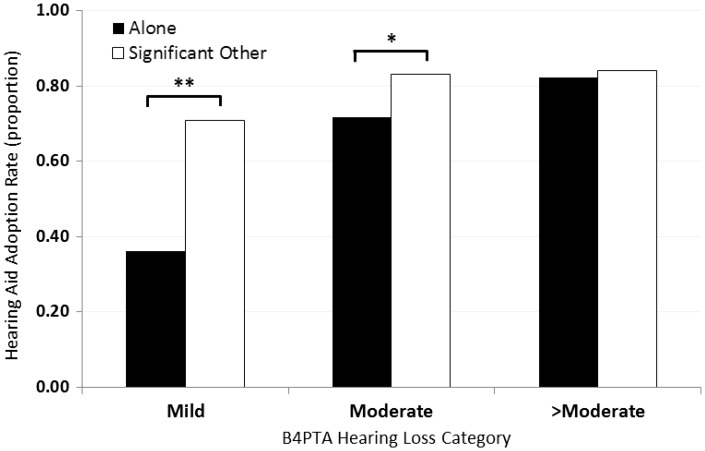
Hearing rehabilitation tends to focus on the influence of intraindividual factors and concepts such as readiness for change and health beliefs. In contrast, less is known about the role of social context and the potential role of significant others on hearing aid adoption. This explorative retrospective study investigated whether hearing aid adoption is associated with significant other attendance at audiology appointments. The study sample consisted of 33,933 and 27,031 individuals who attended appointments either alone or with a significant other, respectively (n = 60,964). It was found that hearing aid adoption was significantly greater when patients attended audiology appointments with a significant other (63.8%) than when attending appointments alone (50.6%). The association between hearing aid adoption and attendance by a significant other was hearing dependent, with 96% higher hearing aid adoption for patients with mild hearing losses when patients attended appointments with a significant other than when attending appointments alone. Hearing aid return rates were comparable when patients attended appointments alone (27%) or with a significant other (24%). Several potential explanations for the observed association are discussed. The pattern of results is consistent with the view that greater adherence is observed when audiologic care is provided from a patient-centered care perspective. Future research should establish whether there is a causal relationship between attendance at appointments by significant others and hearing aid adoption and should attempt to better understand the mechanisms underpinning the relationship between these variables.
听力康复往往侧重于个体内部因素的影响,以及诸如改变意愿和健康信念等概念。相比之下,对于社会环境的作用以及其他重要他人对助听器采用的潜在作用,了解较少。这项探索性回顾性研究调查了助听器的采用是否与其他重要他人参加听力学预约有关。研究样本由分别单独或与重要他人一起参加预约的 33933 名和 27031 名个体组成(n=60964)。结果发现,当患者与其他重要他人一起参加听力学预约时(63.8%),助听器的采用明显更高,而当患者单独参加预约时(50.6%)则较低。助听器采用与其他重要他人参加预约之间的关联是听力依赖的,当患者与其他重要他人一起参加预约时,轻度听力损失患者的助听器采用率比单独参加预约时高 96%。当患者单独参加预约(27%)或与其他重要他人一起参加预约(24%)时,助听器退货率相当。讨论了观察到的关联的几种潜在解释。结果模式与从以患者为中心的护理角度提供听力学护理时观察到更高的依从性的观点一致。未来的研究应确定其他重要他人参加预约与助听器采用之间是否存在因果关系,并应尝试更好地理解这些变量之间关系的机制。