Department of Physics and Institute of Medical Engineering, Technische Universität München, Garching, Germany.
PLoS One. 2013;8(3):e58439. doi: 10.1371/journal.pone.0058439. Epub 2013 Mar 11.
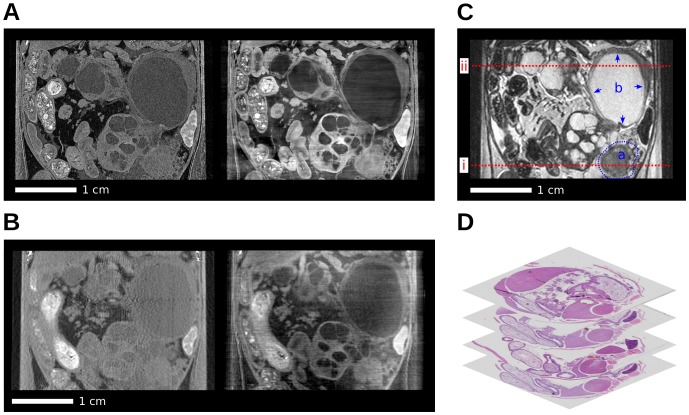
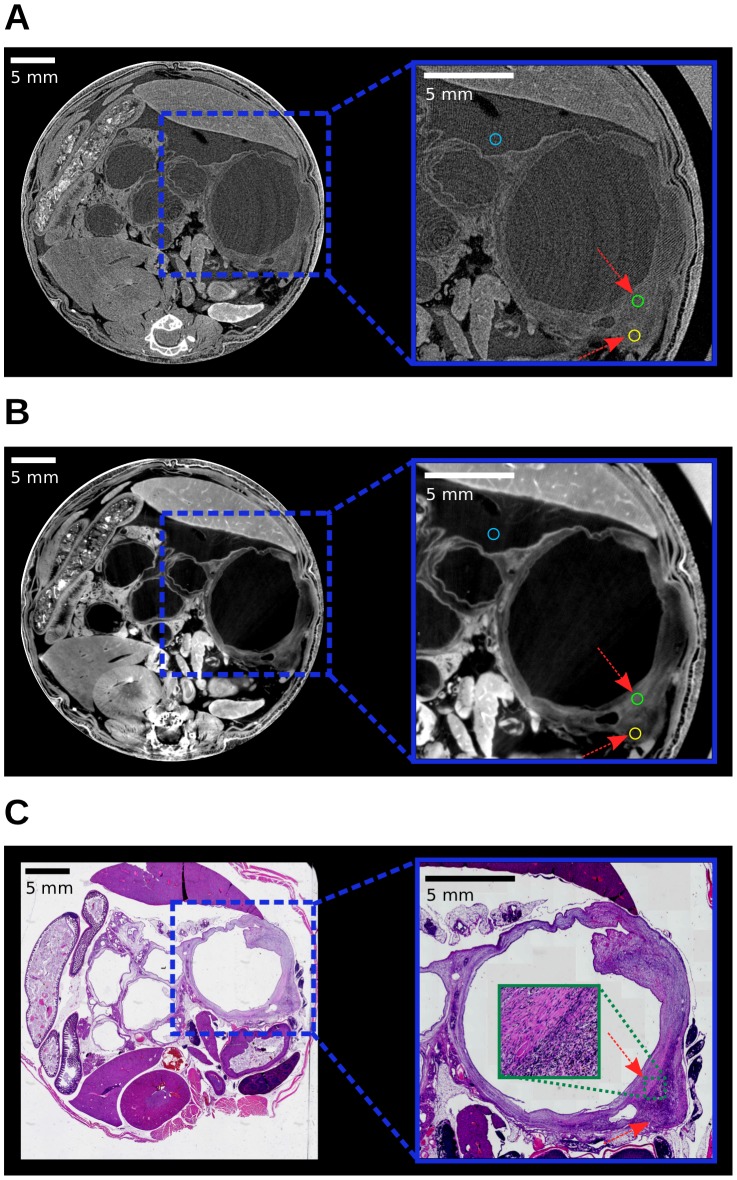
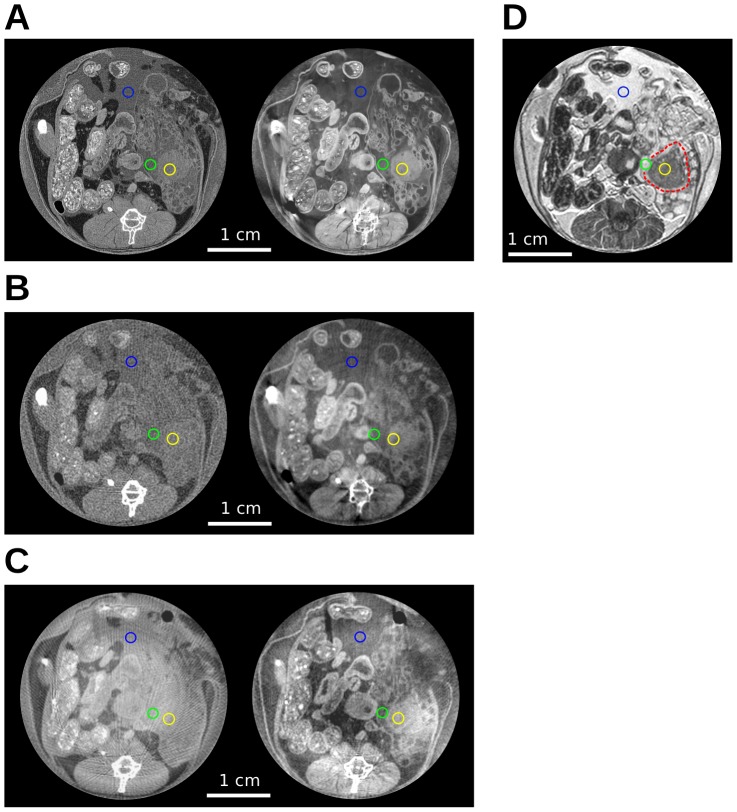
To explore the potential of grating-based x-ray phase-contrast computed tomography (CT) for preclinical research, a genetically engineered mouse model of pancreatic ductal adenocarcinoma (PDAC) was investigated. One ex-vivo mouse specimen was scanned with different grating-based phase-contrast CT imaging setups covering two different settings: i) high-resolution synchrotron radiation (SR) imaging and ii) dose-reduced imaging using either synchrotron radiation or a conventional x-ray tube source. These experimental settings were chosen to assess the potential of phase-contrast imaging for two different types of application: i) high-performance imaging for virtual microscopy applications and ii) biomedical imaging with increased soft-tissue contrast for in-vivo applications. For validation and as a reference, histological slicing and magnetic resonance imaging (MRI) were performed on the same mouse specimen. For each x-ray imaging setup, attenuation and phase-contrast images were compared visually with regard to contrast in general, and specifically concerning the recognizability of lesions and cancerous tissue. To quantitatively assess contrast, the contrast-to-noise ratios (CNR) of selected regions of interest (ROI) in the attenuation images and the phase images were analyzed and compared. It was found that both for virtual microscopy and for in-vivo applications, there is great potential for phase-contrast imaging: in the SR-based benchmarking data, fine details about tissue composition are accessible in the phase images and the visibility of solid tumor tissue under dose-reduced conditions is markedly superior in the phase images. The present study hence demonstrates improved diagnostic value with phase-contrast CT in a mouse model of a complex endogenous cancer, promoting the use and further development of grating-based phase-contrast CT for biomedical imaging applications.
为了探索基于光栅的 X 射线相衬计算机断层扫描(CT)在临床前研究中的潜力,我们研究了一种胰腺导管腺癌(PDAC)的基因工程小鼠模型。对一只离体小鼠标本进行了不同基于光栅的相衬 CT 成像设置的扫描,这些设置涵盖了两种不同的设置:i)高分辨率同步辐射(SR)成像和 ii)使用同步辐射或常规 X 射线管源进行剂量降低的成像。选择这些实验设置是为了评估相衬成像在两种不同类型的应用中的潜力:i)虚拟显微镜应用的高性能成像和 ii)用于体内应用的软组织对比度增加的生物医学成像。为了验证和参考,对同一只小鼠标本进行了组织切片和磁共振成像(MRI)。对于每个 X 射线成像设置,从总体上比较了衰减和相衬图像,特别是在病变和癌组织的可识别性方面,对对比度进行了视觉比较。为了定量评估对比度,分析并比较了衰减图像和相图像中选定感兴趣区域(ROI)的对比噪声比(CNR)。结果发现,对于虚拟显微镜和体内应用,相衬成像都具有很大的潜力:在基于 SR 的基准数据中,相图像中可以访问有关组织成分的细微细节,并且在剂量降低条件下实体瘤组织的可见度在相图像中明显更高。因此,本研究在复杂内源性癌症的小鼠模型中证明了相衬 CT 的诊断价值有所提高,促进了基于光栅的相衬 CT 在生物医学成像应用中的使用和进一步发展。