
遭受氧化应激的恶性疟原虫寄生虫失去 pH 控制。
Loss of pH control in Plasmodium falciparum parasites subjected to oxidative stress.
机构信息
Research School of Biology, The Australian National University, Canberra, Australian Capital Territory, Australia.
出版信息
PLoS One. 2013;8(3):e58933. doi: 10.1371/journal.pone.0058933. Epub 2013 Mar 11.
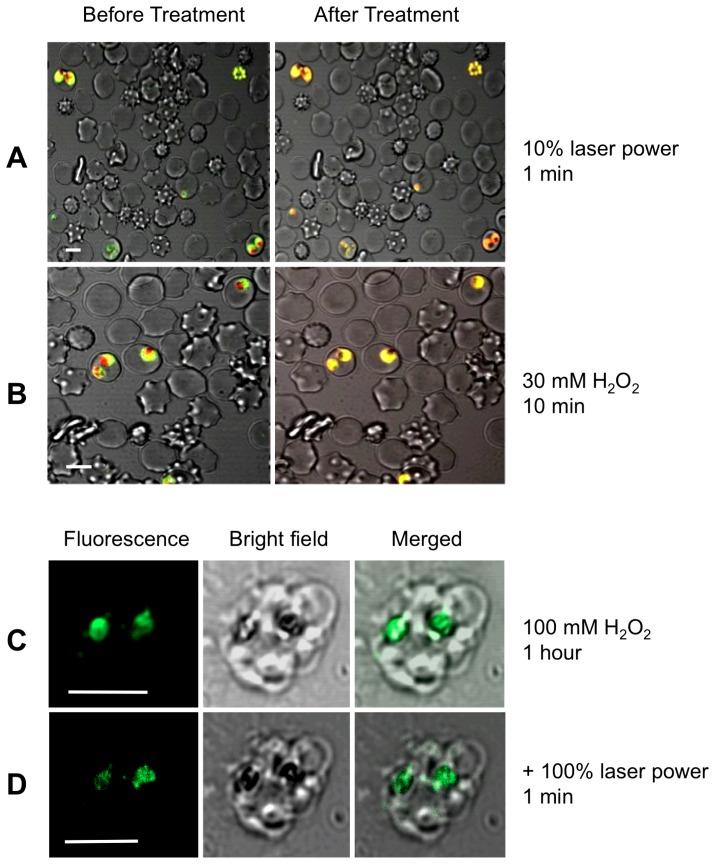
The intraerythrocytic malaria parasite is susceptible to oxidative stress and this may play a role in the mechanism of action of some antimalarial agents. Here we show that exposure of the intraerythrocytic malaria parasite to the oxidising agent hydrogen peroxide results in a fall in the intracellular ATP level and inhibition of the parasite's V-type H(+)-ATPase, causing a loss of pH control in both the parasite cytosol and the internal digestive vacuole. In contrast to the V-type H(+)-ATPase, the parasite's digestive vacuole H(+)-pyrophosphatase is insensitive to hydrogen peroxide-induced oxidative stress. This work provides insights into the effects of oxidative stress on the intraerythrocytic parasite, as well as providing an alternative possible explanation for a previous report that light-induced oxidative stress causes selective lysis of the parasite's digestive vacuole.
疟原虫在红细胞内易受氧化应激的影响,这可能在一些抗疟药物的作用机制中发挥作用。在这里,我们表明,将红细胞内疟原虫暴露于氧化剂过氧化氢中会导致细胞内 ATP 水平下降和寄生虫 V 型 H(+)-ATP 酶的抑制,从而导致寄生虫细胞质和内部消化液泡中的 pH 控制丧失。与 V 型 H(+)-ATP 酶相反,寄生虫的消化液泡 H(+)-焦磷酸酶对过氧化氢诱导的氧化应激不敏感。这项工作深入了解了氧化应激对红细胞内寄生虫的影响,并为之前的一项报告提供了另一种可能的解释,即光诱导的氧化应激导致寄生虫的消化液泡选择性破裂。


 Zotero 插件