Department of Pharmacology, Institute of Postgraduate Medical Education and Research, 244B Acharya J C Bose Road, Kolkata, West Bengal, India.
Indian J Pharmacol. 2013 Jan-Feb;45(1):34-9. doi: 10.4103/0253-7613.106432.
To assess the efficacy and safety of NSF-3, a polyherbal sedative-hypnotic (containing standardized extracts of Valeriana officinalis, Passiflora incarnate and Humulus lupulus), in comparison to zolpidem in primary insomnia.
The present study was designed as a parallel group, double- blind, randomized, controlled trial and registered with Clinical Trials Registry-India (CTRI/2011/12/002197). Patients diagnosed with primary insomnia with a perceived total sleep time of <6 hours per night and insomnia severity index >7 were included. They were treated with either NSF-3 (one tablet) or zolpidem (one 10 mg tablet) at bedtime for two weeks. Total sleep time, sleep latency and number of awakenings per night were assessed using a sleep diary. Quality of life and daytime sleepiness were evaluated by insomnia severity index and Epworth sleepiness score respectively. Vital signs, routine blood counts, liver and renal function tests, and treatment emergent adverse events were recorded for safety assessment.
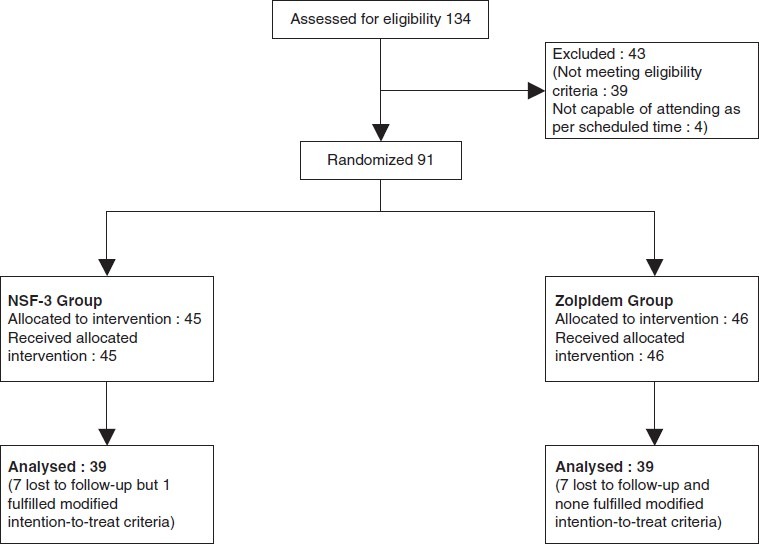
A total of 91 subjects were recruited, of which 39 in each group completed the study. There was significant improvement in total sleep time, sleep latency, number of nightly awakenings and insomnia severity index scores in both groups. However, no statistically significant difference was observed between the groups. Epworth sleepiness scores did not change significantly over the study period. Although 12 treatment emergent adverse events were reported with NSF-3 and 16 with zolpidem (commonest was drowsiness in both), most were mild and no serious adverse events were encountered.
NSF-3 is a safe and effective short-term alternative to zolpidem for primary insomnia. It remains to be explored whether the benefits are sustained and whether there is dependence liability with this formulation upon long term use.
评估 NSF-3(一种包含标准化缬草根、西番莲和啤酒花提取物的复方镇静催眠药)在原发性失眠中的疗效和安全性,并与唑吡坦进行比较。
本研究设计为平行组、双盲、随机、对照临床试验,并在印度临床试验注册处(CTRI/2011/12/002197)注册。纳入的患者诊断为原发性失眠,每晚总睡眠时间<6 小时,失眠严重指数>7。他们在睡前分别服用 NSF-3(一片)或唑吡坦(一片 10mg),疗程为两周。使用睡眠日记评估总睡眠时间、睡眠潜伏期和每晚觉醒次数。通过失眠严重指数和 Epworth 嗜睡评分评估生活质量和白天嗜睡。记录生命体征、常规血常规、肝肾功能检查和治疗中出现的不良事件以评估安全性。
共纳入 91 例患者,其中每组 39 例完成研究。两组的总睡眠时间、睡眠潜伏期、每晚觉醒次数和失眠严重指数评分均有显著改善。然而,两组间无统计学差异。Epworth 嗜睡评分在研究期间无显著变化。虽然 NSF-3 组报告了 12 例治疗中出现的不良事件,唑吡坦组报告了 16 例(最常见的是两组的困倦),但大多数为轻度,未发生严重不良事件。
NSF-3 是原发性失眠的一种安全有效的短期替代唑吡坦的药物。尚需探讨该制剂长期使用是否具有持续的益处以及是否存在依赖风险。