School of Biological Sciences, University of Essex, Colchester, United Kingdom.
PLoS One. 2013;8(3):e59415. doi: 10.1371/journal.pone.0059415. Epub 2013 Mar 27.
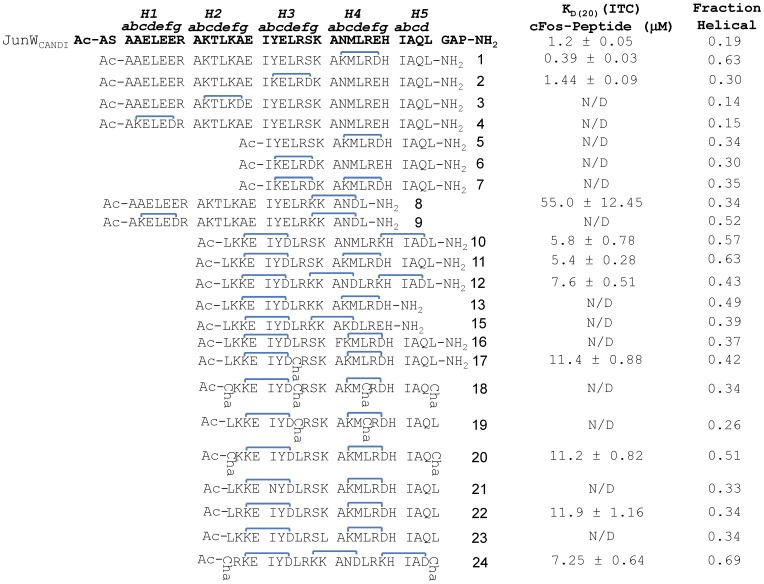
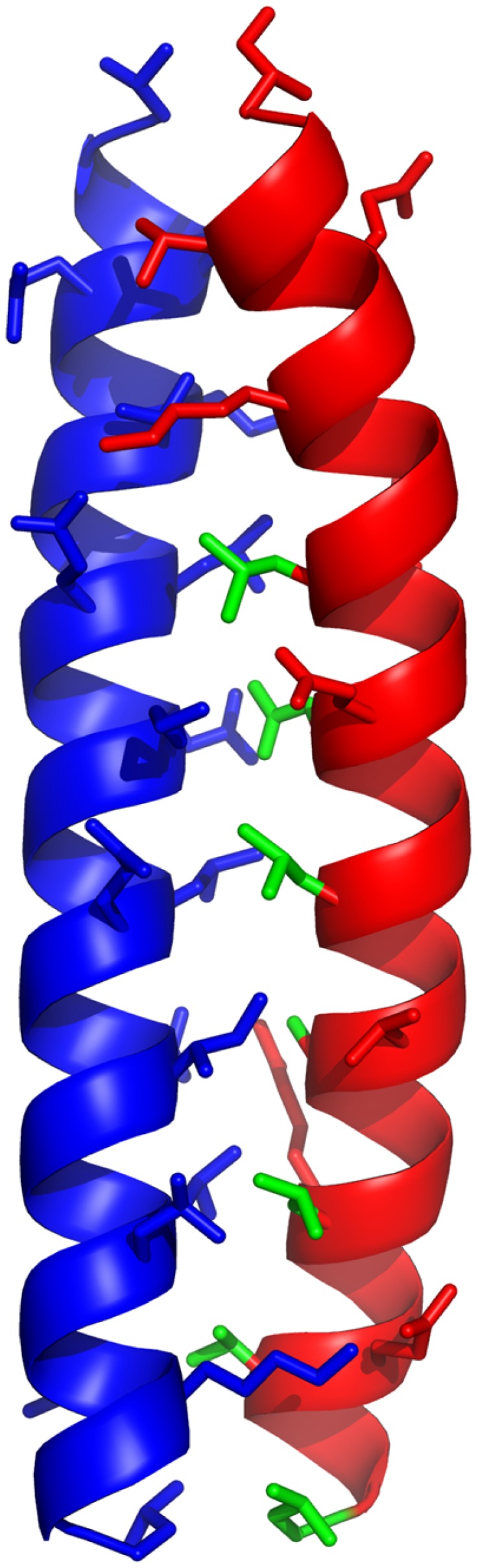
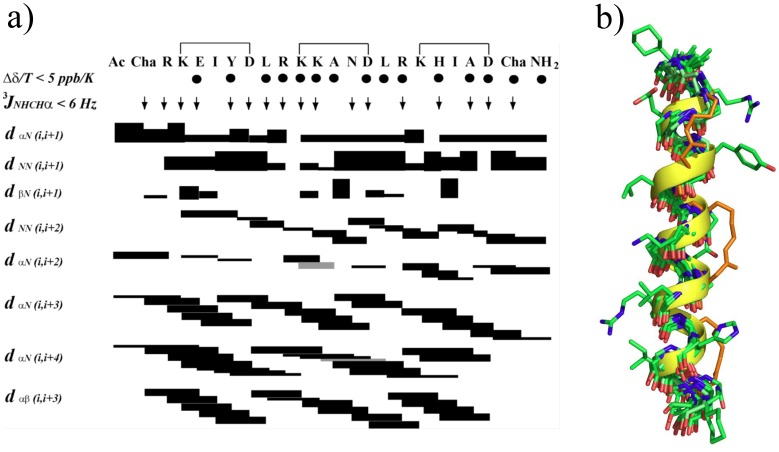
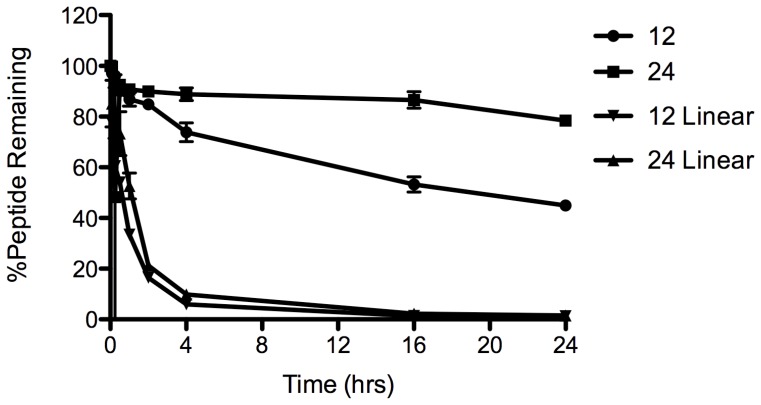
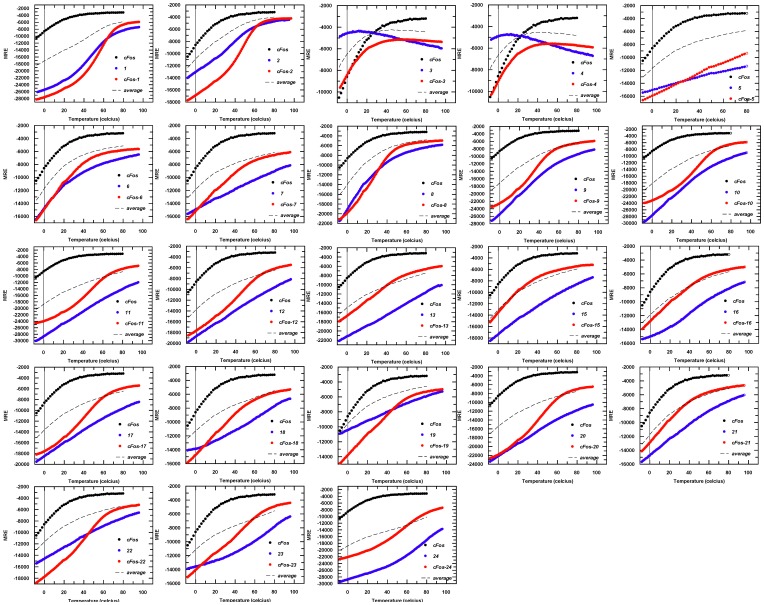
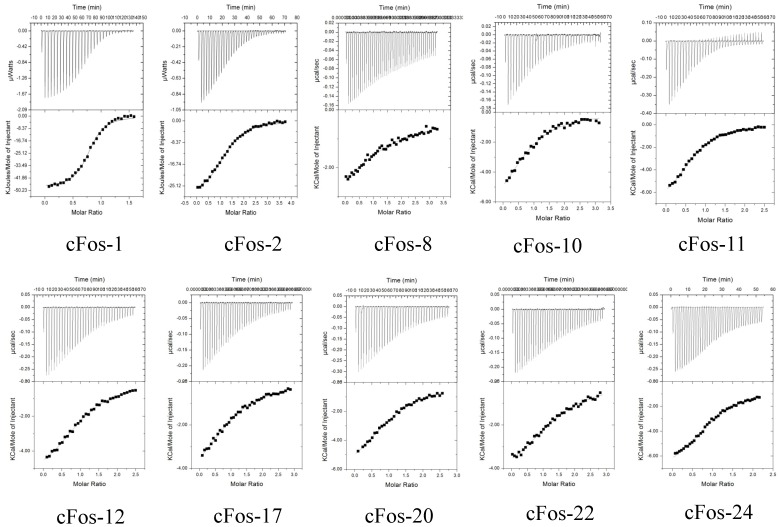
Protein-based therapeutics feature large interacting surfaces. Protein folding endows structural stability to localised surface epitopes, imparting high affinity and target specificity upon interactions with binding partners. However, short synthetic peptides with sequences corresponding to such protein epitopes are unstructured in water and promiscuously bind to proteins with low affinity and specificity. Here we combine structural stability and target specificity of proteins, with low cost and rapid synthesis of small molecules, towards meeting the significant challenge of binding coiled coil proteins in transcriptional regulation. By iteratively truncating a Jun-based peptide from 37 to 22 residues, strategically incorporating i→i+4 helix-inducing constraints, and positioning unnatural amino acids, we have produced short, water-stable, α-helical peptides that bind cFos. A three-dimensional NMR-derived structure for one peptide (24) confirmed a highly stable α-helix which was resistant to proteolytic degradation in serum. These short structured peptides are entropically pre-organized for binding with high affinity and specificity to cFos, a key component of the oncogenic transcriptional regulator Activator Protein-1 (AP-1). They competitively antagonized the cJun-cFos coiled-coil interaction. Truncating a Jun-based peptide from 37 to 22 residues decreased the binding enthalpy for cJun by ∼9 kcal/mol, but this was compensated by increased conformational entropy (TΔS ≤7.5 kcal/mol). This study demonstrates that rational design of short peptides constrained by α-helical cyclic pentapeptide modules is able to retain parental high helicity, as well as high affinity and specificity for cFos. These are important steps towards small antagonists of the cJun-cFos interaction that mediates gene transcription in cancer and inflammatory diseases.
蛋白质疗法具有较大的相互作用表面。蛋白质折叠赋予局部表面表位结构稳定性,使其与结合伴侣相互作用时具有高亲和力和靶标特异性。然而,与这些蛋白质表位相对应的短合成肽在水中无结构,并且与低亲和力和特异性的蛋白质随机结合。在这里,我们将蛋白质的结构稳定性和靶标特异性与小分子的低成本和快速合成相结合,以应对结合转录调节中卷曲螺旋蛋白的重大挑战。通过从 37 个残基逐步截短基于 Jun 的肽,策略性地引入 i→i+4 螺旋诱导约束,以及定位非天然氨基酸,我们已经产生了短的、水稳定的、α-螺旋肽,能够与 cFos 结合。一种基于三维 NMR 的结构确定了一个高度稳定的α-螺旋,该螺旋能够抵抗血清中的蛋白水解降解。这些短的结构化肽在热力学上预先组织好,能够与 cFos 高亲和力和特异性结合,cFos 是致癌转录调节剂激活蛋白-1 (AP-1) 的关键组成部分。它们竞争性地拮抗 cJun-cFos 卷曲螺旋相互作用。从 37 个残基截短基于 Jun 的肽使 cJun 的结合焓降低了约 9 kcal/mol,但这被增加的构象熵(TΔS ≤7.5 kcal/mol)所补偿。这项研究表明,通过α-螺旋环状五肽模块约束的短肽的合理设计能够保留亲本的高螺旋度,以及对 cFos 的高亲和力和特异性。这是开发 cJun-cFos 相互作用小分子拮抗剂的重要步骤,该拮抗剂介导癌症和炎症疾病中的基因转录。