Clinical Exercise Physiology Program, Human Performance Laboratory, Ball State University, Muncie, IN 47306, USA.
BMC Med Res Methodol. 2013 Apr 1;13:53. doi: 10.1186/1471-2288-13-53.
Accelerometer cutpoints based on absolute intensity may under or overestimate levels of physical activity due to the lack of consideration for an individual's current fitness level. The purpose of this study was to illustrate the interindividual variability in accelerometer activity counts measured at relative intensities (40 and 60% heart rate reserve (HRR)) and demonstrate the differences between relative activity counts between low, moderate and high fitness groups.
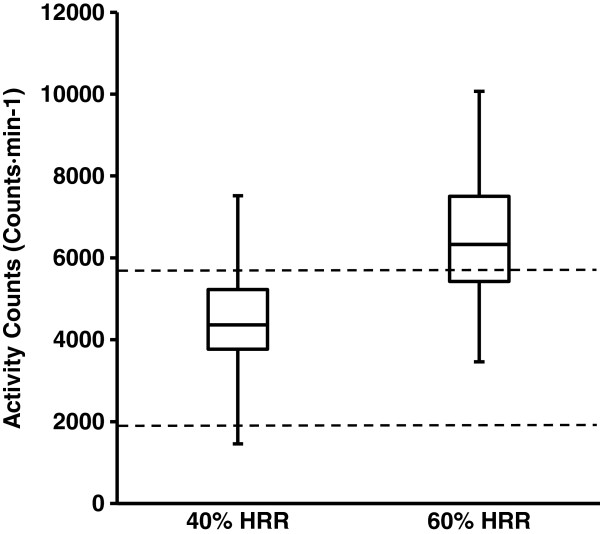
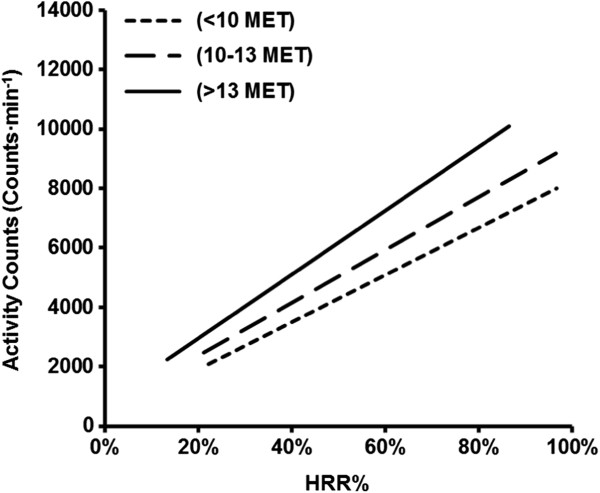
Seventy-three subjects (38 men, 35 women) with a wide range of cardiorespiratory fitness (maximal oxygen consumption (VO2max): 27.9 to 58.5 ml · kg⁻¹ · min⁻¹), performed a submaximal exercise test with measures of heart rate (HR) and accelerometer activity counts. Linear regression equations were developed for each subject to determine accelerometer activity counts for moderate and vigorous intensity physical activity corresponding to 40% and 60% of HRR. Interindividual variability of activity counts between subjects at both 40% and 60% of HRR was demonstrated by plotting values using a box and whisker plot. To examine the difference between absolute and relative activity cutpoints, subjects were categorized into 3 fitness groups based on metabolic equivalents (MET) (<10 MET, 10-13 MET, >13 MET).
At 40 and 60% of HRR, activity counts ranged from 1455-7520, and 3459-10066 counts · min-1, respectively. Activity counts at 40% HRR (3385 ± 850, 4048 ± 1090, and 5037 ± 1019 counts · min⁻¹) and 60% HRR (5159 ± 765, 5995 ± 1131 and 7367 ± 1374 counts · min-1) significantly increased across fitness groups (<10 MET, 10-13 MET, and >13 MET, respectively).
This study revealed interindividual variability in activity counts at relative moderate (40% HRR) and vigorous (60% HRR) intensities, while fitness level was shown to have a significant influence on relative activity counts measured at these intensities. Individualizing activity count cutpoints may be more representative of an individual's PA level relative to their fitness capacity, compared to absolute activity count cutpoints.
由于缺乏对个体当前健康水平的考虑,基于绝对强度的加速度计切点可能会低估或高估身体活动水平。本研究的目的是说明在相对强度(40%和 60%心率储备(HRR))下测量的加速度计活动计数的个体间变异性,并展示低、中、高健康组之间的相对活动计数之间的差异。
73 名受试者(38 名男性,35 名女性)具有广泛的心肺健康水平(最大摄氧量(VO2max):27.9 至 58.5ml·kg-1·min-1),进行了次最大运动测试,测量心率(HR)和加速度计活动计数。为每个受试者制定了线性回归方程,以确定对应于 40%和 60%HRR 的中度和剧烈强度身体活动的加速度计活动计数。通过使用箱线图绘制值来展示在 40%和 60%HRR 下个体之间活动计数的个体间变异性。为了检查绝对和相对活动切点之间的差异,根据代谢当量(MET)将受试者分为 3 个健康组(<10MET、10-13MET、>13MET)。
在 40%和 60%HRR 时,活动计数范围分别为 1455-7520 和 3459-10066 计数·min-1。40%HRR(3385±850、4048±1090 和 5037±1019 计数·min-1)和 60%HRR(5159±765、5995±1131 和 7367±1374 计数·min-1)的活动计数在健康组之间(<10MET、10-13MET 和>13MET)显著增加。
本研究揭示了相对中度(40%HRR)和剧烈(60%HRR)强度下活动计数的个体间变异性,而健康水平被证明对这些强度下测量的相对活动计数有显著影响。与绝对活动计数切点相比,个体化活动计数切点可能更能代表个体相对于其健康能力的 PA 水平。