Department of Chemistry and ∥Paul G. Allen School for Global Animal Health, Washington State University , Pullman, Washington 99164, United States.
ACS Chem Biol. 2013;8(6):1283-90. doi: 10.1021/cb400090d. Epub 2013 Apr 16.
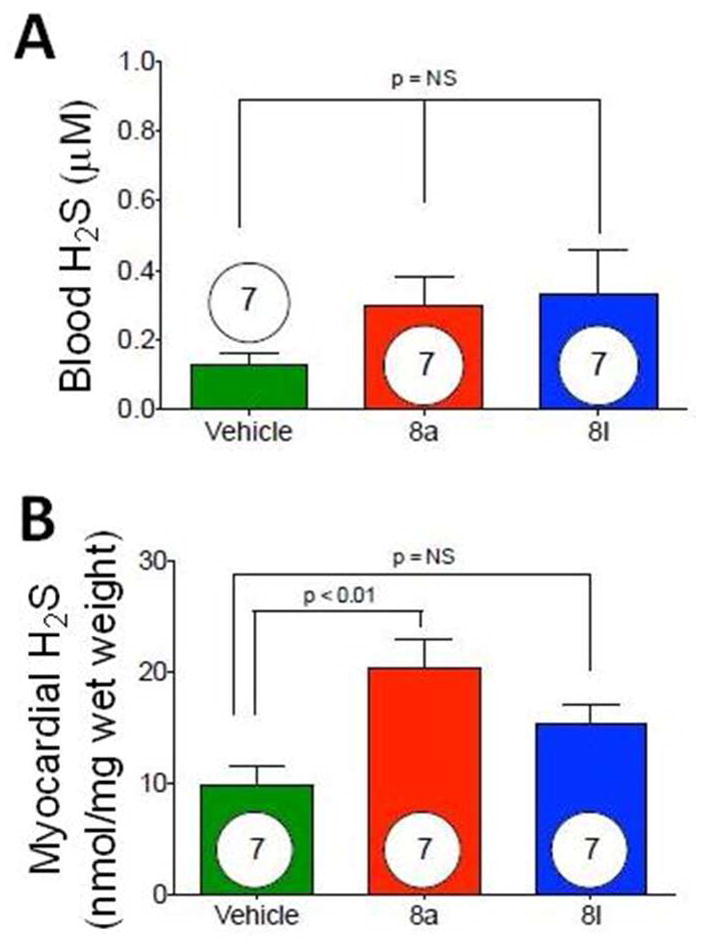
Hydrogen sulfide (H2S), known as an important cellular signaling molecule, plays critical roles in many physiological and/or pathological processes. Modulation of H2S levels could have tremendous therapeutic value. However, the study on H2S has been hindered due to the lack of controllable H2S releasing agents that could mimic the slow and moderate H2S release in vivo. In this work we report the design, synthesis, and biological evaluation of a new class of controllable H2S donors. Twenty-five donors were prepared and tested. Their structures were based on a perthiol template, which was suggested to be involved in H2S biosynthesis. H2S release mechanism from these donors was studied and proved to be thiol-dependent. We also developed a series of cell-based assays to access their H2S-related activities. H9c2 cardiac myocytes were used in these experiments. We tested lead donors' cytotoxicity and confirmed their H2S production in cells. Finally we demonstrated that selected donors showed potent protective effects in an in vivo murine model of myocardial ischemia-reperfusion injury, through a H2S-related mechanism.
硫化氢 (H2S) 作为一种重要的细胞信号分子,在许多生理和/或病理过程中发挥着关键作用。调节 H2S 水平可能具有巨大的治疗价值。然而,由于缺乏能够模拟体内缓慢和适度 H2S 释放的可控 H2S 释放剂,H2S 的研究受到了阻碍。在这项工作中,我们报告了一类新的可控 H2S 供体的设计、合成和生物学评价。我们制备和测试了 25 种供体。它们的结构基于一个过硫醇模板,该模板被认为参与 H2S 的生物合成。研究了这些供体中 H2S 的释放机制,并证明其依赖于巯基。我们还开发了一系列基于细胞的测定方法来评估它们的 H2S 相关活性。在这些实验中使用了 H9c2 心肌细胞。我们测试了先导供体的细胞毒性,并在细胞中证实了它们的 H2S 产生。最后,我们通过 H2S 相关机制证明,选定的供体在心肌缺血再灌注损伤的体内小鼠模型中表现出强大的保护作用。