Immunomedics, Inc, 300 American Rd, Morris Plains, NJ 07950, USA.
BMC Cancer. 2013 Apr 1;13:170. doi: 10.1186/1471-2407-13-170.
Advanced or metastatic renal cell carcinoma (RCC) has a poor prognosis, because it is relatively resistant to conventional chemotherapy or radiotherapy. Treatments with human interferon-α2b alone or in combination with mammalian target of rapamycin (mTOR) inhibitors have led to only a modest improvement in clinical outcome. One observation made with mTOR inhibitors is that carcinomas can overcome these inhibitory effects by activating the insulin-like growth factor-I (IGF-I) signaling pathway. Clinically, there is an association of IGF-I receptor (IGF-IR) expression in RCC and poor long-term patient survival. We have developed a humanized anti-IGF-IR monoclonal antibody, hR1, which binds to RCC, resulting in effective down-regulation of IGF-IR and moderate inhibition of cell proliferation in vitro. In this work, we evaluate the anti-tumor activity of two novel IGF-1R-targeting agents against renal cell carcinoma given alone or in combination with an mTOR inhibitor.
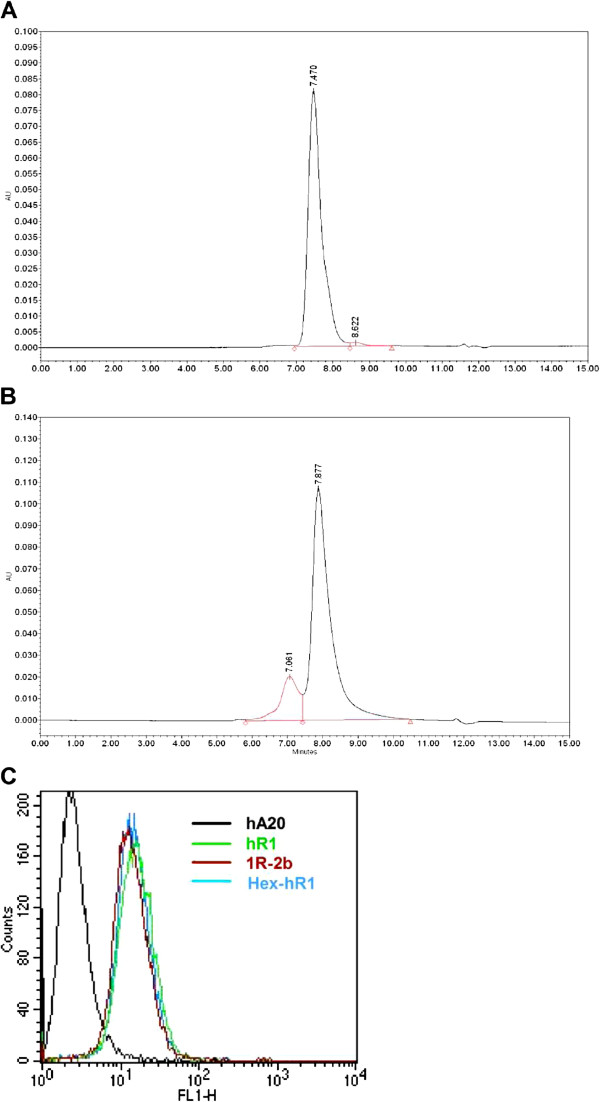
hR1 was linked by the DOCK-AND-LOCK™ (DNL™) method to four Fabs of hR1, generating Hex-hR1, or to four molecules of interferon-α2b, generating 1R-2b. Eight human RCC cell lines were screened for IGF-1R expression and sensitivity to treatment with hR1 in vitro. Synergy with an mTOR inhibitor, temsirolimus, was tested in a cell line (ACHN) with low sensitivity to hR1.
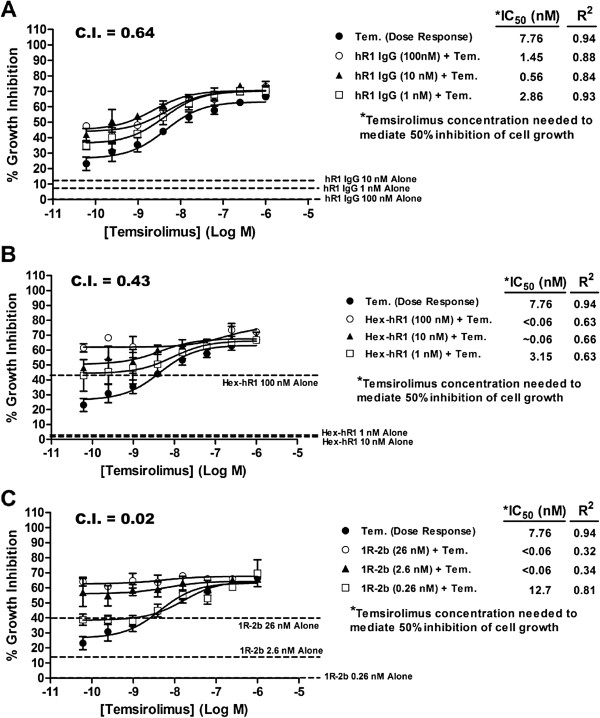
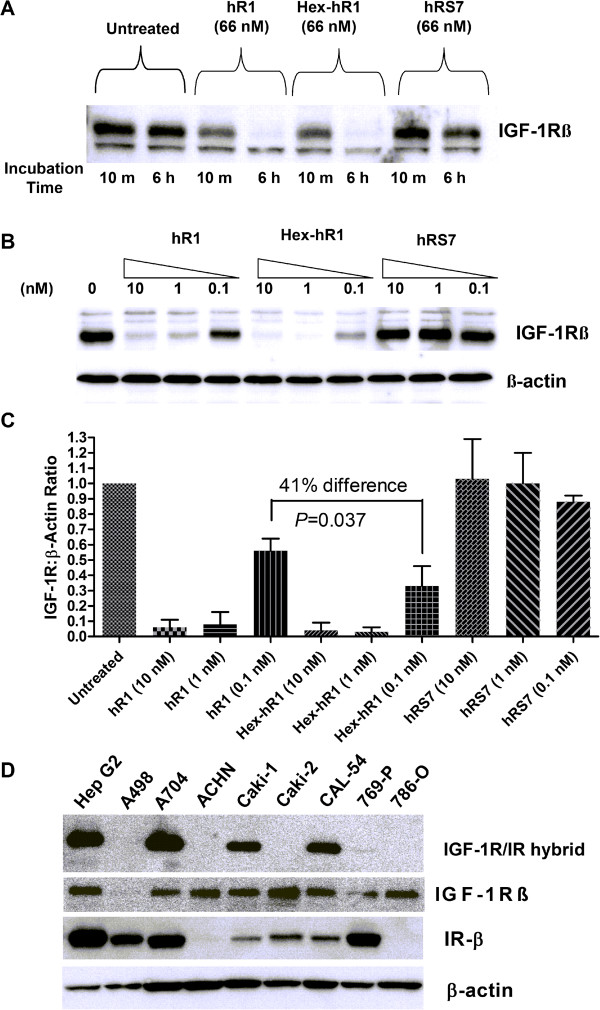
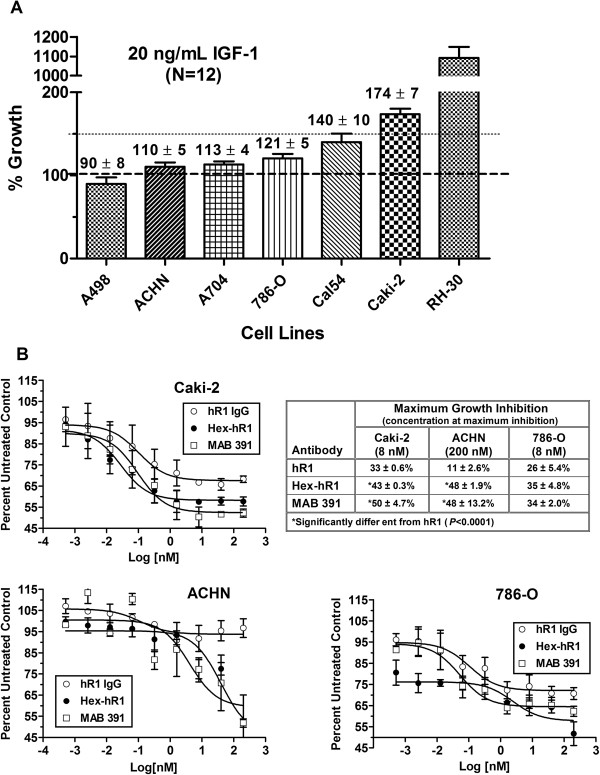
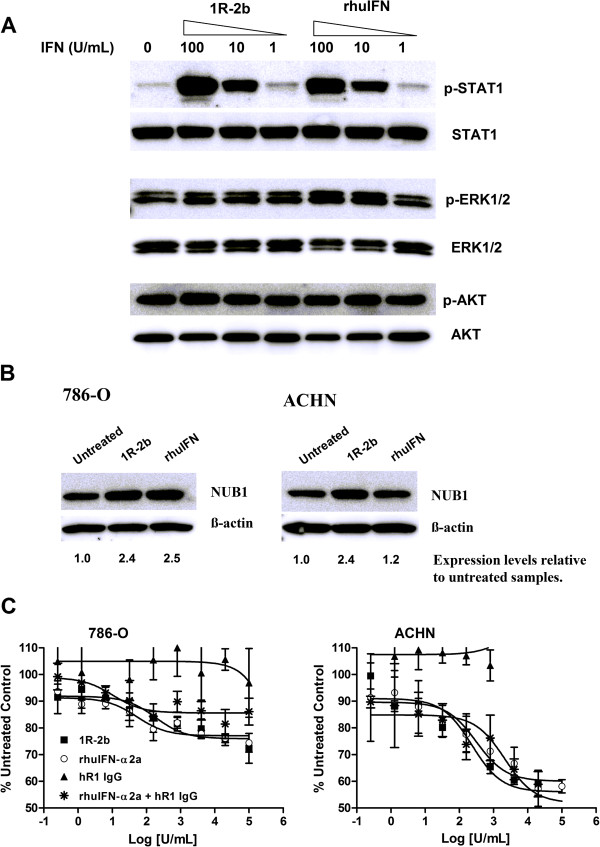
Hex-hR1 induced the down-regulation of IGF-IR at 10-fold lower concentrations compared to the parental hR1. Sensitivity to growth inhibition mediated by hR1 and Hex-hR1 treatments correlated with IGF-1R expression (higher expression was more sensitive). The potency of 1R-2b to inhibit the in vitro growth of RCC was also demonstrated in two human cell lines, ACHN and 786-O, with EC50-values of 63 and 48 pM, respectively. When combined with temsirolimus, a synergistic growth-inhibition with hR1, Hex-hR1, and 1R-2b was observed in ACHN cells at concentrations as low as 10 nM for hR1, 1 nM for Hex-hR1, and 2.6 nM for 1R-2b.
Both Hex-hR1 and 1R-2b proved to be more potent than parental hR1 in inhibiting growth of RCC in vitro. Synergy was achieved when each of the three hR1-based agents was combined with temsirolimus, suggesting a new approach for treating RCC.
晚期或转移性肾细胞癌(RCC)预后较差,因为它对常规化疗或放疗相对耐药。单独使用人干扰素-α2b 或与哺乳动物雷帕霉素靶蛋白(mTOR)抑制剂联合治疗仅导致临床结局略有改善。mTOR 抑制剂的一个观察结果是,癌细胞可以通过激活胰岛素样生长因子-I(IGF-I)信号通路来克服这些抑制作用。临床上,RCC 中 IGF-I 受体(IGF-IR)的表达与患者长期生存不良有关。我们开发了一种人源化抗 IGF-IR 单克隆抗体 hR1,它与 RCC 结合,导致 IGF-IR 有效下调和体外细胞增殖适度抑制。在这项工作中,我们评估了两种新型 IGF-1R 靶向药物单独或与 mTOR 抑制剂联合治疗肾细胞癌的抗肿瘤活性。
hR1 通过 DOCK-AND-LOCK™(DNL™)方法与 hR1 的四个 Fab 连接,生成 Hex-hR1,或与四个分子的干扰素-α2b 连接,生成 1R-2b。筛选了八种人 RCC 细胞系以检测 IGF-1R 表达,并在体外检测 hR1 治疗的敏感性。在对 hR1 敏感性低的细胞系(ACHN)中测试了与 mTOR 抑制剂替西罗莫司的协同作用。
与亲本 hR1 相比,Hex-hR1 在低 10 倍浓度下诱导 IGF-IR 下调。hR1 和 Hex-hR1 处理诱导的生长抑制敏感性与 IGF-1R 表达相关(表达越高越敏感)。在两种人细胞系 ACHN 和 786-O 中也证明了 1R-2b 抑制 RCC 体外生长的效力,EC50 值分别为 63 和 48 pM。当与替西罗莫司联合使用时,在浓度低至 10 nM 的 hR1、1 nM 的 Hex-hR1 和 2.6 nM 的 1R-2b 时,在 ACHN 细胞中观察到 hR1、Hex-hR1 和 1R-2b 的协同生长抑制。
Hex-hR1 和 1R-2b 均比亲本 hR1 更有效地抑制 RCC 在体外生长。当三种 hR1 制剂中的每一种与替西罗莫司联合使用时,均实现了协同作用,这为治疗 RCC 提供了一种新方法。