Int J Equity Health. 2013 Apr 3;12:23. doi: 10.1186/1475-9276-12-23.
The prevalence of undernutrition, which is closely associated with socioeconomic and sanitation conditions, is often higher among indigenous than non-indigenous children in many countries. In Brazil, in spite of overall reductions in the prevalence of undernutrition in recent decades, the nutritional situation of indigenous children remains worrying. The First National Survey of Indigenous People's Health and Nutrition in Brazil, conducted in 2008-2009, was the first study to evaluate a nationwide representative sample of indigenous peoples. This paper presents findings from this study on the nutritional status of indigenous children < 5 years of age in Brazil.
A multi-stage sampling was employed to obtain a representative sample of the indigenous population residing in villages in four Brazilian regions (North, Northeast, Central-West, and Southeast/South). Initially, a stratified probabilistic sampling was carried out for indigenous villages located in these regions. Households in sampled villages were selected by census or systematic sampling depending on the village population. The survey evaluated the health and nutritional status of children < 5 years, in addition to interviewing mothers or caretakers.
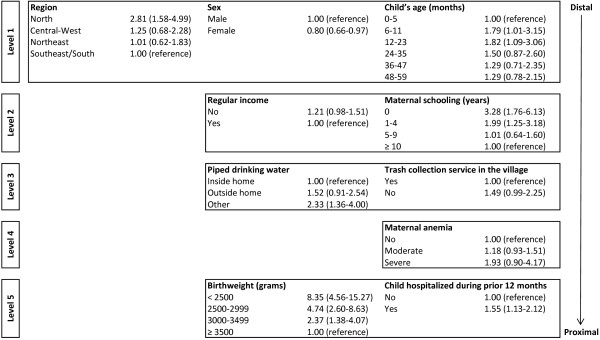
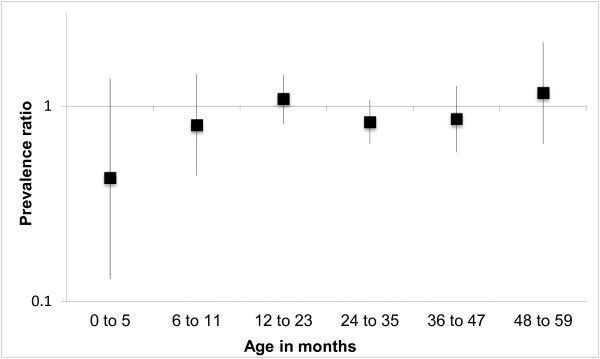
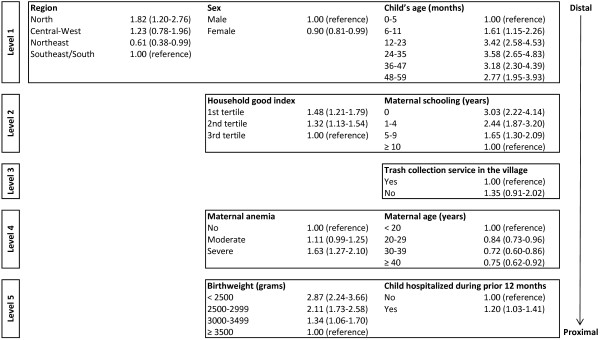
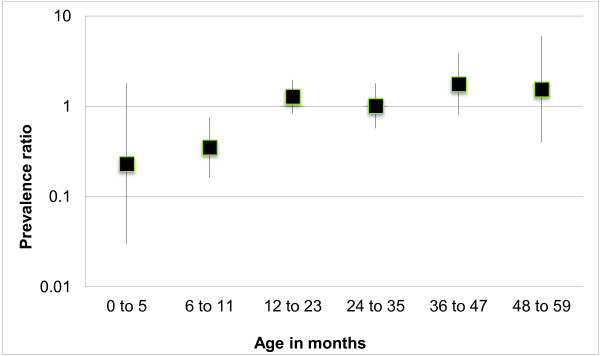
Height and weight measurements were taken of 6,050 and 6,075 children, respectively. Prevalence rates of stunting, underweight, and wasting were 25.7%, 5.9%, and 1.3%, respectively. Even after controlling for confounding, the prevalence rates of underweight and stunting were higher among children in the North region, in low socioeconomic status households, in households with poorer sanitary conditions, with anemic mothers, with low birthweight, and who were hospitalized during the prior 6 months. A protective effect of breastfeeding for underweight was observed for children under 12 months.
The elevated rate of stunting observed in indigenous children approximates that of non-indigenous Brazilians four decades ago, before major health reforms greatly reduced its occurrence nationwide. Prevalence rates of undernutrition were associated with socioeconomic variables including income, household goods, schooling, and access to sanitation services, among other variables. Providing important baseline data for future comparison, these findings further suggest the relevance of social, economic, and environmental factors at different scales (local, regional, and national) for the nutritional status of indigenous peoples.
在许多国家,营养不良的流行率与社会经济和卫生条件密切相关,在土著儿童中往往高于非土著儿童。尽管巴西在过去几十年中整体上降低了营养不良的流行率,但土著儿童的营养状况仍然令人担忧。2008-2009 年进行的巴西第一次土著人民健康和营养全国调查是第一项评估全国代表性土著人民样本的研究。本文介绍了该研究关于巴西 5 岁以下土著儿童营养状况的发现。
采用多阶段抽样方法获得居住在巴西四个地区(北部、东北部、中西部和东南部/南部)村庄的土著人口的代表性样本。首先,对居住在这些地区的土著村庄进行分层概率抽样。根据村庄人口,采用普查或系统抽样选择抽样村庄中的家庭。该调查评估了 5 岁以下儿童的健康和营养状况,此外还对母亲或照顾者进行了访谈。
分别对 6050 名和 6075 名儿童进行了身高和体重测量。发育迟缓、体重不足和消瘦的患病率分别为 25.7%、5.9%和 1.3%。即使在控制了混杂因素后,北部地区儿童、社会经济地位较低的家庭、卫生条件较差的家庭、贫血母亲、低出生体重以及在过去 6 个月住院的儿童,体重不足和发育迟缓的患病率仍然较高。母乳喂养对 12 个月以下儿童体重不足有保护作用。
土著儿童的发育迟缓率与四十年前巴西非土著儿童的发育迟缓率相近,此前全国范围内的重大卫生改革大大降低了其发生率。营养不足的流行率与社会经济变量有关,包括收入、家庭用品、教育程度和获得卫生服务等,以及其他变量。这些发现为未来的比较提供了重要的基线数据,进一步表明了不同规模(地方、地区和国家)的社会、经济和环境因素对土著人民营养状况的重要性。