Department of Psychology, Metropolitan State University, St Paul, Minnesota, United States of America.
PLoS Med. 2013;10(3):e1001403. doi: 10.1371/journal.pmed.1001403. Epub 2013 Mar 12.
Atypical antipsychotic medications are widely prescribed for the adjunctive treatment of depression, yet their total risk-benefit profile is not well understood. We thus conducted a systematic review of the efficacy and safety profiles of atypical antipsychotic medications used for the adjunctive treatment of depression.
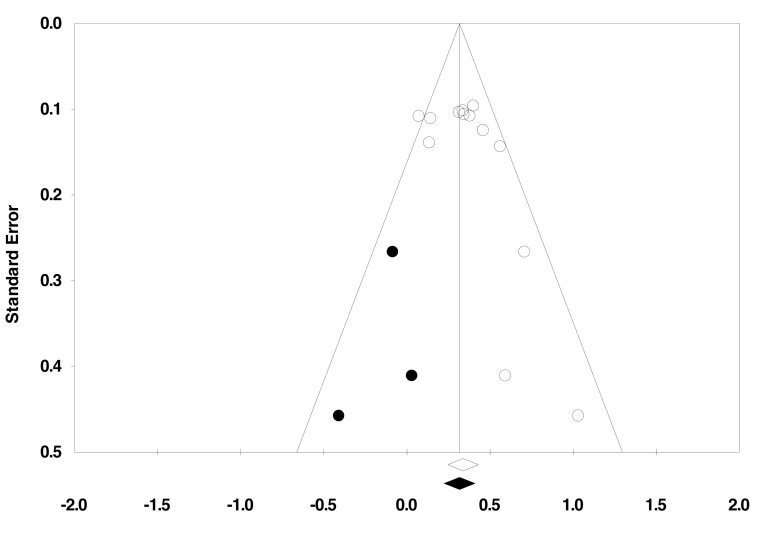
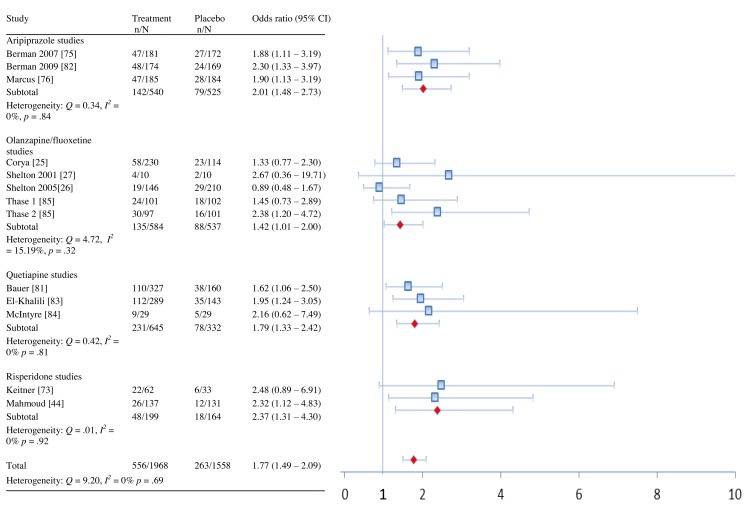
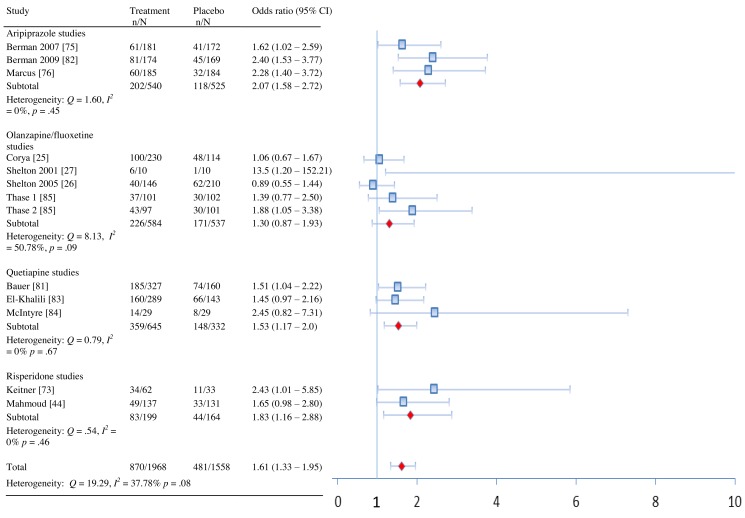
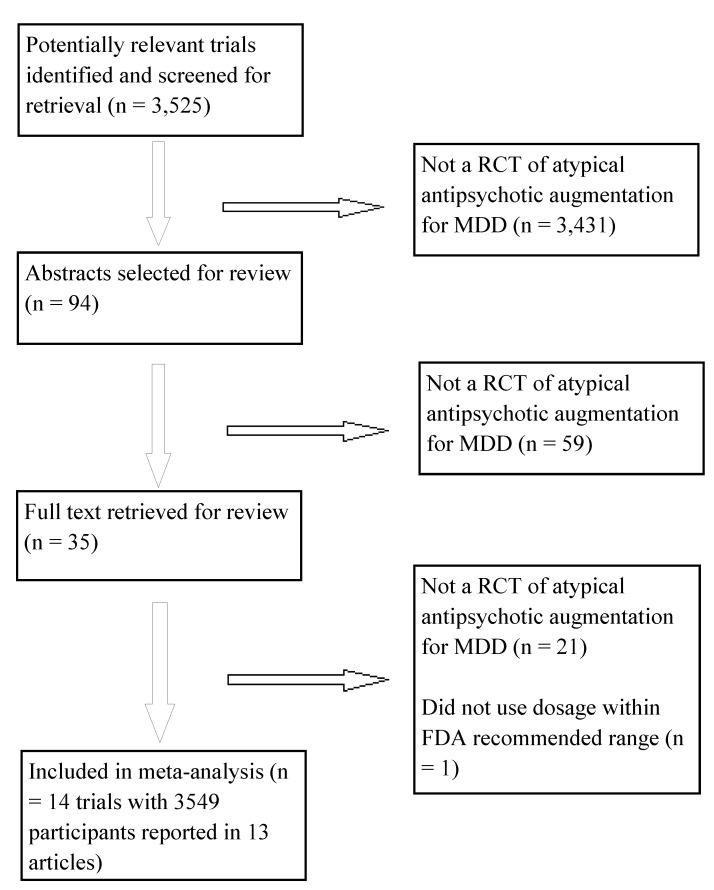
We included randomized trials comparing adjunctive antipsychotic medication to placebo for treatment-resistant depression in adults. Our literature search (conducted in December 2011 and updated on December 14, 2012) identified 14 short-term trials of aripiprazole, olanzapine/fluoxetine combination (OFC), quetiapine, and risperidone. When possible, we supplemented published literature with data from manufacturers' clinical trial registries and US Food and Drug Administration New Drug Applications. Study duration ranged from 4 to 12 wk. All four drugs had statistically significant effects on remission, as follows: aripiprazole (odds ratio [OR], 2.01; 95% CI, 1.48-2.73), OFC (OR, 1.42; 95% CI, 1.01-2.0), quetiapine (OR, 1.79; 95% CI, 1.33-2.42), and risperidone (OR, 2.37; 95% CI, 1.31-4.30). The number needed to treat (NNT) was 19 for OFC and nine for each other drug. All drugs with the exception of OFC also had statistically significant effects on response rates, as follows: aripiprazole (OR, 2.07; 95% CI, 1.58-2.72; NNT, 7), OFC (OR, 1.30, 95% CI, 0.87-1.93), quetiapine (OR, 1.53, 95% CI, 1.17-2.0; NNT, 10), and risperidone (OR, 1.83, 95% CI, 1.16-2.88; NNT, 8). All four drugs showed statistically significant effects on clinician-rated depression severity measures (Hedges' g ranged from 0.26 to 0.48; mean difference of 2.69 points on the Montgomery-Asberg Depression Rating Scale across drugs). On measures of functioning and quality of life, these medications produced either no benefit or a very small benefit, except for risperidone, which had a small-to-moderate effect on quality of life (g = 0.49). Treatment was linked to several adverse events, including akathisia (aripiprazole), sedation (quetiapine, OFC, and aripiprazole), abnormal metabolic laboratory results (quetiapine and OFC), and weight gain (all four drugs, especially OFC). Shortcomings in study design and data reporting, as well as use of post hoc analyses, may have inflated the apparent benefits of treatment and reduced the apparent incidence of adverse events.
Atypical antipsychotic medications for the adjunctive treatment of depression are efficacious in reducing observer-rated depressive symptoms, but clinicians should interpret these findings cautiously in light of (1) the small-to-moderate-sized benefits, (2) the lack of benefit with regards to quality of life or functional impairment, and (3) the abundant evidence of potential treatment-related harm. Please see later in the article for the Editors' Summary.
非典型抗精神病药物被广泛用于辅助治疗抑郁症,但它们的总体风险-效益情况尚不清楚。因此,我们对用于辅助治疗抑郁症的非典型抗精神病药物的疗效和安全性进行了系统评价。
我们纳入了比较辅助使用抗精神病药物与安慰剂治疗难治性抑郁症的随机试验。我们的文献检索(于 2011 年 12 月进行,并于 2012 年 12 月 14 日更新)共识别出 14 项阿立哌唑、奥氮平/氟西汀(OFC)、喹硫平和利培酮的短期试验。在可能的情况下,我们补充了制造商临床试验注册处和美国食品和药物管理局新药申请的数据。研究持续时间从 4 到 12 周不等。所有四种药物对缓解均有统计学显著的影响,具体如下:阿立哌唑(比值比[OR],2.01;95%置信区间[CI],1.48-2.73)、OFC(OR,1.42;95%CI,1.01-2.0)、喹硫平(OR,1.79;95%CI,1.33-2.42)和利培酮(OR,2.37;95%CI,1.31-4.30)。OFC 的需要治疗人数(NNT)为 19,其他每种药物的 NNT 为 9。除 OFC 外,所有其他药物对反应率也有统计学显著的影响,具体如下:阿立哌唑(OR,2.07;95%CI,1.58-2.72;NNT,7)、OFC(OR,1.30;95%CI,0.87-1.93)、喹硫平(OR,1.53;95%CI,1.17-2.0;NNT,10)和利培酮(OR,1.83;95%CI,1.16-2.88;NNT,8)。所有四种药物对临床医生评定的抑郁严重程度测量值均有统计学显著的影响(Hedges'g 从 0.26 到 0.48;四种药物的蒙哥马利-阿斯伯格抑郁评定量表的平均差异为 2.69 分)。在功能和生活质量的测量方面,这些药物要么没有益处,要么只有很小的益处,除了利培酮,它对生活质量有较小到中度的影响(g=0.49)。治疗与多种不良事件相关,包括静坐不能(阿立哌唑)、镇静(喹硫平、OFC 和阿立哌唑)、代谢实验室异常结果(喹硫平和 OFC)和体重增加(所有四种药物,尤其是 OFC)。研究设计和数据报告的缺陷,以及事后分析的使用,可能夸大了治疗的益处,减少了不良事件的发生率。
辅助治疗抑郁症的非典型抗精神病药物在减轻观察者评定的抑郁症状方面是有效的,但鉴于(1)益处较小,(2)对生活质量或功能损害没有益处,以及(3)有大量潜在治疗相关危害的证据,临床医生应谨慎解读这些发现。请在文章稍后部分查看编辑总结。