Experimental Marine Ecology Laboratory, Department of Biological Sciences, National University of Singapore, Singapore, Singapore.
PLoS One. 2013;8(3):e58819. doi: 10.1371/journal.pone.0058819. Epub 2013 Mar 13.
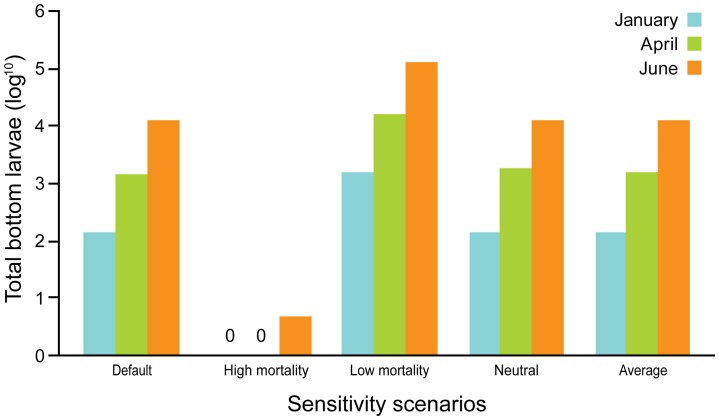
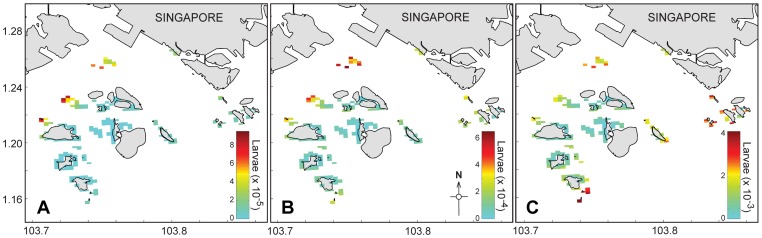
Recruitment constraints on Singapore's dwindling fluted giant clam, Tridacna squamosa, population were studied by modelling fertilisation, larval transport, and settlement using real-time hydrodynamic forcing combined with knowledge of spawning characteristics, larval development, behaviour, and settlement cues. Larval transport was simulated using a finite-volume advection-diffusion model coupled to a three-dimensional hydrodynamic model. Three recruitment constraint hypotheses were tested: 1) there is limited connectivity between Singapore's reefs and other reefs in the region, 2) there is limited exchange within Singapore's Southern Islands, and 3) there exist low-density constraints to fertilisation efficacy (component Allee effects). Results showed that connectivity among giant clam populations was primarily determined by residual hydrodynamic flows and spawning time, with greatest chances of successful settlement occurring when spawning and subsequent larval dispersal coincided with the period of lowest residual flow. Simulations suggested poor larval transport from reefs located along the Peninsular Malaysia to Singapore, probably due to strong surface currents between the Andaman Sea and South China Sea combined with a major land barrier disrupting larval movement among reefs. The model, however, predicted offshore coral reefs to the southeast of Singapore (Bintan and Batam) may represent a significant source of larvae. Larval exchange within Singapore's Southern Islands varied substantially depending on the locations of source and sink reefs as well as spawning time; but all simulations resulted in low settler densities (2.1-68.6 settled individuals per 10,000 m(2)). Poor fertilisation rates predicted by the model indicate that the low density and scattered distribution of the remaining T. squamosa in Singapore are likely to significantly inhibit any natural recovery of local stocks.
采用实时水动力强迫与产卵特征、幼虫发育、行为和附着线索相结合的方法,通过建模授精、幼虫输运和附着,研究了新加坡不断减少的波纹巴非蛤(Tridacna squamosa)种群的补充限制因素。幼虫输运采用有限体积平流-扩散模型与三维水动力模型相结合进行模拟。测试了三个补充限制假设:1)新加坡的珊瑚礁与该地区其他珊瑚礁之间的连通性有限,2)新加坡南部岛屿之间的交换有限,3)受精效率(组件阿利效应)存在低密度限制。结果表明,蛤种群之间的连通性主要取决于残余水动力流和产卵时间,当产卵和随后的幼虫扩散与残余流最低的时期相吻合时,成功附着的可能性最大。模拟结果表明,从位于马来半岛的珊瑚礁到新加坡的幼虫输运情况较差,这可能是由于安达曼海和南中国海之间的强表面流以及主要陆地障碍扰乱了珊瑚礁之间的幼虫运动。然而,该模型预测新加坡东南方向(民丹岛和巴淡岛)的近海珊瑚礁可能是幼虫的重要来源。新加坡南部岛屿内的幼虫交换量随源礁和汇礁的位置以及产卵时间而有很大差异;但是所有模拟结果导致附着者密度较低(每 10,000 平方米有 2.1-68.6 个附着个体)。模型预测的受精率低表明,新加坡剩余波纹巴非蛤密度低且分布分散,这可能会严重抑制当地种群的任何自然恢复。