Lal Monal M, Southgate Paul C, Jerry Dean R, Bosserelle Cyprien, Zenger Kyall R
Centre for Sustainable Tropical Fisheries and Aquaculture, and College of Science and Engineering, James Cook University, Townsville, QLD 4811, QLD, Australia.
Australian Centre for Pacific Islands Research, Faculty of Science, Health, Education and Engineering, University of the Sunshine Coast, Maroochydore, QLD 4558, QLD, Australia.
BMC Genomics. 2017 Jan 10;18(1):66. doi: 10.1186/s12864-016-3410-y.
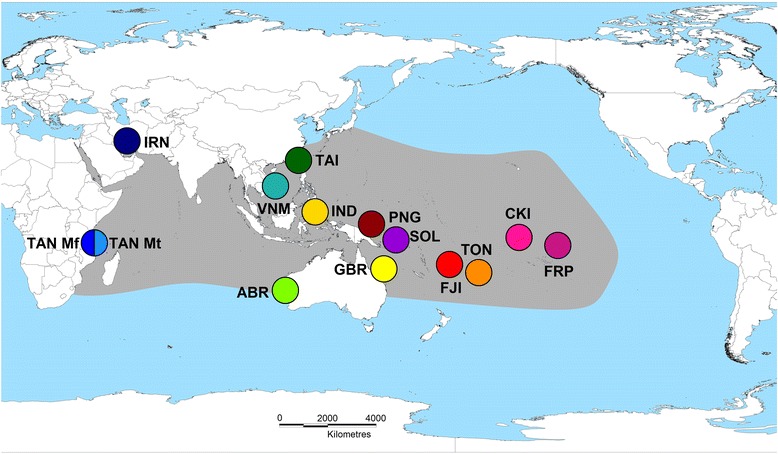
Genetic structure in many widely-distributed broadcast spawning marine invertebrates remains poorly understood, posing substantial challenges for their fishery management, conservation and aquaculture. Under the Core-Periphery Hypothesis (CPH), genetic diversity is expected to be highest at the centre of a species' distribution, progressively decreasing with increased differentiation towards outer range limits, as populations become increasingly isolated, fragmented and locally adapted. The unique life history characteristics of many marine invertebrates such as high dispersal rates, stochastic survival and variable recruitment are also likely to influence how populations are organised. To examine the microevolutionary forces influencing population structure, connectivity and adaptive variation in a highly-dispersive bivalve, populations of the black-lip pearl oyster Pinctada margaritifera were examined across its ~18,000 km Indo-Pacific distribution.
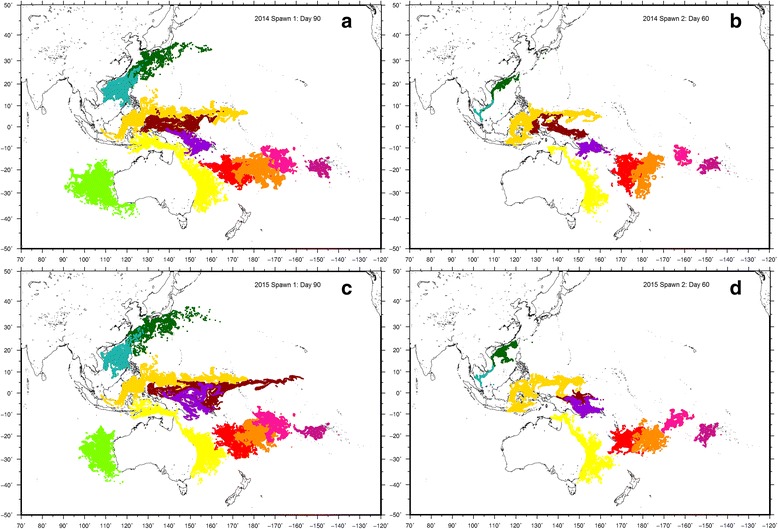
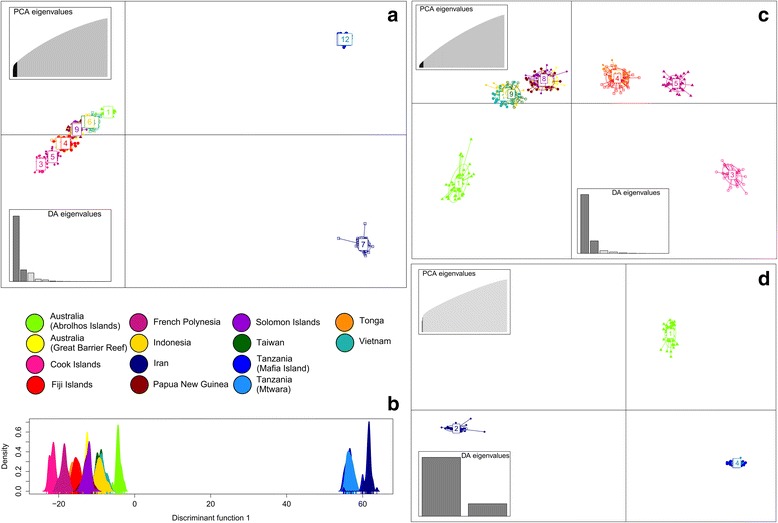
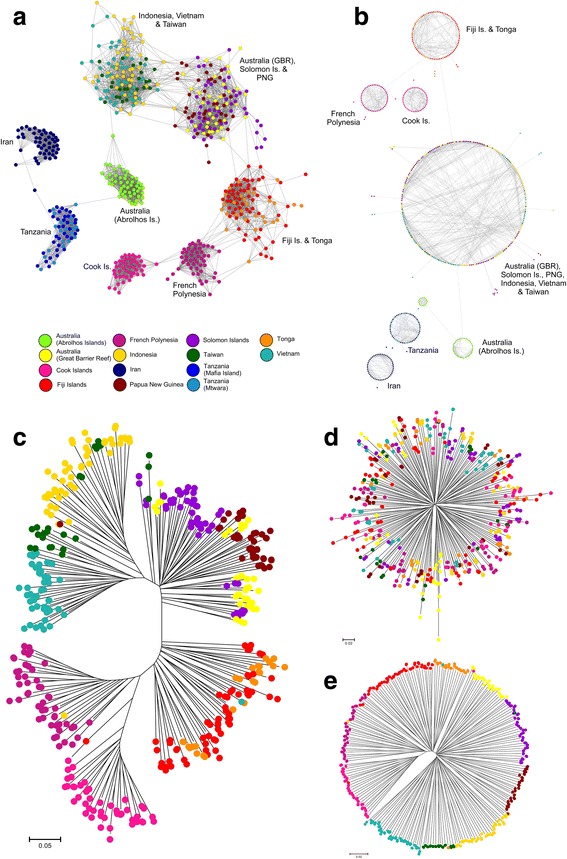
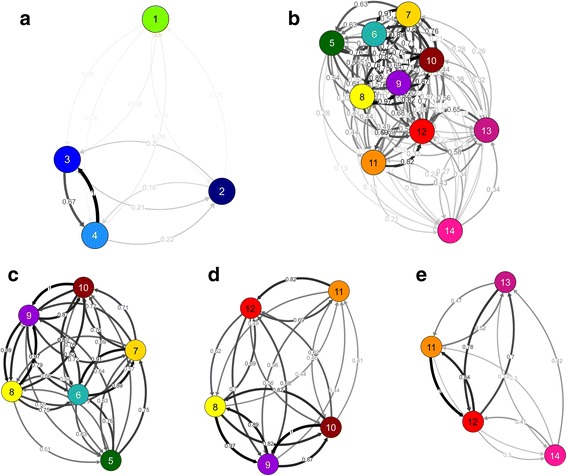
Analyses utilising 9,624 genome-wide SNPs and 580 oysters, discovered differing patterns of significant and substantial broad-scale genetic structure between the Indian and Pacific Ocean basins. Indian Ocean populations were markedly divergent (F = 0.2534-0.4177, p < 0.001), compared to Pacific Ocean oysters, where basin-wide gene flow was much higher (F = 0.0007-0.1090, p < 0.001). Partitioning of genetic diversity (hierarchical AMOVA) attributed 18.1% of variance between ocean basins, whereas greater proportions were resolved within samples and populations (45.8% and 35.7% respectively). Visualisation of population structure at selectively neutral loci resolved three and five discrete genetic clusters for the Indian and Pacific Oceans respectively. Evaluation of genetic structure at adaptive loci for Pacific populations (89 SNPs under directional selection; F = 0.1012-0.4371, FDR = 0.05), revealed five clusters identical to those detected at neutral SNPs, suggesting environmental heterogeneity within the Pacific. Patterns of structure and connectivity were supported by Mantel tests of isolation by distance (IBD) and independent hydrodynamic particle dispersal simulations.
It is evident that genetic structure and connectivity across the natural range of P. margaritifera is highly complex, and produced by the interaction of ocean currents, IBD and seascape features at a broad scale, together with habitat geomorphology and local adaptation at regional levels. Overall population organisation is far more elaborate than generalised CPH predictions, however valuable insights for regional fishery management, and a greater understanding of range-wide genetic structure in a highly-dispersive marine invertebrate have been gained.
许多广泛分布的散播型产卵海洋无脊椎动物的遗传结构仍知之甚少,这给它们的渔业管理、保护和水产养殖带来了重大挑战。根据核心-边缘假说(CPH),遗传多样性预计在物种分布中心最高,随着向外部范围界限的分化增加,遗传多样性会逐渐降低,因为种群变得越来越隔离、碎片化并适应当地环境。许多海洋无脊椎动物独特的生活史特征,如高扩散率、随机生存和可变补充率,也可能影响种群的组织方式。为了研究影响种群结构、连通性和适应性变异的微观进化力量,我们对分布在印度-太平洋约18,000公里范围内的黑唇珍珠贝种群进行了研究,以考察这种高度扩散的双壳贝类。
利用9624个全基因组单核苷酸多态性(SNP)和580个牡蛎进行分析,发现印度洋和太平洋盆地之间存在显著且大规模的遗传结构差异模式。与太平洋牡蛎相比,印度洋种群明显分化(F = 0.2534 - 0.4177,p < 0.001),而太平洋牡蛎的全盆地基因流要高得多(F = 0.0007 - 0.1090,p < 0.001)。遗传多样性的划分(层次化AMOVA)表明,18.1%的变异存在于海洋盆地之间,而更大比例的变异存在于样本和种群内部(分别为45.8%和35.7%)。在选择性中性位点的种群结构可视化分析分别为印度洋和太平洋解析出三个和五个离散的遗传簇。对太平洋种群适应性位点的遗传结构评估(89个处于定向选择下的SNP;F = 0.1012 - 0.4371,FDR = 0.05),揭示出五个与在中性SNP处检测到的相同的簇,这表明太平洋内部存在环境异质性。结构和连通性模式得到了距离隔离(IBD)的Mantel检验和独立的水动力粒子扩散模拟的支持。
显然,黑唇珍珠贝自然分布范围内的遗传结构和连通性非常复杂,是由洋流、IBD和大范围的海貌特征相互作用,以及区域层面的栖息地地貌和局部适应性共同作用产生的。总体种群组织远比CPH的一般预测更为复杂,然而,我们已经获得了对区域渔业管理有价值的见解,以及对高度扩散的海洋无脊椎动物的全范围遗传结构有了更深入的理解。