Monmouth County Mosquito Extermination Commission, Eatontown, New Jersey, United States of America.
PLoS One. 2013;8(3):e60524. doi: 10.1371/journal.pone.0060524. Epub 2013 Mar 29.
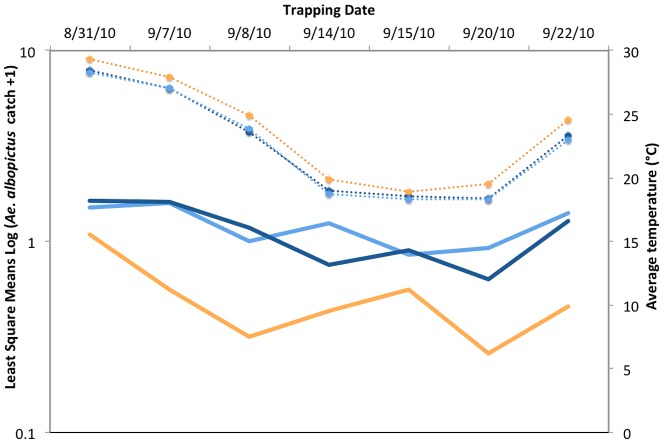
The Biogents® Sentinel (BGS) trap is the standard tool to monitor adult Aedes (Stegomyia) albopictus (Skuse) (Diptera: Culicidae), the Asian tiger mosquito. BGS traps are commonly placed in residential properties during surveillance operations, but locations within properties may have significant differences in ambient light, temperature, and humidity (e.g. between a sunlit lawn and shady underbrush). We examined the effect of BGS trap placement on Ae. albopictus capture rates in three residential properties in Monmouth County, New Jersey, USA. In each property we visually selected locations as shade, partial shade, and sun. Traps in "partial shade" locations were under vegetation and were exposed to filtered sunlight during some parts of the day while "shaded" locations were never exposed to direct sunlight. Locations defined as "sun" were exposed to direct sunlight for large parts of the day. We placed a BGS trap in each of the three location types and used small data loggers to measure temperature, relative humidity, and light exposure at each trap during a 24-hour deployment. To address temporal variability, we made seven separate measurements from 31 August to 22 September 2010. We found that "partial shade" and "full shade" locations did not differ but that "full sun" locations had significantly higher light exposure, higher temperature, and lower humidity. Importantly, Ae. albopictus catches (males, females, or both) were consistently and significantly over 3 times higher in traps located in shaded locations. To further investigate the effects of local temperature and humidity on surveillance we examined Ae. albopictus collections from 37 BGS traps fitted with data loggers and deployed weekly from August through mid October, during the 2009 season, in three urban sites in Mercer County, NJ. We confirmed that local climate influences capture rates and that Ae. albopictus surveillance projects need to monitor trap placement carefully for maximum efficiency.
贝吉安斯® Sentinel(BGS)诱捕器是监测白纹伊蚊(Stegomyia)(双翅目:蚊科)成虫的标准工具。BGS 诱捕器通常在监测行动中放置在住宅物业中,但物业内的位置可能在环境光、温度和湿度方面存在显著差异(例如,在阳光充足的草坪和阴凉的灌木丛之间)。我们在美国新泽西州蒙茅斯县的三个住宅物业中检查了 BGS 诱捕器放置位置对白纹伊蚊捕获率的影响。在每个物业中,我们都通过视觉选择了阴凉、半阴凉和阳光充足的位置。“半阴凉”位置的诱捕器位于植被下,在一天中的某些时间暴露在过滤后的阳光下,而“阴凉”位置则从未暴露在直射阳光下。定义为“阳光充足”的位置在一天中的大部分时间都暴露在直射阳光下。我们在这三种位置类型中的每一种位置都放置了一个 BGS 诱捕器,并使用小型数据记录器在 24 小时部署期间测量每个诱捕器的温度、相对湿度和光照暴露情况。为了解决时间变化,我们在 2010 年 8 月 31 日至 9 月 22 日期间进行了七次单独测量。我们发现,“半阴凉”和“全阴凉”位置没有差异,但“阳光充足”位置的光照暴露度、温度和湿度明显更高。重要的是,位于阴凉位置的诱捕器捕获的白纹伊蚊(雄性、雌性或两者兼有)始终显著高出 3 倍以上。为了进一步研究局部温度和湿度对监测的影响,我们检查了 2009 年 8 月至 10 月中旬在新泽西州默瑟县三个城市地点每周部署的带有数据记录器的 37 个 BGS 诱捕器中收集的白纹伊蚊。我们证实,当地气候会影响捕获率,并且白纹伊蚊监测项目需要仔细监测诱捕器的放置位置,以实现最大效率。