College of Public Health, Medical and Veterinary Sciences, James Cook University, Cairns, Australia.
Australian Institute of Tropical Health and Medicine, James Cook University, Cairns, Australia.
J Med Entomol. 2021 Mar 12;58(2):708-716. doi: 10.1093/jme/tjaa242.
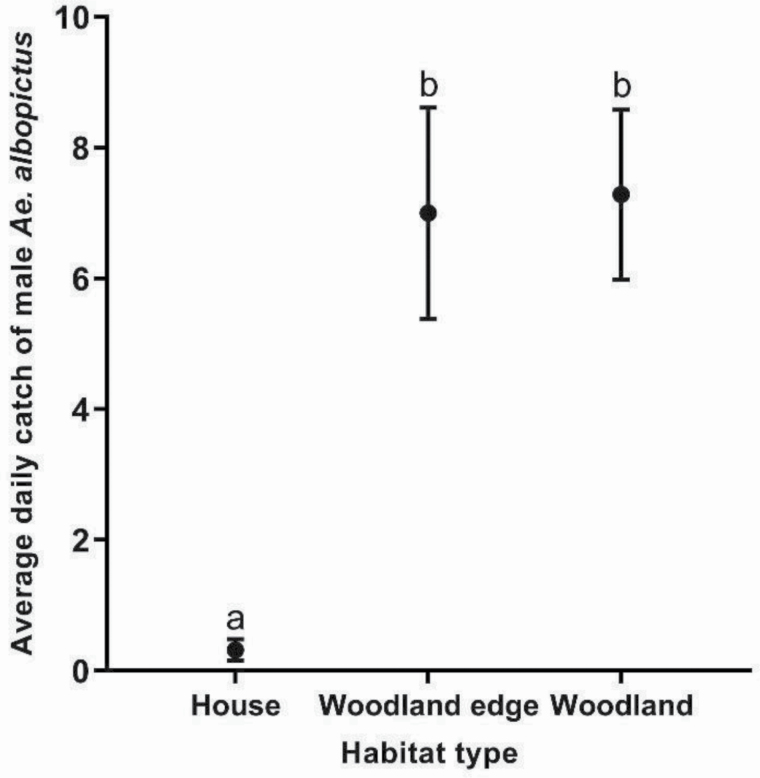
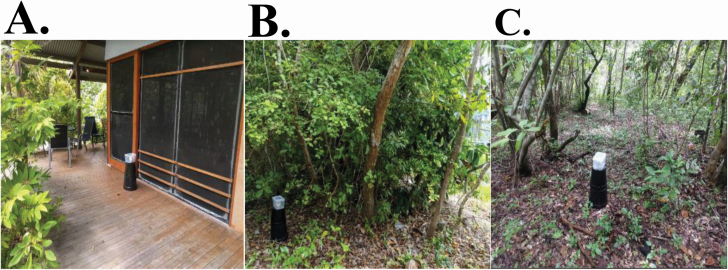
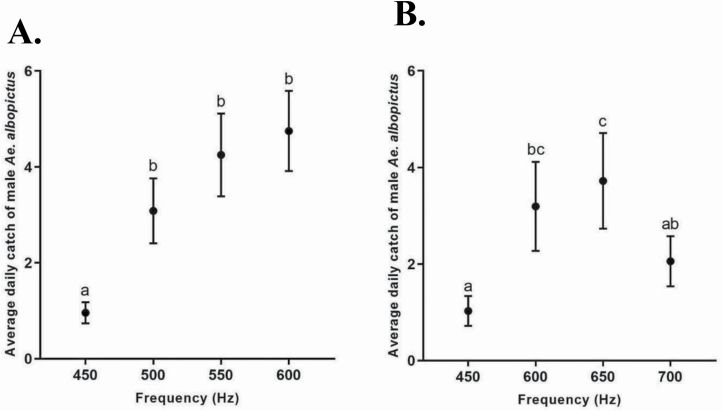
The global distribution of Aedes albopictus (Skuse) is rapidly expanding which has contributed to the emergence and re-emergence of dengue and chikungunya outbreaks. Improvements in vector surveillance are necessary to facilitate optimized, evidence-based vector control operations. Current trapping technology used to target Ae. albopictus and other Aedes species for vector surveillance are limited in both scale and scope, thus novel tools are required. Here, we evaluated the Male Aedes Sound Trap (MAST) for its capacity to sample male Ae. albopictus. Aims of this study were twofold: 1) to determine the most effective frequency for capturing male Ae. albopictus and 2) to investigate fine-scale variations in male Ae. albopictus abundance. MASTs which produced sound lure frequencies between 500 and 650 Hz captured significantly more male Ae. albopictus than those with sound lure frequencies set to 450 Hz. Further, the higher sound lure frequency of 700 Hz significantly reduced catches relative to 650 Hz. MASTs placed in woodland habitats captured significantly more male Ae. albopictus than MASTs placed near houses. These results provide baseline information for optimizing sound lure frequencies and placement of the MAST to sample male Ae. albopictus in remote areas.
白纹伊蚊(Skuse)在全球范围内的分布迅速扩大,这导致登革热和基孔肯雅热的暴发和再次出现。为了促进基于证据的优化蚊虫控制行动,必须改进媒介监测。目前用于针对白纹伊蚊和其他伊蚊物种进行媒介监测的诱捕技术在规模和范围上都受到限制,因此需要新的工具。在这里,我们评估了雄蚊声音诱捕器(MAST)对雄性白纹伊蚊的采样能力。本研究的目的有两个:1)确定捕获雄性白纹伊蚊的最有效频率;2)调查雄性白纹伊蚊丰度的细尺度变化。产生 500 至 650 Hz 声诱饵频率的 MAST 比设定为 450 Hz 声诱饵频率的 MAST 捕获了更多的雄性白纹伊蚊。此外,700 Hz 的较高声诱饵频率与 650 Hz 相比,显著减少了捕获量。放置在林地生境中的 MAST 比放置在房屋附近的 MAST 捕获了更多的雄性白纹伊蚊。这些结果为优化声诱饵频率以及在偏远地区使用 MAST 采样雄性白纹伊蚊提供了基线信息。