Department of Neuroscience, AOU San Giovanni Battista, Turin, Italy.
EJNMMI Res. 2013 Apr 4;3(1):22. doi: 10.1186/2191-219X-3-22.
Functional brain changes induced by chemotherapy are still not well characterized. We used a novel approach with a multivariate technique to analyze brain resting state [18 F]FDG-PET in patients with lymphoma, to explore differences on cerebral metabolic glucose rate between chemotherapy-treated and non-treated patients.
PET/CT scan was performed on 28 patients, with 14 treated with systemic chemotherapy. We used a support vector machine (SVM) classification, extracting the mean metabolism from the metabolic patterns, or networks, that discriminate the two groups. We calculated the correct classifications of the two groups using the mean metabolic values extracted by the networks.
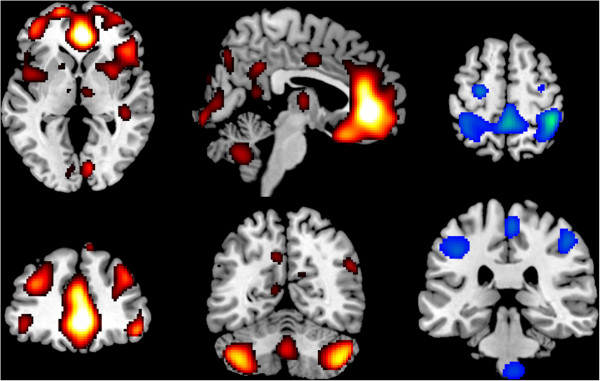
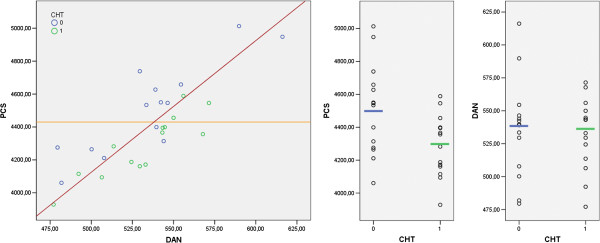
The SVM classification analysis gave clear-cut patterns that discriminate the two groups. The first, hypometabolic network in chemotherapy patients, included mostly prefrontal cortex and cerebellar areas (central executive network, CEN, and salience network, SN); the second, which is equal between groups, included mostly parietal areas and the frontal eye field (dorsal attention network, DAN). The correct classification membership to chemotherapy or not chemotherapy-treated patients, using only one network, was of 50% to 68%; however, when all the networks were used together, it reached 80%.
The evidenced networks were related to attention and executive functions, with CEN and SN more specialized in shifting, inhibition and monitoring, DAN in orienting attention. Only using DAN as a reference point, indicating the global frontal functioning before chemotherapy, we could better classify the subjects. The emerging concept consists in the importance of the investigation of brain intrinsic networks and their relations in chemotherapy cognitive induced changes.
化疗引起的功能性大脑变化仍未得到很好的描述。我们使用一种新的方法,即多元技术,来分析淋巴瘤患者的脑静息状态 [18F]FDG-PET,以探索化疗治疗与非治疗患者之间大脑代谢葡萄糖率的差异。
对 28 名患者进行了 PET/CT 扫描,其中 14 名患者接受了全身化疗。我们使用支持向量机(SVM)分类法,从区分两组的代谢模式或网络中提取平均代谢值。我们使用网络提取的平均代谢值计算两组的正确分类。
SVM 分类分析给出了清晰的模式,可以区分两组。第一个是化疗患者的低代谢网络,包括大部分前额叶皮层和小脑区域(中央执行网络,CEN 和突显网络,SN);第二个是两组之间相等的网络,包括大部分顶叶区域和额眼区(背侧注意网络,DAN)。使用一个网络进行分类,正确分类为化疗或非化疗治疗患者的比例为 50%至 68%;然而,当所有网络一起使用时,准确率达到 80%。
所证实的网络与注意力和执行功能有关,CEN 和 SN 更专门用于转移、抑制和监测,DAN 用于定向注意力。仅使用 DAN 作为参考点,表明化疗前的全局额叶功能,我们可以更好地对患者进行分类。新兴的概念在于研究大脑内在网络及其在化疗引起的认知变化中的关系的重要性。